TL;DR:
- AI-driven guest engagement uses artificial intelligence to create personalized interactions throughout a guest’s stay. Successful implementation depends on clean data, staff training, and transparent AI practices to deliver measurable improvements in service and revenue.
AI-driven guest engagement is the use of artificial intelligence to create personalised, anticipatory interactions with hotel guests across every touchpoint of their stay. The industry term for this practice is “intelligent guest interaction,” though AI-driven guest engagement has become the working shorthand across UK hospitality circles. Techniques including natural language processing (NLP), predictive modelling, and real-time data analytics now sit at the core of how forward-thinking hotels communicate with guests. Platforms such as EnGAIgeVIEW™ demonstrate how AI replaces static guest surveys with continuous, real-time dialogue. For hotel managers across the UK, the question is no longer whether to adopt AI, but how to do it well.
What AI technologies drive effective guest engagement?
The foundation of hotel AI-powered guest engagement rests on four core technologies. Each one addresses a specific gap in how hotels currently communicate with guests.
AI chatbots and voice assistants handle the front line of guest interaction. They answer questions, process requests, and manage bookings at any hour without placing additional load on reception staff. Conversational AI reduces average handle time and improves agent conversion rates by absorbing repetitive queries, freeing staff to focus on complex guest needs. That shift in workload is significant for properties running lean teams.
Predictive AI models analyse historical booking data, past preferences, and behavioural signals to anticipate what a guest wants before they ask. A guest who ordered a vegetarian breakfast on their last three stays should not need to request it again. Predictive models make that connection automatically.
Natural language processing allows AI systems to understand conversational requests rather than rigid commands. A guest typing “something quiet near the pool” receives a relevant room recommendation rather than an error message. NLP is what makes AI customer interaction feel natural rather than mechanical.
Sentiment analysis reads the emotional tone of guest messages in real time. If a guest’s messages shift from neutral to frustrated, the system flags the conversation for human intervention before the situation escalates. This is the technology that gives AI genuine emotional intelligence in guest communication.
Key capabilities to look for when evaluating AI platforms for your property:
- 24/7 automated guest communication across voice, text, and chat channels
- Integration with your property management system (PMS) for live data access
- Sentiment detection with automatic escalation to human staff
- Multilingual support for international guests
- Real-time reporting dashboards for management oversight
Pro Tip: Before selecting any AI platform, confirm it integrates directly with your existing PMS. An AI system that cannot read live reservation data will give guests inaccurate information, which erodes trust faster than no AI at all.
Why does data quality determine AI engagement success?
AI guest engagement systems are only as reliable as the data feeding them. Fragmented guest records spread across online travel agencies (OTAs), property management systems, and loyalty databases cause AI models to produce inaccurate outputs. The industry calls this “AI hallucination,” and in a hospitality context it means a guest receives wrong information about their booking, preferences, or room status.
The solution is a unified guest profile, sometimes called a “Golden Record” or “source of truth.” This is a single, deduplicated record that consolidates every data point about a guest from every system your property uses. Unified guest profiles are crucial for successful AI deployment, preventing inaccurate outputs and maintaining guest trust. Without this foundation, even the most sophisticated AI will produce unreliable results.
Practical steps to improve data hygiene before AI adoption:
- Audit your current data sources. List every system that holds guest data: PMS, OTA feeds, loyalty programmes, and CRM tools.
- Identify duplicates and conflicts. A guest who has booked through three different channels may have three different profiles with conflicting contact details.
- Establish a master record standard. Decide which system holds the authoritative version of each data field and build your integration around it.
- Set data governance rules. Define who can update guest records and how conflicts are resolved when two systems disagree.
- Schedule regular data reviews. Guest data degrades over time. Email addresses change, preferences shift, and old records accumulate. Monthly reviews keep your AI accurate.
Pro Tip: Treat data hygiene as an ongoing operational task, not a one-off project. Assign a named team member responsibility for data quality before you go live with any AI system. This single step prevents the majority of AI performance problems hotels encounter in the first six months.
Cross-industry experience confirms this principle. Service businesses that have reduced admin workload through AI adoption consistently cite clean, centralised data as the prerequisite that made everything else work.
How are UK hotels applying AI guest engagement in practice?
The practical applications of automated guest communication in UK hotels span the entire guest journey, from pre-arrival to post-checkout. The financial and operational results are measurable.
Call centre efficiency
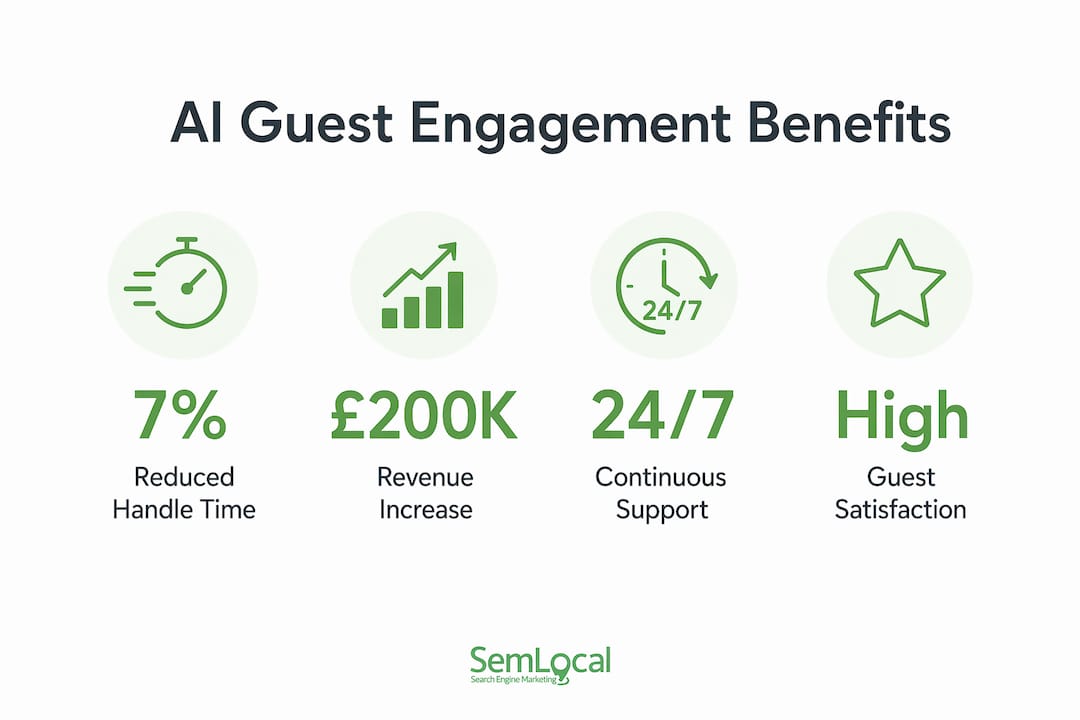
AI-powered tools in hotel call centres reduce average handle times by 7%, saving thousands of staff hours annually. That 7% compounds quickly across a property handling hundreds of calls per day. Hotels using AI for business calls report that agents spend less time on routine queries and more time converting high-value enquiries.
Personalised booking and in-stay communication
AI chatbots integrated into hotel apps and websites guide guests through the booking process with personalised recommendations based on past behaviour. During a stay, the same system handles room service requests, maintenance reports, and local recommendations without requiring a call to reception. AI can improve customer experience by shortening wait times, personalising interactions, and maintaining consistency across every communication channel.

Real-time guest feedback
Static end-of-stay surveys capture sentiment too late to act on it. Platforms like EnGAIgeVIEW™ replace surveys with continuous AI voice, text, and chat interactions that surface guest concerns in real time. A guest who mentions a noisy room at 10PM can have the issue resolved before midnight, rather than reading about it in a post-checkout review.
Revenue impact
The financial case for AI in hospitality is concrete. Hotels using AI-powered platforms have seen up to £200,000 in incremental revenue through improved direct bookings and AI-driven upselling. AI identifies the right moment to offer a room upgrade or spa package based on a guest’s booking history and current behaviour, making upselling feel helpful rather than intrusive.
| Application | Primary benefit | Measurable outcome |
|---|---|---|
| AI call handling | Reduced staff workload | 7% reduction in average handle time |
| Personalised booking AI | Higher conversion | Increased direct bookings |
| Real-time feedback AI | Faster issue resolution | Fewer negative post-stay reviews |
| AI upselling | Revenue growth | Up to £200,000 incremental revenue |
| Automated communications | Staff time savings | Reduced routine query volume |
What are the biggest pitfalls when implementing AI guest engagement?
Deploying AI without a clear plan produces predictable problems. 73% of consumers say a negative customer support experience defines their perception of a brand, and 56% report bad experiences specifically with new AI features. Those numbers confirm that a poorly implemented AI system causes more damage than no AI at all.
The most common pitfalls UK hotel managers encounter:
- Insufficient staff training. AI does not replace staff. It changes what staff do. Teams need training on how to monitor AI interactions, when to intervene, and how to hand off conversations smoothly.
- Ignoring privacy obligations. UK GDPR applies to AI systems that process guest data. Guests have the right to know when they are interacting with an AI, and your privacy notices must reflect this.
- No human override. Sensitive situations, complaints, and distressed guests require human empathy. Any AI system without a clear escalation path to a human agent will eventually fail a guest at the worst possible moment.
- Treating launch as completion. AI performance degrades if left unmonitored. Guest language evolves, new query types emerge, and the system needs regular updates to stay accurate.
Segmenting AI satisfaction data by demographics helps identify which guest groups respond well to AI and which prefer human contact. Women tend to prefer human support more than men, and older guests are more sensitive to AI failures than younger ones. Tailoring your AI strategy by guest segment reduces friction and protects your reputation.
Pro Tip: Run a phased rollout. Start with one AI application, such as automated pre-arrival messaging, and measure its impact for 60 days before expanding. This gives your team time to adapt and gives you real data to guide the next phase. Reviewing AI agent best practices before launch significantly reduces early-stage errors.
Transparent AI usage is not optional. Guests who discover they have been speaking to an AI without being told feel deceived. A simple disclosure at the start of any AI interaction, such as “You are chatting with our AI assistant,” preserves trust and sets accurate expectations.
Key takeaways
AI-driven guest engagement delivers measurable results only when clean data, well-trained staff, and transparent AI practices work together.
| Point | Details |
|---|---|
| Data hygiene is the foundation | Unified guest profiles prevent AI errors and protect guest trust from day one. |
| Four core technologies | NLP, predictive models, sentiment analysis, and AI chatbots each address a distinct engagement gap. |
| Financial ROI is real | AI-powered hotel platforms have driven up to £200,000 in incremental revenue through direct bookings and upselling. |
| Human override is non-negotiable | Every AI system needs a clear escalation path to a human agent for sensitive or complex situations. |
| Phased rollout reduces risk | Starting with one AI application and measuring results before expanding protects both guests and staff. |
Why I think most hotels are getting AI adoption backwards
Hotels tend to buy the AI platform first and sort out the data later. I have seen this pattern repeatedly, and it almost always produces the same outcome: an AI system that frustrates guests, confuses staff, and gets quietly switched off within a year.
The hotels that get genuine results from AI do the unglamorous work first. They spend weeks cleaning guest records, deduplicating profiles, and building integrations between their PMS and other data sources. Only then do they turn on the AI. The technology itself is rarely the hard part. The data is.
The second mistake I see is treating AI as a cost-cutting tool rather than a guest experience tool. The hotels that frame AI as “we can reduce headcount” end up with under-resourced teams who cannot handle the complex interactions that AI escalates to them. The hotels that frame AI as “we can give every guest a better experience” invest in training, monitor performance obsessively, and iterate quickly. Their guest satisfaction scores reflect it.
The role of AI in call centres is not to replace the human voice. It is to make every human interaction count more by removing the low-value noise around it. That distinction matters enormously for how you build your team and set expectations with guests.
— Geoff
How Aimagency helps UK hotels with AI guest interaction
Aimagency specialises in building AI agents that handle real guest communication, not just automated responses. The AI receptionist answers calls 24 hours a day, responds to guest questions in a natural tone, and books qualified appointments without requiring staff to be available around the clock.
For UK hotel managers ready to move from theory to practice, Aimagency provides the full setup: agent configuration, data integration support, and ongoing performance monitoring. The AI agents in hospitality guide covers exactly how this works in a hotel context, from first call to confirmed booking. If you want to see what a well-built AI agent does for guest satisfaction and revenue, that is the right place to start.
FAQ
What is AI-driven guest engagement?
AI-driven guest engagement is the use of artificial intelligence, including chatbots, voice agents, and predictive models, to personalise and automate hotel guest interactions across every stage of a stay.
How does AI reduce call handling time in hotels?
AI-powered tools handle repetitive guest queries automatically, reducing average handle times by 7% and freeing staff to focus on complex, high-value conversations.
Why is data hygiene critical for AI guest engagement?
Fragmented guest data across OTAs and PMS systems causes AI to produce inaccurate outputs. A unified guest profile, or “Golden Record,” gives the AI a reliable source of truth and prevents errors that damage guest trust.
Do guests need to know they are speaking to an AI?
Yes. UK GDPR and basic trust principles require hotels to disclose when guests are interacting with an AI system. Clear disclosure at the start of any AI conversation protects your brand and meets legal obligations.
How should hotels start with AI guest engagement?
Start with one application, such as automated pre-arrival messaging or AI call handling, measure its impact over 60 days, then expand. Reviewing AI agent onboarding guidance before launch reduces early errors and speeds up results.