The future hotel receptionist is a human hospitality professional amplified by AI automation. That is the co-pilot model, and it is already reshaping front desks across the UK. Routine transactions move to machines; your people focus on the moments that actually drive loyalty and revenue.
The three-layer front desk makes this concrete:
- Automated transactions: digital check-in and check-out, mobile key issuance, routine FAQs, basic billing, and task routing handled without staff involvement.
- AI-assisted interactions: AI drafts responses and surfaces information; a trained team member reviews, approves, or escalates within seconds.
- Human-only hospitality: complaints, emotional support, upselling, accessibility needs, and anything requiring genuine judgement.
Industry analysis finds that 60–70% of low-value transactional front-desk interactions are automatable, recovering substantial labour time for front-desk teams. This is not a distant forecast. Hotels piloting AI phone attendants and chat automation are seeing it now.
Pro Tip: Start with email or webchat automation before touching voice or check-in flows. It is lower risk, trains your team to supervise AI outputs, and delivers measurable wins within weeks.
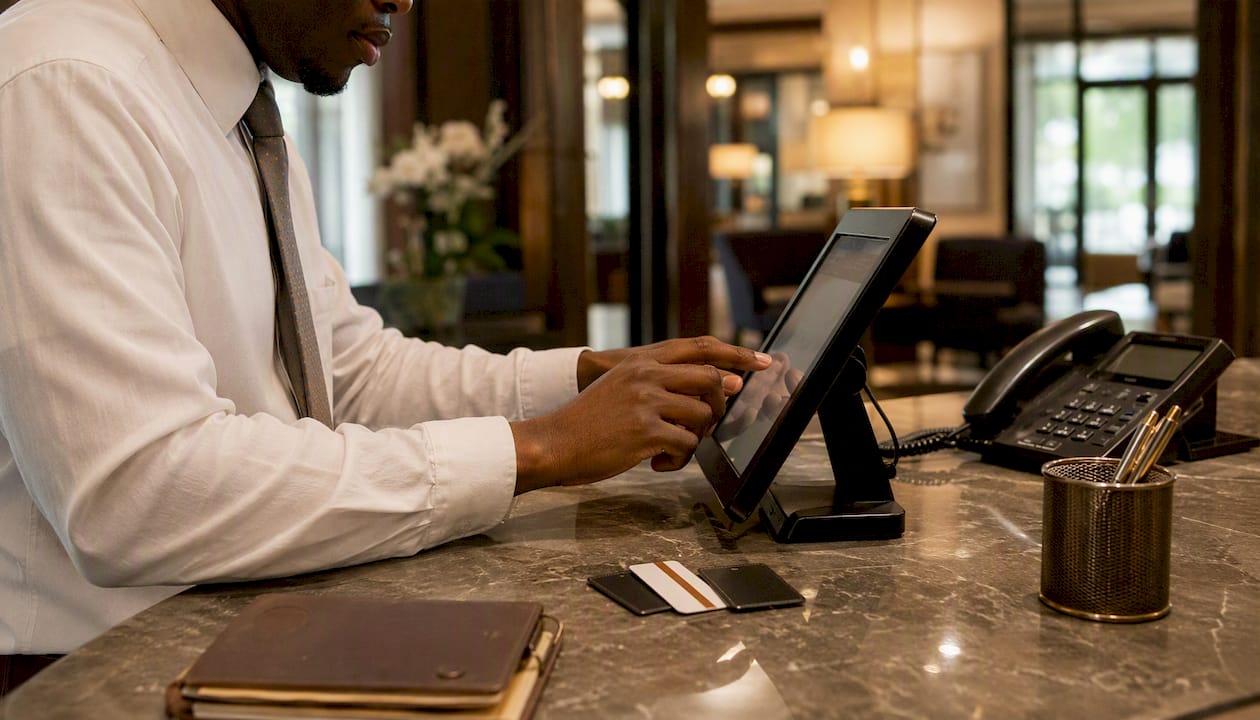
Table of Contents
- Which receptionist tasks will AI handle at the front desk?
- How will the receptionist role actually change day to day?
- What operational and lobby changes does AI reception require?
- Step-by-step pilot plan for a UK hotel
- How do you build the business case and measure ROI?
- What are the key risks and how do you mitigate them?
- Which deployment model suits your hotel?
- Key takeaways
- Why AI receptionists are worth acting on now
- Semlocal’s managed AI receptionist service for UK hotels
- Useful sources and further reading
Which receptionist tasks will AI handle at the front desk?
AI is well-suited to volume and repetition. The tasks it handles reliably today include:
- Digital check-in and check-out processing
- ID verification and mobile key credential issuance
- Routine guest queries (Wi-Fi passwords, breakfast times, parking)
- Basic billing queries and receipt requests
- Maintenance and housekeeping task routing via access-control logic (ACL)
- Phone answering and IVR triage during peak windows
A modular three-module approach combining digital check-in, an AI chatbot, and an ACL task board is particularly effective during peak check-in hours, removing queues and letting staff handle exceptions rather than routine processing. AI phone attendants can answer the majority of routine calls and surface only complex cases to staff, making phone automation one of the highest-return channels to tackle first.
Integrations required to make this work: your Property Management System (PMS), smart door locks, payment gateway, telephony or SIP provider, and CRM. Without clean API connections between these systems, automation stalls at the edges.
Pro Tip: Audit your PMS’s API documentation before selecting any AI vendor. A system that cannot expose reservation data in real time will block most automation use cases before you start.
How will the receptionist role actually change day to day?
The shift is from composing to reviewing. AI agents convert what were 5–10 minute administrative tasks into sub-minute approvals. Your receptionist reads an AI-drafted reply, adjusts the tone if needed, and sends it. That frees capacity for the work machines cannot do.
By 2030, the Eric Friedheim Tourism Institute projects hospitality will operate as a “co-pilot economy” where AI handles logistics while human roles focused on empathy and creativity increase in value. New job titles are already appearing: guest experience curator, lobby ambassador, AI supervisor.
Skills to prioritise when hiring or retraining:
- Empathy and de-escalation under pressure
- Escalation judgement (knowing when to override AI)
- Upselling and personalised recommendation
- Basic systems literacy: reading dashboards, flagging model errors
- Accessibility awareness for guests with varying needs
Pro Tip: Cross-train two or three existing team members as AI supervisors before your pilot launches. Peer-led adoption is faster and less disruptive than top-down mandates. AI-assisted hiring tools can also help you screen candidates for the right blend of technical comfort and interpersonal skill.
What operational and lobby changes does AI reception require?
Physical and workflow changes matter as much as the technology itself. Technology can reduce the heads-down effect at front desks, but it cannot replace empathetic human contact. Design your space to make human interaction the default, not the fallback.
- Reduce the fixed desk footprint and introduce a roaming host model with mobile devices.
- Create clear visual escalation pathways so guests know instantly where to find a person.
- Redesign lobby flow to guide self-service guests away from the staffed area, reducing congestion.
- Equip overnight staff with dashboard monitoring rather than expecting them to handle full transaction volume.
- Install accessible self-service terminals at appropriate heights with audio support and large-print options.
- Brief housekeeping and maintenance on automated task routing so they receive and close jobs digitally.
Staffing patterns shift too. Peak coverage remains human-led, but overnight and shoulder periods can run leaner when dashboards flag exceptions automatically.
Step-by-step pilot plan for a UK hotel
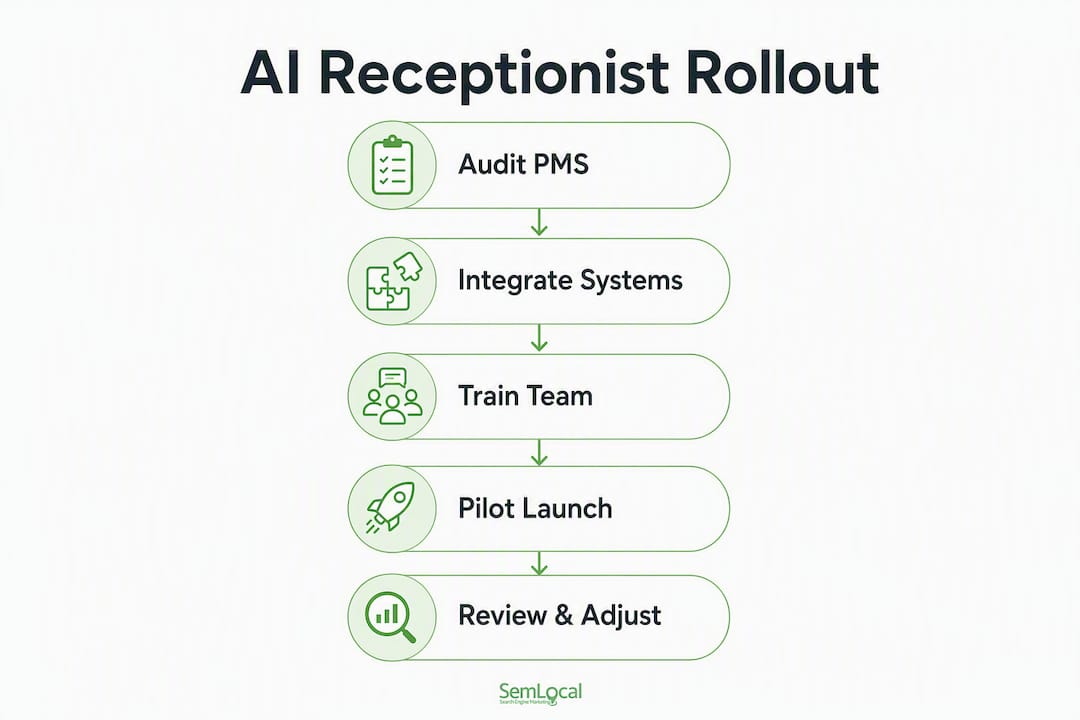
A structured 4–8 week pilot reduces risk and produces the evidence you need to scale.
- Week 1 — Discovery: Define pilot scope (one channel: phone, chat, or check-in). Assign a pilot lead. Audit PMS, locks, telephony, and CRM for API readiness.
- Week 2 — Configuration: Connect integrations, configure AI responses for your top 20 guest query types, set escalation rules and scripts.
- Week 3 — Staff training: Run two sessions covering AI supervision workflows, escalation triggers, and how to correct AI errors. Assign review responsibilities.
- Week 4 — Soft launch: Go live with the pilot channel. Monitor daily. Log every escalation and error.
- Weeks 5–8 — Evaluation: Measure against KPIs (see table below). Iterate on response quality and escalation thresholds before expanding.
UK GDPR and ICO compliance callout: Before go-live, complete a Data Protection Impact Assessment (DPIA). Map every data flow: PMS to AI to telephony to CRM. Obtain explicit consent for voice recording at the point of booking and at check-in. Apply data minimisation: retain only what you need, for as long as the ICO’s guidance requires. If your AI vendor stores data outside the UK, confirm adequacy decisions or Standard Contractual Clauses are in place.
| KPI | How to measure | Pilot target |
|---|---|---|
| Labour hours recovered | Time-tracked tasks pre vs. post automation | — |
| Call answer rate | Telephony dashboard | — |
| Average handling time | CRM or helpdesk logs | — |
| Guest satisfaction / NPS | Post-stay survey | Maintain or improve baseline |
| AI error / escalation rate | Escalation log | Below 5% of interactions |
How do you build the business case and measure ROI?
Direct savings come from labour reallocation: fewer overtime hours during peak windows, reduced agency cover, and the ability to run leaner overnight. Indirect gains follow: faster check-in correlates with better arrival experience, which drives higher in-stay spend and stronger review scores.
Independent hotels often see higher near-term ROI from peak-hour automation than large chains, because a small team can manage full occupancy when routine queries are automated. A property with four front-desk staff covering a Friday evening peak might find that automating phone triage and check-in processing frees two of those staff to focus entirely on upselling and guest engagement.
Key metrics to track beyond the pilot table above:
- Upsell conversion rate (room upgrades, F&B add-ons)
- Cost per guest interaction (total front-desk cost divided by guest contacts)
- Staff retention and satisfaction scores (automation should reduce stress, not add it)
If your hotel booking line is currently missing calls outside staffed hours, the revenue recovery from AI phone handling alone often covers the cost of the pilot within the first quarter.
What are the key risks and how do you mitigate them?
- Data protection: Complete a DPIA. Map all data flows. Minimise retention. The ICO’s guidance on automated decision-making applies when AI influences a guest outcome.
- Voice recording consent: Display notices at check-in terminals and state recording clearly at the start of AI phone calls.
- Erroneous automated answers: Set conservative confidence thresholds. Any query the AI cannot answer with high confidence routes to a human immediately.
- Accessibility gaps: Test all digital touchpoints with users who have visual, hearing, and mobility impairments. Maintain a staffed fallback at all times.
- Vendor lock-in: Require open API access and data portability clauses in every contract.
- Cyber security: Encrypt all data in transit and at rest. Require your vendor to confirm penetration testing, SOC 2 compliance or equivalent, and incident response SLAs. Segment AI systems from your core PMS network.
- Model drift: Schedule quarterly reviews of AI response quality. Assign a named team member to monitor escalation rates and flag degradation.
Pro Tip: Treat your escalation log as a product backlog. Every time a guest query reaches a human unnecessarily, that is a training opportunity for the AI. Review it weekly during the pilot.
Which deployment model suits your hotel?
Three main routes exist, each with real tradeoffs.
| Deployment model | Speed to launch | Customisation | Data control | Best suited to |
|---|---|---|---|---|
| Cloud SaaS hotel AI module | Fast (weeks) | Low–medium | Shared cloud | Larger groups with standard PMS |
| On-premises or hybrid | Slow (months) | High | Full control | Properties with strict data residency needs |
| Managed service (agency + ongoing support) | Medium (4–8 weeks) | High | Configurable | Independent and boutique hotels |
Vendor selection checklist:
- API access to your specific PMS (Mews, Opera, Protel, etc.)
- Support for your door lock system (RFID, BLE, or PIN)
- Telephony compatibility: PSTN, SIP, or VoIP
- Written UK GDPR compliance assurances and a signed Data Processing Agreement
- SLA terms covering uptime, response time, and escalation support
- References from UK hospitality clients
For independent and boutique UK hotels, a managed service removes the internal technical burden entirely. Semlocal’s AI receptionist service for hotels covers design, integration, training, and ongoing optimisation, with no requirement for an in-house technical team.
Key takeaways
AI handles 60–70% of transactional front-desk volume, freeing your team to focus on the empathy-led work that drives loyalty and revenue.
| Point | Details |
|---|---|
| Automate transactions first | Digital check-in, phone triage, and routine FAQs are ready to automate now with available tools. |
| Hire and train for the co-pilot role | Prioritise empathy, escalation judgement, and AI supervision skills over traditional clerical speed. |
| Run a structured 4–8 week pilot | Define scope, map integrations, complete your DPIA, and measure against a KPI table before scaling. |
| Build the business case on recovered hours | Labour reallocation and call answer rate improvements typically cover pilot costs within the first quarter. |
| Semlocal manages the full pilot | Semlocal designs, integrates, trains, and optimises AI receptionist deployments for UK hotels end to end. |
Why AI receptionists are worth acting on now
The hotels that will struggle are not the ones that move too fast. They are the ones that wait until the technology is so normalised that adopting it no longer gives them an edge. The co-pilot model is not a future state. It is operational at properties across the UK right now, and the gap between early movers and late adopters is widening every quarter.
What I see consistently is that the hesitation is rarely about budget. It is about not knowing where to start. A manager who understands the three-layer front desk model, has a clear pilot checklist, and knows which KPIs to report to ownership can move from conversation to live deployment in under two months. The future of AI in hospitality is not a single technology decision. It is a series of small, measurable steps that compound. Start with one channel, prove the numbers, and expand from there.
Semlocal’s managed AI receptionist service for UK hotels
More calls answered, fewer hours wasted on routine queries, and a front-desk team free to do the work that actually earns five-star reviews. That is the concrete outcome Semlocal delivers for UK hotels through its managed AI receptionist service.
Semlocal designs, builds, and manages custom AI voice agents, web chat agents, and SMS automation tailored to your property’s PMS, telephony, and access systems. The managed model means you get a fully configured, compliant deployment without needing an in-house technical team. Pricing follows a project fee for build and integration, plus a monthly management fee for optimisation and support. Most properties see measurable results within the first four weeks of go-live.
Data handling is covered: Semlocal operates under UK GDPR, signs a Data Processing Agreement with every client, and configures data retention to match ICO guidance. To book a discovery call and scope your pilot, visit aimagency.co.uk.
Useful sources and further reading
- HospitalityOS — The front desk revolution: AI, check-in, staffing and service: Q1 2026 analysis covering automatable task volumes and labour recovery data.
- Eric Friedheim Tourism Institute — The future of hospitality careers 2030–2060: Academic framing of the co-pilot economy and evolving human roles.
- Skift — The evolution of the hotel front desk: Industry commentary on the limits of automation and the continued importance of human training.
- Guestara — AI hotel front desk automation during peak check-in hours: Practical breakdown of the three-module approach for peak-hour automation.
- Opally — Hotel receptionist AI: from typing to hospitality: Vendor and practitioner accounts of review-based workflows and rollout advice.
- ICO — Automated decision-making and profiling guidance: Primary UK GDPR reference for AI deployments handling guest data.
- Semlocal / AIM Agency — AI reception for UK hospitality: UK-focused implementation guide and managed service detail.