Perplexity generates citations by running a live retrieval layer alongside its language model, then mapping the sources it finds into inline numbers and a source panel beneath the answer. This makes it a fast way to scope a topic, but not a substitute for checking the underlying material. Anyone using Perplexity for research or professional writing should treat every citation as a lead, then open and verify the primary source before quoting or relying on it.
TL;DR:
- Perplexity’s citations are generated through live web retrieval, making them useful leads but not reliable sources to cite without verification.
- Developers must handle streaming citations carefully, ensuring they collect all search result batches and validate URLs before presenting sources to users.
- Publisher disputes and reports reveal that Perplexity may misattribute, scrape content improperly, or fabricate quotations, which damages citation trustworthiness.
- For academic work, always verify sources directly and use specialized databases, as Perplexity should only guide initial research rather than serve as a final citation.
- For businesses, accurate citations influence visibility and referral traffic, making it vital to monitor and ensure trustworthy source attributions across search platforms and AI tools.
Table of Contents
- How Perplexity generates citations
- How citations appear on the page
- Developer view: parsing streaming citations
- Citation reliability and documented controversies
- Verifying Perplexity citations: a research checklist
- Where Perplexity falls short for academic citation
- Why citation visibility matters beyond research
- Sources and documentation worth checking
- Getting more from AI visibility as a business
- Sources
- FAQ
How Perplexity generates citations
Perplexity works on a retrieval-augmented generation model. When you ask a question, it searches a live web index, ranks the most relevant pages, and then has its language model summarise those pages while inserting numbered references back to the sources it used. The citations you see are a by-product of that retrieval step, not something the model invents from memory.
The product now offers this through more than one interface, and each behaves differently:
- The Perplexity Search API returns structured results: a title, a URL and a snippet for each match, with no prose written around them.
- The Agent API (built on Perplexity’s Sonar models) returns a written answer with citation mapping already embedded, so developers get narrative text rather than a raw list.
- Deep Research mode runs several search passes in sequence, digging deeper into a topic before compiling a longer, heavily cited report.
Deep Research is still a web-scoped tool. It searches public pages more thoroughly than a single-pass query, but it does not query a bounded, peer-reviewed corpus the way a university database does. Any specific claim about how many passes it runs or how many sources it always returns is worth treating cautiously, since those figures are vendor-controlled and change as the product is updated. The Search API documentation confirms the split between structured results and prose answers, which matters if you are deciding which mode to build against.
How citations appear on the page
Whatever route generates the answer, the reader-facing presentation follows a consistent pattern. Perplexity’s own materials describe the goal as letting people “verify information or dig deeper” without leaving the answer, and the interface is built around that promise.
- Inline numeric markers, shown as [1], [2] and so on, sit directly after the claim they support and link to the matching entry in the source panel.
- The source panel, usually shown above or beside the answer, lists clickable titles, the source URL and a short snippet, with a date or last-updated field when the underlying page provides one.
- Source chips and domain badges appear inline so you can see which outlet or site is behind a claim without leaving the reading flow.
- Mobile layouts often collapse the panel into a scrollable strip, so the same information is there but takes an extra tap to expand.
When judging a source at a glance, look for the domain itself (a government site or an established outlet carries more weight than an aggregator), the presence of a date, and whether the snippet actually contains the fact being cited rather than just a related phrase.
Developer view: parsing streaming citations
Anyone building on the Agent API needs to handle citations as a moving target rather than a finished list. According to Perplexity’s own streaming citations cookbook, responses arrive as a stream of text chunks containing numeric markers, with the actual source data delivered separately in search_results events. Each marker in the text corresponds to an id inside one of those batches.
The practical risk is straightforward: multi-step queries, including Deep Research style requests, can produce several search_results batches in sequence. If a client only captures the first batch and stops listening, later numeric markers in the text will have no matching id, and the citation breaks or appears to point nowhere.
- Collect every
search_resultsbatch for the full duration of the response, not just the first one. - Keep the mapping between marker id and source persisted across reconnects and retries, since a dropped connection can otherwise orphan citations.
- Validate returned URLs (check the status code and prefer the canonical URL) before showing them to a user, since a dead or redirected link undermines trust in the whole answer.
- Deduplicate repeated sources and apply sensible rate limiting on your own validation requests so you are not hammering the same domain.
Pro Tip: Log the raw search_results payloads alongside the rendered answer during development. It is the fastest way to spot an unresolved marker before a user does.
Citation reliability and documented controversies
Perplexity’s citations look authoritative, but the record shows they are not always right, and the product’s design has drawn scrutiny from publishers directly. Reporting from The Verge documented allegations that Perplexity republished exclusive reporting with inadequate attribution, and that it used third-party scraping methods that led to publisher complaints, including questions over whether robots.txt exclusions were being respected.
- Independent research summarised by CASRAI notes a documented history of misattributed information and, in some cases, fabricated quotations presented with the same confident tone as accurate ones.
- Legal filings have since pushed the dispute further: a complaint reviewed by Courthouse News alleges large-scale copying and argues that Perplexity’s retrieval process harmed publishers whose content was aggregated without adequate credit.
Perplexity positions itself as an “answer engine” designed to reduce the need to click through to original sources, a design choice that sits in direct tension with publishers who depend on that referral traffic.
Practically, this means a confident-looking citation is not proof of accuracy. A researcher should read the point being made, then read the source itself to see whether it says the same thing, and a publisher should assume some of its content may be summarised without a click-through ever happening.
Verifying Perplexity citations: a research checklist
Perplexity is genuinely useful for finding a starting point on an unfamiliar topic. The value comes from what you do with the citation next, not from the citation itself.
- Open every cited source before you use its claim, rather than trusting the summary sentence attached to it.
- Check that the quoted text actually appears in the source, confirm the named author and the publication date, and record the URL or DOI while you have the page open.
- For paywalled material, capture the full citation metadata and try your institution’s library access or a DOI lookup rather than relying on the snippet alone.
- Treat Perplexity’s output as a set of leads: turn the terminology and named sources it surfaces into targeted searches in a proper academic database.
- Keep a simple audit trail: the query you ran, the date you ran it, and the primary source URLs you actually verified and relied on.
Pro Tip: Keep a running spreadsheet of query, timestamp and verified URL for any piece of work that might face scrutiny later. It takes two minutes per source and saves hours if a citation is ever challenged.
Where Perplexity falls short for academic citation
Perplexity is a synthesis tool, and its documented history of misattribution and fabricated quotations, noted by CASRAI, means it should not be cited directly as a source in formal academic writing. It tells you where to look, not what to write down as fact.
- For reproducible literature searches, tools that index peer-reviewed corpora directly, such as Elicit, Consensus, PubMed or Web of Science, give you a citable trail that Perplexity’s live web index cannot.
- Use Perplexity to surface search terms and possible grey literature, then confirm every relevant item inside a domain-specific database before it goes into a bibliography.
- When a project requires disclosing AI-assisted research, document the process you used and cite only the primary sources you personally checked.
Why citation visibility matters beyond research
I spend most of my time helping local businesses get found and chosen across Google Maps, search and now AI platforms, and citations are the same problem in a different coat. An accurate, clickable citation sends a reader to the real source; a confident summary with no click keeps that traffic inside the AI platform instead.
For publishers, that means checking crawl access, reviewing robots.txt settings with a tool like the robots.txt checker, and watching referral clicks from AI platforms the way you already watch organic search. For local businesses, it means adding AI citation monitoring to the same visibility strategy you use for Maps and search results, because being cited accurately is quickly becoming as valuable as ranking well.
— Geoff
Sources and documentation worth checking
The claims above rest on a mix of vendor documentation, independent reporting and legal filings, and it is worth going to the originals rather than taking any single summary at face value.
- Perplexity’s own Search API quickstart sets out the difference between structured search results and prose Agent answers
- The streaming citations cookbook is the primary reference for developers building citation handling against the Agent API.
- CASRAI’s guide to Perplexity for research sets out where the tool fits, and does not fit, in an academic workflow.
- The Verge’s reporting documents the publisher disputes over attribution and scraping that sit behind much of the current scrutiny.
Getting more from AI visibility as a business
Understanding how Perplexity handles citations is useful well beyond academic research. If your business depends on being found and chosen online, the same summarised answers that frustrate publishers are increasingly deciding who gets called, booked or ignored, and a citation that never gets clicked is a lead you never see.
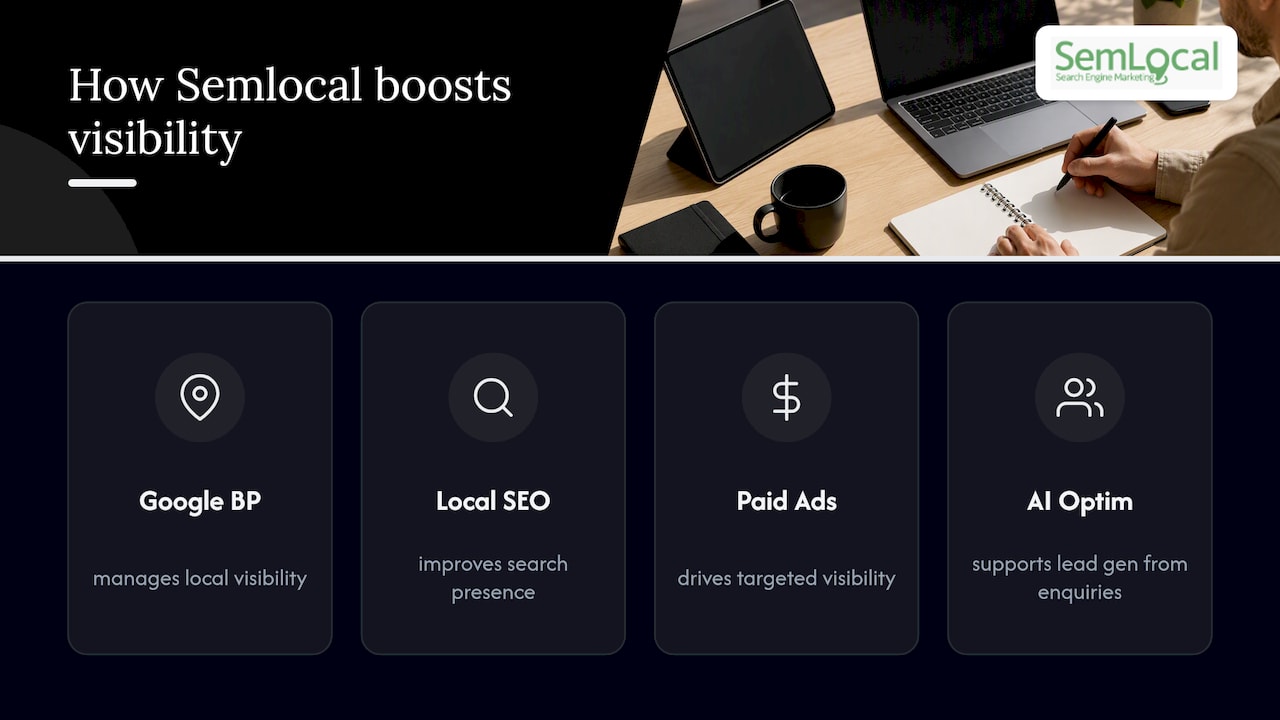
Semlocal manages local business visibility through Google Business Profiles, Local SEO, paid ads, and AI Optimisation to help businesses be represented accurately across various search platforms. Our AI Lead Generation service is built around real enquiries rather than vanity metrics, turning visibility into calls and bookings you can measure.
If you want a clear view of how your business currently appears across AI search and what to do about it, consider contacting a local visibility management service for a straightforward review of your status and possible improvements.
Sources
The two tools serve different purposes: Perplexity is built around live retrieval and attaches citations to nearly every claim, while general-purpose chatbots do not always ground answers in current web sources by default. Neither should be treated as a finished citation without checking the source it points to.
- Perplexity AI for Academic Research: Capabilities and citation reliability (CASRAI)
- Streaming citation parsing (Perplexity docs cookbook)
- Perplexity controversy reporting (The Verge)
FAQ
What is the Perplexity controversy about?
The controversy centres on allegations that Perplexity republished exclusive reporting with inadequate attribution and used scraping methods that may have bypassed robots.txt restrictions, prompting publisher complaints and legal filings. Publishers argue this undermines referral traffic while reporting documents the pattern of disputes.
How do I cite Perplexity AI in my own work?
Perplexity itself should not be cited as a primary source, since it is a synthesis tool with a documented history of misattribution, according to CASRAI. Instead, verify and cite the original sources it points you to, and note separately if you used an AI tool during your research process.
Is Perplexity good for academic writing?
Perplexity works well for early-stage scoping, finding terminology and identifying leads, but it is not suited to final academic citation because of its documented misattribution and fabrication issues, per CASRAI. For a citable, reproducible search, a peer-reviewed database remains the better tool.