A hotel digital concierge is an always-on, AI-powered guest assistant that handles requests, makes bookings, delivers recommendations, and connects to your property management system — all without a member of staff picking up the phone. For UK hotel owners and managers, it means three things above all else:
- Guests get instant, accurate answers at 2 AM as readily as at noon.
- Front-desk and night teams spend less time on routine requests and more time on high-value interactions.
- Every upsell opportunity — a spa booking, a late checkout, a restaurant table — is captured automatically.
Key takeaways
A hotel digital concierge delivers measurable guest experience, efficiency, and revenue gains only when it is properly integrated with your PMS, trained on property-specific data, and measured against agreed KPIs from day one.
| Point | Details |
|---|---|
| Integration is non-negotiable | A concierge without live PMS data cannot personalise or act — prioritise this above all other features. |
| Omnichannel continuity matters | Guests expect one conversation thread across WhatsApp, SMS, and web; fragmented channels damage satisfaction scores. |
| Measure from day one | Track auto-resolution rate, mean response time, upsell conversion, and NPS/CSAT to prove ROI and improve the system. |
| Managed vs. SaaS | SaaS suits tech-confident teams; a managed deployment reduces time-to-value for properties without a dedicated IT resource. |
| Semlocal managed service | Semlocal handles design, integration, training, and ongoing optimisation so your team focuses on running the hotel. |
Table of Contents
- What a hotel digital concierge actually is
- Core features every hotel digital concierge should have
- What are the real benefits for your hotel?
- How do hotels typically buy these systems?
- How to implement a digital concierge in a UK hotel
- Best practices and common mistakes to avoid
- How do you measure whether it is working?
- Where hotel digital concierges are heading
- Guest privacy and data security beyond GDPR
- How customisation works for different UK hotel types
- An honest view on where hotels get this wrong
- Managed AI concierge deployment for UK hotels
- Sources
What a hotel digital concierge actually is
The industry term you will encounter most often is “virtual concierge,” though “digital concierge service” and “guest messaging platform” are used interchangeably by vendors. Whatever the label, the definition is consistent: a digital concierge is a guest-facing system that automates requests, delivers local recommendations, and integrates with property systems to personalise every answer.
That last part is what separates a digital concierge from a basic scripted chatbot. A chatbot replies from a fixed script. A digital concierge connects to live reservation data, takes actions on the guest’s behalf, and preserves the hospitality context of the conversation. It knows the guest’s name, their room number, their check-out date, and whether they have already asked about parking.
Where guests encounter it
- Mobile app or web widget — the most common format; guests access it before arrival and throughout their stay.
- SMS or WhatsApp — ideal for guests who prefer messaging over downloading an app.
- In-room tablet or smart TV — suits properties where in-room service requests are high volume.
- Phone/voice assistant — handles inbound calls and in-room voice commands; particularly useful for accessibility.
When the concierge sits inside your own guest portal, it has direct access to your PMS data and can act on reservations in real time. When it runs through a third-party channel like WhatsApp, a middleware layer bridges the gap — though the guest experience feels identical.
Core features every hotel digital concierge should have
Not every platform deserves the name. When you evaluate solutions, focus on capability over marketing language. The ability to take actions — book, charge, log a housekeeping request — is the core value differentiator, not the quality of the chat interface.
- PMS and CRM integration. Live reservation data, room status, and guest profile access are non-negotiable. Without this, the system cannot personalise or act.
- Actionable automation. The concierge must be able to make bookings, process upsells, log housekeeping tasks, and handle payments — not just answer questions.
- Multilingual support. UK hotels serving international guests need responses in the guest’s language without manual intervention.
- Omnichannel continuity. A single conversation history that follows the guest across WhatsApp, SMS, and web chat. Forcing a guest to repeat themselves is a service failure.
- Context-aware escalation. When the AI’s confidence is low, it hands off to a staff member with the full conversation intact. The guest never notices the join.
- Reporting and analytics. Auto-resolution rate, response time, upsell conversion, and NPS changes should all be visible in a single dashboard.
- Secure data handling. GDPR-compliant PII storage, configurable retention periods, and role-based access controls.
Pro Tip: When shortlisting vendors, ask for a live demo that starts a conversation on WhatsApp and continues it on the web widget. If the conversation history breaks, the omnichannel claim is marketing copy, not product reality.
What are the real benefits for your hotel?
Digital concierges operate around the clock, automating routine guest requests and reducing front-desk workload. The operational gains are direct: fewer calls, faster resolution, and staff freed for tasks that genuinely require human judgement.
For smaller properties, the benefit is disproportionate. A digital concierge absorbs high-volume, low-complexity requests — extra towels, late checkout, airport transfers — filling the gap where a dedicated concierge desk is not staffed overnight. A boutique hotel in Edinburgh or a coastal B&B in Cornwall gets the same 24/7 coverage as a 300-room city-centre property.
On the revenue side, every automated upsell prompt is an opportunity that would otherwise go unmissed. A guest asking about dinner via WhatsApp at 6 PM can be offered a restaurant reservation and a bottle of wine in the same message thread, with payment taken immediately.
| Metric | What it measures | Why it matters |
|---|---|---|
| Auto-resolution rate | % of requests resolved without staff | Directly reflects workload reduction |
| Mean response time | Average time from guest message to reply | Correlates with guest satisfaction scores |
| Upsell conversion rate | % of offers accepted by guests | Measures ancillary revenue impact |
| NPS / CSAT change | Guest satisfaction before and after deployment | Tracks overall experience improvement |
| Ticket throughput saved | Staff hours recovered per week | Supports ROI calculation |
Tracking auto-resolution, response times, upsell revenue, and guest satisfaction gives you the evidence base to evaluate vendors, justify investment, and improve the system over time.
How do hotels typically buy these systems?
Understanding the vendor landscape saves you from buying the wrong category of product. Vendor selection guidance consistently highlights that buyers who focus on integration depth and escalation logic get better outcomes than those who prioritise interface aesthetics.
There are five broad vendor categories:
- Integrated PMS modules — concierge functionality built into your existing PMS (e.g. Opera Cloud, Mews). Low integration friction, but often limited in AI capability.
- Guest messaging platforms — standalone tools that connect to your PMS via API and manage all guest communication channels. Strong on omnichannel; variable on AI depth.
- Standalone concierge apps — white-labelled mobile apps with booking and recommendation features. Good for mid-market properties wanting a branded guest experience.
- In-room device manufacturers — tablet or voice-device providers with proprietary software. Suited to full-service hotels where in-room interaction is a brand priority.
- Managed and custom AI services — agencies or consultancies that design, train, and integrate a bespoke AI concierge, then manage it on an ongoing basis. Higher upfront cost, faster time-to-value, and better fit for properties with complex PMS environments or specific brand requirements.
For a UK manager’s overview of the different AI agent types and which suits your property size, the distinction between a SaaS subscription and a managed deployment is worth understanding before you brief any supplier.
Commercial models follow the vendor type: SaaS platforms charge a monthly subscription (sometimes per-room or per-guest-message), while managed services typically combine an implementation fee with a monthly retainer.
How to implement a digital concierge in a UK hotel
A structured approach reduces risk and gets you to a working pilot faster. The steps below assume you are starting from scratch, though many apply equally to a platform migration.
- Map your data flows. Identify what your PMS exports (reservation data, room status, guest profile fields) and confirm the API or middleware your chosen platform requires.
- Define your core use cases. Prioritise the ten most common guest requests your front desk handles. These become the first automations you build and test.
- Set KPI targets before you go live. Agree on auto-resolution rate, mean response time, and upsell conversion targets with your operations team. Without baselines, you cannot measure progress.
- Configure integrations. Connect the concierge layer to your PMS, booking engine, and payment processor. Test every action flow (booking, housekeeping log, upsell charge) in a staging environment.
- Address GDPR and data security. Under UK GDPR, guest PII must be processed lawfully, stored securely, and retained only as long as necessary. Confirm your vendor’s data residency (UK or EU servers are preferable), configure retention periods, and document your lawful basis for processing. The ICO’s guidance on AI and data protection is the primary reference for UK properties.
- Train the agent on property-specific rules. House rules, local area knowledge, pricing, and escalation thresholds all need to be loaded and tested before guests interact with the system.
- Brief your team and set escalation rules. Staff need to know when the AI will hand off to them, what information they will receive, and what the SLA for response is. Buy-in at this stage prevents the most common post-launch failure.
- Run a 4–8 week pilot. Limit the pilot to one channel (WhatsApp is often the lowest-friction starting point) and one property. Measure against your pre-set KPIs weekly.
Managed service deployments can configure property details in as little as 24–48 hours, with enterprise-grade security and PII handling built in from day one. For busy UK hotels without a dedicated IT team, that speed matters.
Pro Tip: Set a confidence threshold in your AI configuration — typically 80–85% — below which the system automatically escalates to a human. Review escalated conversations weekly during the pilot to identify gaps in the agent’s training data.
Best practices and common mistakes to avoid
The hotels that get the most from a digital concierge share a few habits. Those that struggle tend to make the same mistakes.
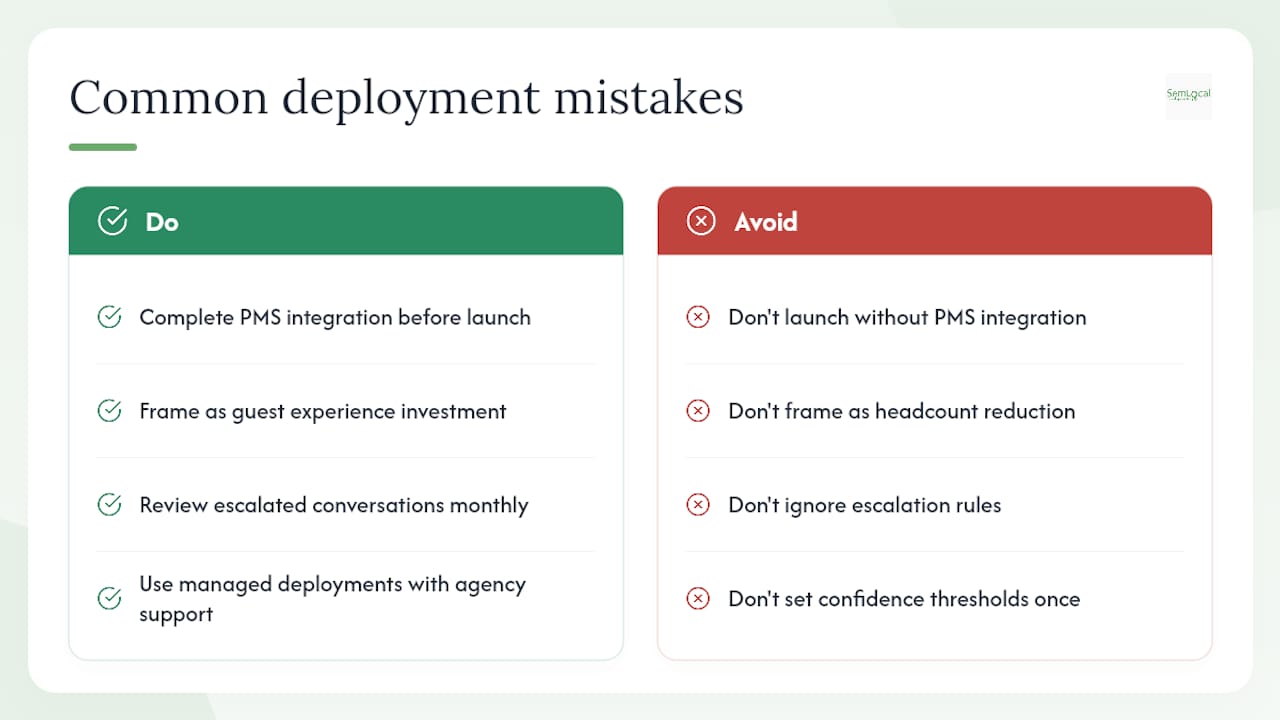
Do:
- Train the agent on your specific property rules, not just generic hospitality responses.
- Maintain omnichannel context so a guest who starts on SMS and switches to the web widget never has to repeat themselves.
- Set clear escalation thresholds and review them monthly as the agent learns.
- Measure from day one — even a simple weekly report on auto-resolution rate tells you whether the system is working.
Avoid:
- Deploying a generic model without PMS integration. Without live data, the system cannot personalise and will frustrate guests with inaccurate answers.
- Expecting the digital concierge to replace staff empathy. It handles volume; your team handles complexity and emotional moments.
- Running fragmented channels with no shared conversation history. A guest who has to repeat their request across three touchpoints will rate the experience poorly regardless of how fast each individual reply was.
- Skipping staff training. The most common post-launch complaint from hotel teams is that they did not know when or how to take over from the AI.
Poor data mapping between your PMS and the concierge layer is the single most common technical failure. Invest time here before launch, not after.
How do you measure whether it is working?
Integrations, escalation rules, and measuring auto-resolution and NPS are the primary success indicators cited across industry reporting. Build your measurement framework around these five KPIs:
- Auto-resolution rate — target 70–80% for a well-trained, integrated system.
- Mean response time — sub-60 seconds is achievable for automated responses; track separately for escalated conversations.
- Upsell revenue per guest — compare the 30 days before and after deployment on the same ancillary categories.
- NPS or CSAT score — run a short post-stay survey and segment responses by guests who used the concierge versus those who did not.
- Staff hours recovered — count the routine requests handled automatically each week and multiply by average handling time.
A simple ROI calculation: if your front desk handles 200 routine requests per week at an average of four minutes each, that is roughly 13 staff hours. At a fully loaded cost of £15 per hour, the system saves approximately £200 per week before any upsell revenue is counted. Set that against your monthly subscription or retainer cost and you have a clear payback picture.
For voice AI integration and call-handling performance, the same measurement logic applies — track call deflection rate alongside the digital concierge metrics for a complete picture.
Report weekly during the pilot, monthly at scale. Operations teams need auto-resolution and response time; revenue teams need upsell conversion and ancillary revenue per guest.
Where hotel digital concierges are heading
The direction of travel is clear. Omnichannel continuity — a single conversational thread that follows the guest across WhatsApp, SMS, in-room tablet, and voice — is becoming the baseline expectation, not a premium feature.
Personalisation will deepen as hotels accumulate first-party guest data and loyalty profiles. A returning guest’s preferences (room temperature, pillow type, preferred restaurant cuisine) will be surfaced automatically, making every interaction feel considered rather than generic.
Voice and in-room assistants are growing as a complementary channel rather than a replacement for messaging. For voice assistants and UK hotel efficiency, the use case is strongest in full-service and luxury properties where in-room interaction is part of the brand promise.
Tighter integration with revenue-management systems will enable dynamic upsells — a room upgrade offered at the precise moment occupancy data suggests availability, priced in real time. That is where the revenue opportunity becomes genuinely significant.
Guest privacy and data security beyond GDPR
UK GDPR sets the legal floor, but the hotels guests trust most go further. A few practices worth building into your deployment from the start:
Data minimisation. Collect only the guest data the concierge needs to function. If the system does not need a guest’s nationality to answer a housekeeping request, do not pass it.
Transparency at the point of interaction. Guests should know they are interacting with an AI system. A brief disclosure at the start of the conversation (“You’re chatting with our virtual concierge”) is both good practice and increasingly expected.
Access controls. Role-based permissions mean a housekeeping supervisor can see room-status requests but not payment data. Audit logs should record every data access event.
Vendor due diligence. Ask your vendor where data is stored, who can access it, and what their breach notification process is. UK-based or EU-based data residency is preferable for UK properties. Check that any AI model used to process guest messages does not train on your guests’ data by default — this is a contractual point, not a technical assumption.
Retention and deletion. Set automated deletion schedules for conversation logs. Most operational purposes are served by 90-day retention; anything longer needs a documented justification.
How customisation works for different UK hotel types
A 400-room conference hotel in Manchester and a 12-room country house hotel in the Cotswolds have genuinely different needs. The good news is that modern digital concierge platforms are modular enough to serve both.
Independent boutique hotels benefit most from a lightweight deployment: WhatsApp or SMS as the primary channel, a curated set of automations covering the ten most common requests, and a simple escalation path to the owner or duty manager. Setup complexity is low; the ROI case is immediate.
Mid-market and branded properties typically need deeper PMS integration, multi-department routing (housekeeping, F&B, maintenance), and branded mobile app delivery. The configuration is more involved, but the volume of requests justifies it.
Full-service and luxury hotels require the highest level of customisation: bespoke tone of voice, integration with spa and restaurant booking systems, loyalty programme data, and in-room device support. A managed deployment is usually the right model here, because the configuration complexity exceeds what most in-house teams can handle alongside day-to-day operations.
UK-specific implementation guidance covers the practical differences between property types in more detail, including PMS compatibility considerations for the systems most common in the UK market.
An honest view on where hotels get this wrong
The technology is mature enough that deployment failure is almost never a technology problem. It is a prioritisation problem.
Hotels that rush to launch without completing PMS integration end up with a digital concierge that cannot answer basic questions accurately. Guests ask about their reservation and get a generic response. The team loses confidence in the system, stops promoting it, and the adoption rate collapses within weeks. The vendor gets blamed, but the root cause was skipping the integration work.
The second failure mode is treating the digital concierge as a cost-cutting exercise rather than a guest experience investment. When the framing is “how do we reduce headcount,” staff resist the system, escalation rules get ignored, and the guest experience suffers. When the framing is “how do we give guests faster, better answers while freeing our team for the moments that matter,” buy-in follows naturally.
Confidence thresholds are consistently underinvested. Most hotels set a threshold once at launch and never revisit it. A monthly review of escalated conversations — looking at what the AI got wrong and why — is the single highest-return maintenance task for any digital concierge deployment.
Managed deployments reduce both failure modes. When an agency handles the integration, trains the agent, and reviews performance monthly, the hotel team focuses on operations rather than configuration. For properties without a dedicated technology lead, that division of responsibility is worth the retainer cost.
Managed AI concierge deployment for UK hotels
If the implementation checklist above looks like more than your team can absorb alongside running a hotel, a managed deployment is the practical alternative.
Semlocal’s managed AI concierge service covers the full deployment: design, agent training, PMS and CRM integration, GDPR-compliant data configuration, staff briefing, and ongoing monthly optimisation. Property configuration typically completes within 24–48 hours of receiving your PMS credentials and use-case brief. You get a production-ready system, not a pilot that needs months of internal resource to reach the same point.
The ongoing retainer includes performance reporting, monthly agent retraining based on escalation reviews, and direct support when your property’s services or policies change. You keep full visibility of KPIs; we handle the technical work.
To discuss your property’s requirements and get a clear picture of timelines and costs, book a discovery call with the Semlocal team today.
Sources
- AI concierge hotels: practical guide
- Digital concierge — AltexSoft glossary
- SiteMinder: digital concierge overview
- Hotel digital concierges: what to look for and what to avoid — Revinate
- AWS Marketplace product listing
- Digital hotel concierge: what it is and how it works | eesel AI
- Guestivo: digital concierge glossary
- Hotel digital concierge — HotelTechReport