Hotel automation is the use of interconnected technology systems that carry out routine and complex hotel operations with minimal human input. At its core, it combines AI, IoT sensors, robotics, and integrated software platforms to handle everything from guest check-in to housekeeping scheduling, inventory management, and real-time pricing. The result is a hotel that runs faster, makes fewer errors, and delivers a more consistent guest experience without proportional increases in staffing.
The main components of a hotel automation system include:
- Property management systems (PMS): the central hub connecting bookings, room assignments, billing, and guest profiles
- IoT devices: sensors that monitor room occupancy, temperature, energy usage, and maintenance needs in real time
- AI and machine learning: algorithms that forecast demand, adjust pricing dynamically, and personalise guest communications
- Robotics: autonomous devices that deliver amenities, restock minibars, and clean common areas
- Guest-facing applications: mobile apps and self-service kiosks that give guests control over check-in, room settings, and service requests
- Automated messaging platforms: tools that handle pre-arrival emails, in-stay queries, and post-departure surveys without staff involvement
Together, these systems create a connected operational backbone. When a guest books a room, the PMS updates availability across all distribution channels, triggers pre-arrival communications, and prepares the room based on stored preferences. That level of coordination, happening automatically and instantly, is what hospitality automation delivers at its best.
How hotel automation is changing the hospitality industry
The shift from manual to automated processes is reshaping every layer of hotel operations, from the front desk to the back office. Accuracy improves because automated systems do not misread handwriting, forget to update a spreadsheet, or double-book a room. Speed improves because actions that once required a staff member to log in, check a system, and make a decision now happen in milliseconds.
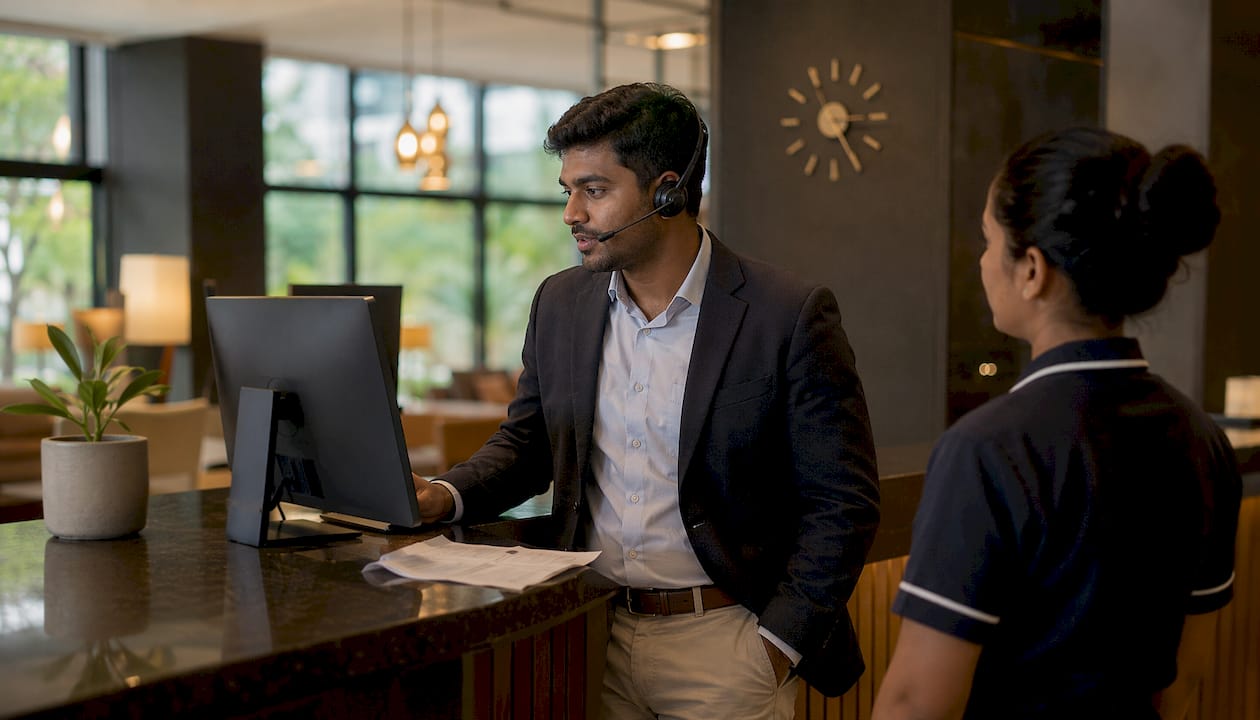
Labour pressure is the most urgent driver of this change. Staffing shortages are a significant challenge for North American hotels in recent years, and labour costs have risen notably year-on-year. UK hotels face comparable pressures, with post-Brexit workforce gaps and rising National Living Wage commitments squeezing margins. Automation does not replace hospitality; it absorbs the repetitive tasks that consume staff time, freeing people for the interactions that guests actually value.
Guest expectations have also shifted. Travellers now arrive expecting the same on-demand convenience they get from retail and banking apps. They want to check in via their phone, control the room temperature before they walk through the door, and get an instant answer to a query at 2AM. Automation makes all of that possible without a 24-hour front desk team.
The operational model is changing too. Hotels that once ran on reactive processes, fixing problems after guests complained, are moving to proactive systems that anticipate maintenance needs and predict demand shifts before they happen. That transition, from reactive to proactive, is the defining change automation brings to the industry.
What are the key benefits of hotel automation for UK hotels?
The advantages of hotel automation are practical and measurable. For UK properties operating in a competitive market with tight margins, the case is clear.
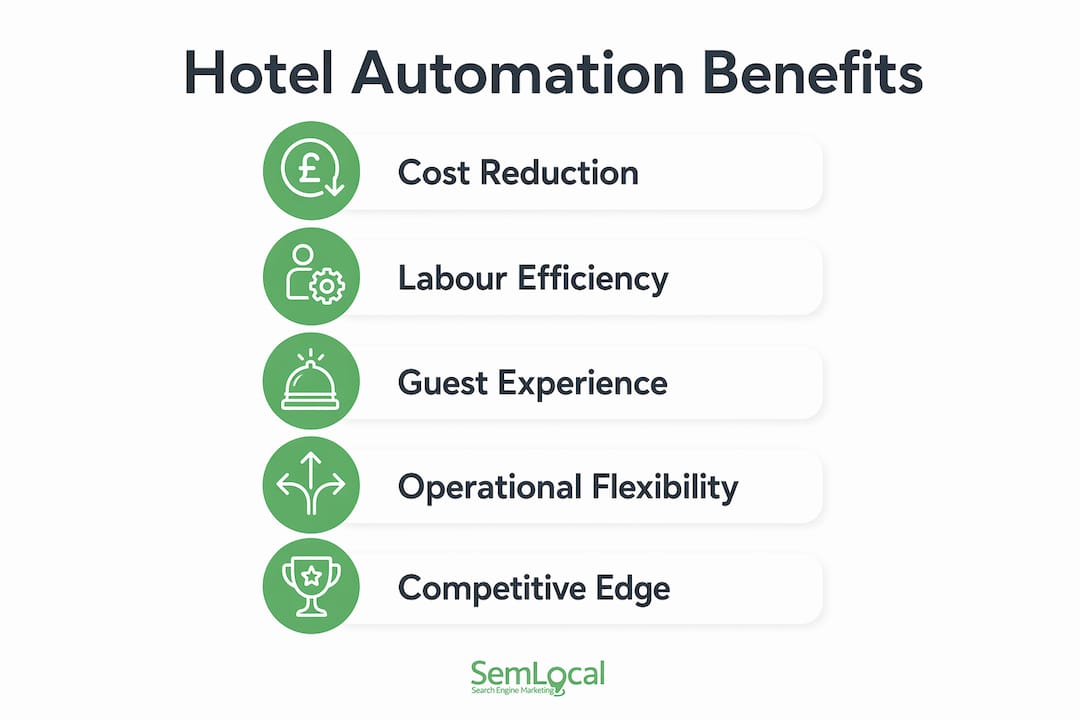
- Labour cost reduction: automated check-in kiosks, housekeeping scheduling tools, and AI-driven workforce planning reduce the hours needed for routine tasks, directly cutting payroll costs
- Improved guest satisfaction: guests get faster service, personalised room settings via mobile app controls, and 24/7 self-service options that remove friction from their stays
- Energy efficiency: IoT sensors track real-time occupancy and adjust heating, cooling, and lighting automatically, reducing energy waste in unoccupied rooms
- Fewer errors in bookings and billing: automated systems synchronise availability across all channels instantly, eliminating double bookings and manual billing mistakes
- Data-driven decisions: unified platforms give managers live visibility into occupancy, revenue per available room (RevPAR), and operational costs, enabling faster and better decisions
- Demand forecasting: AI tools analyse booking patterns, local events, and seasonal trends to predict occupancy and adjust staffing and pricing accordingly
- Competitive positioning: UK boutique hotels using automation can deliver a guest experience that competes with larger chains, without the same headcount
One often-overlooked benefit is flexibility. When demand spikes unexpectedly, an automated system adjusts pricing, reallocates housekeeping resources, and updates availability across booking platforms in real time. A manual operation simply cannot respond at that speed.
Which hotel operations benefit most from automation?
Not every hotel function benefits equally from automation. The areas below deliver the highest returns, and most UK properties can start with at least two or three of them.
- Front desk check-in and check-out: self-service kiosks and mobile check-in apps reduce queue times, free staff for complex queries, and allow late-night arrivals without a staffed desk
- Housekeeping scheduling: automated housekeeping systems track room occupancy and guest departure times, then assign cleaning tasks in real time, cutting unnecessary delays and reducing cleaning time by 20%
- Predictive maintenance: IoT sensors monitor HVAC systems, lifts, and plumbing for anomalies, scheduling repairs before guests are affected and preventing costly emergency callouts
- Inventory and procurement management: AI-enabled procurement tools track stock levels in real time and trigger replenishment orders automatically, reducing waste and preventing shortages
- Guest communications: automated messaging platforms handle pre-arrival instructions, in-stay requests, and post-departure surveys, maintaining consistent contact without staff involvement
- Revenue management: AI pricing engines analyse demand signals, competitor rates, and booking pace to adjust room rates dynamically, maximising RevPAR across every day of the year
- Room assignment: integrated PMS platforms assign rooms based on guest preferences, loyalty status, and real-time availability, personalising the experience before arrival
- Robotic deliveries: autonomous delivery robots restock minibars, deliver towels, and transfer luggage, particularly useful during late-night hours when staffing is minimal
Pro Tip: Start with front desk workflows, payments, and housekeeping coordination. These three areas touch every guest stay and offer the fastest efficiency gains with the lowest implementation risk.
For a UK boutique hotel with a small team, automating housekeeping scheduling and guest communications alone can free up several hours of staff time per day. That time goes back into personal service, which is exactly what boutique guests pay for.

How to implement hotel automation in UK hotels
Implementation works best as a phased process. Trying to automate everything at once creates confusion, staff resistance, and integration problems. A structured approach delivers results faster.
-
Assess your current operations. Map every manual process across front desk, housekeeping, maintenance, and back office. Identify where errors occur most often, where staff time is consumed by repetitive tasks, and where guests experience delays.
-
Set clear goals. Define what success looks like before you buy anything. Reducing check-in time, cutting energy costs, or improving housekeeping turnaround are all measurable targets. Vague goals produce vague results.
-
Evaluate solutions against your property type. A 12-room boutique hotel in the Cotswolds has different needs from a 200-room city-centre property. Look for cloud-based, modular platforms that scale with your business and integrate with your existing PMS without requiring bespoke IT infrastructure.
-
Prioritise integration. The most common implementation failure is buying tools that do not talk to each other. Your automation platform must connect with your booking engine, channel manager, POS system, and maintenance software via open APIs.
-
Train your team properly. Automation is not a “set and forget” solution. Staff need to understand how the systems work, what to do when something flags an error, and how their roles change. Hotels that invest in training see faster adoption and fewer operational disruptions.
-
Run a pilot phase. Deploy automation in one department first, measure the results against your goals, and refine before rolling out further. Front desk or housekeeping scheduling are good starting points.
-
Evaluate ROI continuously. Track the metrics that matter: labour hours saved, energy costs, guest satisfaction scores, and booking error rates. Review them monthly for the first six months, then quarterly.
Pro Tip: Automation works best when staff feel like partners in the process, not passengers. Involve your team in selecting tools and designing new workflows. Resistance drops sharply when people understand what the technology does for them, not just to them.
Vendor selection matters as much as the technology itself. Look for providers with UK-based support, clear SLA commitments, and a track record with properties of your size. A platform built for large chains often carries complexity and cost that a smaller property does not need. For hotels exploring digital transformation for smaller properties, specialist guidance can make the difference between a smooth rollout and an expensive mistake.
Trends shaping hotel automation in 2025 and 2026
The pace of change in hospitality technology is accelerating. These are the developments UK hoteliers need to watch now.
- AI-driven workforce management: tools like Quinyx forecast occupancy and align staffing schedules with demand in real time, reducing both overstaffing and understaffing across shifts
- Robotic automation at scale: autonomous delivery robots now integrate directly with PMS and lift systems to deliver amenities to guest rooms, with early adopters reporting reductions in low-value staff time and more reliable response times during peak periods
- IoT-enabled predictive maintenance: real-time sensor data detects HVAC anomalies and equipment wear before failures occur, reducing downtime and preventing the kind of maintenance emergencies that damage guest reviews
- Dynamic pricing powered by AI: revenue management systems now process booking pace, search data, review sentiment, and local event calendars simultaneously, adjusting rates far more responsively than any manual process
- Blockchain for operational transparency: distributed ledgers and smart contracts are beginning to address reconciliation costs in hotel distribution networks, providing auditable records of bookings, commissions, and cancellations that reduce disputes with OTAs and partners
- AI-powered guest personalisation: systems now use historical stay data and real-time preferences to adjust room settings, recommend services, and tailor communications before a guest even arrives
- Cloud and modular platforms for smaller properties: the barrier to entry has dropped considerably. Plug-and-play cloud solutions now give independent hotels access to the same operational capabilities as large chains, without the capital expenditure
The direction of travel is clear. Hotels that treat AI and automation as isolated add-ons will find themselves outpaced by properties that have rebuilt their operational core around these technologies.
Can boutique and small hotels afford automation?
The most persistent misconception about hotel automation is that it requires a large IT budget and a dedicated technology team. It does not. Modern cloud platforms have changed the economics entirely.
-
Misconception: automation is only for large chains with enterprise IT budgets
Reality: cloud-based, modular platforms are accessible to smaller hotels via subscription models with no large upfront infrastructure costs -
Misconception: boutique hotels will lose their personal touch if they automate
Reality: automation handles the administrative work, giving staff more time for the personal interactions that define boutique hospitality -
Misconception: implementation requires months of disruption
Reality: plug-and-play platforms can be deployed in stages, starting with a single function like guest messaging or housekeeping scheduling, with minimal disruption to daily operations -
Misconception: small hotels do not generate enough data for AI tools to be useful
Reality: even a 15-room property generates enough booking, occupancy, and guest preference data for AI pricing and scheduling tools to deliver measurable improvements
The competitive opportunity for boutique properties is real. A small hotel that automates its guest communications, check-in process, and housekeeping scheduling can deliver a faster, more consistent experience than a larger property still running on manual processes. For boutique operators looking at AI customer interaction tools, the entry point is lower than most assume.
The genuine challenges are cultural, not financial. Staff retraining takes time and requires clear communication about how roles will change. Some team members will be sceptical. The solution is to involve them early, demonstrate the benefits with a small pilot, and make clear that the goal is to remove drudgery, not headcount. Properties that handle this well typically see adoption within weeks rather than months.
For UK independent hotels, the question is no longer whether to automate. It is where to start and how fast to move.
Key takeaways
Hotel automation gives UK properties a practical way to cut costs, improve guest experience, and compete more effectively, regardless of size.
| Point | Details |
|---|---|
| Automation reduces labour pressure | AI scheduling and automated workflows absorb repetitive tasks, freeing staff for high-value guest interactions. |
| Staffing shortages drive adoption | 65% of North American hotels reported staffing shortages in 2025; UK properties face comparable pressures. |
| Small hotels can access the same tools | Cloud-based, modular platforms remove the need for large upfront IT investment, making automation viable for boutique properties. |
| Implementation requires cultural change | Automation is not a set-and-forget solution; staff training and ongoing engagement determine whether it delivers results. |
| Phased rollout reduces risk | Starting with front desk, housekeeping, and guest communications delivers fast gains and builds confidence before wider deployment. |
Ready to make your hotel more visible to the guests who are already searching?
Automation improves how your hotel operates. But guests can only book you if they can find you first. Semlocal helps UK hotels and hospitality businesses get found on Google Maps, Local Services Ads, and AI platforms like ChatGPT and Gemini. We manage your complete local presence: Google Business Profile optimisation, local SEO, targeted paid ads, and AI visibility, all built around real enquiries and measurable returns.
No jargon, no vanity metrics. Just more calls, more bookings, and a clear return on every pound you invest. Talk to Semlocal today and find out how we can put your property in front of the guests who are already looking for you.