Speed to lead is the time between a prospect’s action, a form submission, a call, a chat message, and your first meaningful response. For high-intent leads, the benchmark to aim for is under five minutes. Wait longer than that and your odds of ever speaking to that prospect start falling fast, because the target shifts depending on how urgent the enquiry actually is.
TL;DR:
- Responding within five minutes significantly increases the likelihood of qualifying high-intent leads and can outperform other marketing investments in cost-effectiveness.
- Industry data shows most companies respond to leads between 42 and 47 hours, far beyond the five-minute benchmark, causing many leads to go cold.
- Accurate measurement should start from the actual prospect action timestamp, not CRM logs, to avoid underestimating response times and misjudging performance.
- Immediate fixes like automated acknowledgements, calendar booking, and instant alerts can drastically cut response times without overhauling systems.
- Automating routing and notifications is crucial before adding AI tools, as human response delays or misdirected leads undermine speed improvements.
Table of Contents
- What is speed to lead? Key benchmarks and evidence
- Why speed to lead matters more than most sales teams think
- How to measure speed to lead correctly
- A quick-win playbook for cutting lead response time
- Which systems and tools actually reduce lead response time
- Measurement, KPIs and reporting for speed to lead
- Common pitfalls that stall speed-to-lead improvements
- How faster lead response builds a predictable pipeline
- What actually gets neglected in speed-to-lead advice
- Turning fast response into booked business with Semlocal
- Sources
What is speed to lead? Key benchmarks and evidence
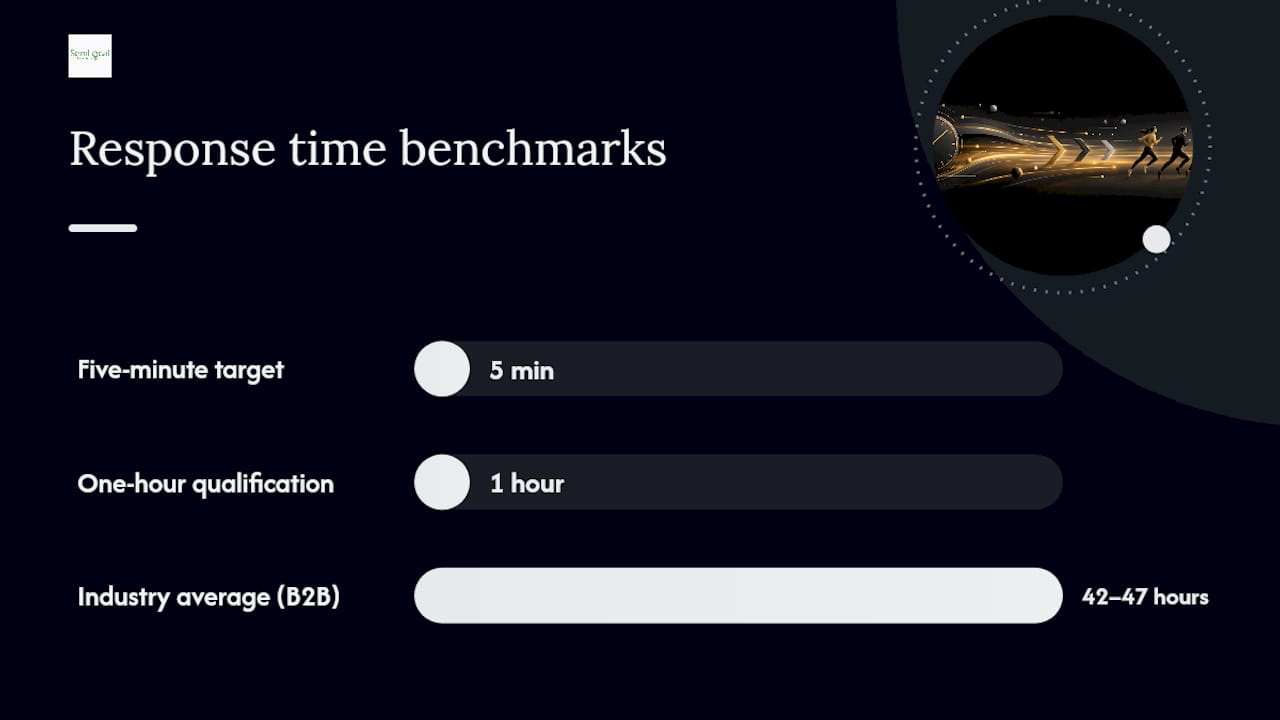
Speed to lead only means something once you know what “fast” actually looks like against real data, not gut feeling. The foundational research here comes from the Lead Response Management Study run by InsideSales.com with MIT’s Dr James Oldroyd. Their finding, cited constantly and rarely applied properly, is that firms contacting a lead within five minutes are dramatically more likely to qualify it than firms that wait 30 minutes, with some reports citing contact rates up to 100 times higher.
Harvard Business Review reached a compatible conclusion through separate analysis. Its coverage of online sales leads found that firms making contact within an hour saw markedly higher qualification rates than those that waited longer, and that the advantage decayed quickly with every additional minute of delay. Two studies, two methodologies, one consistent message: speed wins, and it wins early.
Here’s the uncomfortable part. Despite this evidence circulating for over a decade, most companies still respond slowly. Industry benchmarking from the RevOps Report places average B2B response times at somewhere between 42 and 47 hours, against a five-minute target for the leads that matter most.
Not every lead deserves the same urgency, and treating a brochure download with the same panic as a demo request wastes resources you should be spending on the leads actually ready to buy. Demo requests and pricing enquiries sit at the sharp end because the prospect has already decided they want to talk to someone. Content downloads sit further back, because the intent signal is weaker and the buyer is still browsing.
The gap between the 5-minute target and the 42 to 47-hour industry average is not a rounding error. It represents thousands of leads a year, for any business with meaningful inbound volume, going stone cold before anyone picks up the phone.
Why speed to lead matters more than most sales teams think
The mechanism behind speed to lead is simple: attention decays, and it decays fast. A prospect who fills in a form is, for a short window, actively thinking about your business. That window closes the moment they move on to the next tab, the next email, or the next competitor’s site, and once it closes, re-engaging them takes far more effort than a quick reply would have.
This is why the first responder tends to win the deal, not because they were necessarily the best fit, but because they were the business still in the prospect’s mind when the decision got made. Waiting a day to respond doesn’t just delay a sale, it often hands that sale to whoever replied first.
The pipeline math makes the case on its own:
- If a 5-minute response converts leads to qualified opportunities at several times the rate of a 30-minute response, doubling your speed can outperform doubling your ad spend.
- A business generating 200 leads a month that lifts contact rates through faster response doesn’t need more traffic to hit the same revenue target, it needs less delay.
- Every hour a lead sits unanswered is an hour a competitor has to reach that same prospect first.
The paid-media problem: leads from Google Ads or Local Services Ads are often the most expensive and the most time-sensitive of all. A prospect who has just paid to click a sponsored result and filled in a form is actively comparing options right now. Respond in six hours and you’ve burned real advertising spend on a lead who booked with whoever answered the phone.
Paid channels amplify the cost of slow response because you’ve already spent money to generate the enquiry. A slow follow-up on an organic lead wastes an opportunity. A slow follow-up on a paid lead wastes an opportunity you paid for twice, once for the click and again for the wasted sales effort chasing a prospect who’s already gone elsewhere.
How to measure speed to lead correctly
Most companies measuring speed to lead get the starting point wrong, and that single error can make performance look far better than it is. The clock should start the moment the prospect acts, when the form is submitted, the chat message is sent, or the call comes in, not when your CRM logs the record. CRM sync delays, manual data entry, and batch imports can add minutes or hours that have nothing to do with how fast your team actually responded.
A repeatable audit, step by step:
- Pull raw timestamps from the source system, not the CRM. Your form tool, chat widget, or phone system logs the true moment of contact; treat that as time zero.
- Match each lead to its first genuinely human response, excluding automated acknowledgements that don’t answer the enquiry.
- Calculate the gap in minutes for every lead, then find the median, not the average. A handful of leads that sat for three days will distort a mean badly, while the median shows what a typical prospect actually experiences.
- Segment the results by lead type (demo, pricing, general enquiry), by source (paid, organic, referral), and by rep. This is where coaching opportunities and process gaps show up.
- Run the audit over a rolling 90-day window to smooth out seasonal spikes and one-off staffing gaps, then repeat it monthly once you have a baseline.
The RevOps Report’s guidance on this is consistent: extract timestamps directly from the lead capture system and report medians by type, rep and hour of day, because averages routinely flatter teams that are actually underperforming on their fastest-growing lead segment.
Pro Tip: Run the numbers before you fix anything. Teams that skip the audit and jump straight to buying automation tools often solve the wrong problem, because they never actually measured how bad their median response time was in the first place. Some overestimate their own speed by three to five times once real timestamps are checked against what staff believed was happening.
Once you have a genuine median, segmented by source and lead type, you have a diagnostic tool rather than a vanity number. That’s the difference between “we think we’re pretty responsive” and knowing precisely which rep, which channel, or which hour of the day is losing you leads.
A quick-win playbook for cutting lead response time
Fixing speed to lead does not require a system overhaul on day one. The highest-leverage changes are often the cheapest to implement, and they should come before anything structural.
Immediate actions (implement this week):
- Send an automated acknowledgement that carries real value, not a generic “we’ll be in touch.” Confirm what happens next, give a realistic timeframe, and where possible, answer the most obvious follow-up question straight away.
- Embed a calendar scheduler directly on your contact and pricing forms. For a genuinely high-intent lead, this can reduce effective response time to zero: the prospect books a slot themselves the moment they submit the form, without waiting on anyone.
- Turn on live chat or a competent AI responder for your highest-traffic pages, particularly pricing and demo request pages, where prospects expect an answer in seconds, not hours.
Operational actions (implement this month):
- Set up round-robin or skills-based routing so a lead never sits in a shared inbox waiting for someone to notice it.
- Build escalation rules: if a lead goes unanswered for 10 minutes, it reassigns automatically to the next available rep or a manager.
- Push mobile and instant-messaging alerts (Slack, WhatsApp, SMS) rather than relying on email, which reps check on their own schedule rather than in real time.
- Plan rep capacity around lead volume peaks, not average daily volume, since most inbound traffic clusters around specific hours and days.
Behavioural and process actions:
- Give every rep a short first-touch script so the first response is fast and useful, not a rushed message that damages the impression you’re making.
- Define what counts as a “meaningful response” so a one-line “thanks, got your message” doesn’t get logged as a completed contact.
- Set follow-up persistence rules: how many attempts, over what window, before a lead moves to a nurture sequence instead of active pursuit.
Practitioner resources consistently rank these interventions in roughly this order of impact, with routing, escalation and scheduling widgets doing most of the heavy lifting before any AI tooling gets involved.
Pro Tip: Test the scheduler trick on your single highest-value form first. A demo request page with a booking widget attached often shows the fastest visible improvement in qualified meetings booked, because you’ve removed the entire manual step between interest and a confirmed appointment.
For leads that aren’t ready to book immediately, the same urgency doesn’t apply in quite the same way, but they still need a plan. A structured nurture sequence keeps mid and low-intent prospects warm without demanding the five-minute response reserved for the leads actively comparing vendors right now.
Which systems and tools actually reduce lead response time
The tools that fix speed to lead fall into a handful of functional categories, and understanding what each one actually does matters more than any specific product name.
Auto-routing systems assign a lead to the right person or team the instant it arrives, based on rules like territory, product interest, or lead score, removing the manual triage step that adds minutes or hours in busier teams.
Scheduling widgets let a prospect book time directly, converting a lead into a confirmed meeting without a single back-and-forth email. For high-intent enquiries, this is often the single biggest speed improvement available, because it sidesteps the human bottleneck entirely.
AI autoresponders handle the first reply on your behalf, confirming receipt, asking a qualifying question, or even scheduling a call, and can operate around the clock rather than only during office hours. The line between “acknowledgement” and “qualification” matters here: a simple acknowledgement buys you time, while a properly configured AI agent can actually move the lead forward while a human gets free to take the call.
Chatbots and web chat need either genuine staffing or a competent AI handoff behind them. An unanswered chat window does more damage than no chat at all, because it signals disorganisation to a prospect who expected an instant reply and got silence instead.
Notification bridges push alerts into Slack, SMS, or WhatsApp rather than email, closing the gap between “a lead arrived” and “a human rep noticed.”
A few integration points are worth checking before you commit to any of these:
- CRM sync timing: confirm whether your CRM logs the lead at the moment of form submission or after a batch sync, since a delayed sync will quietly corrupt your speed-to-lead measurement.
- GDPR and consent handling: any automated first response, especially one involving AI, needs to respect consent preferences captured at the point of submission.
- Measurement blind spots: if a tool doesn’t expose raw timestamps in a format you can audit, you’ll lose the ability to verify whether it’s actually improving anything.
Whether to invest in AI-assisted qualification or simple automated acknowledgements comes down to volume and complexity. A business fielding a handful of high-value enquiries a week can often manage with fast human response and a good scheduler. A business fielding hundreds of leads across multiple channels usually needs an AI layer that can triage and respond at a scale humans can’t match around the clock.
Measurement, KPIs and reporting for speed to lead
Improvements to lead response time don’t stick without a reporting rhythm that catches drift before it becomes the new normal.
Primary KPIs to track:
- Median speed to lead, overall and segmented by intent tier
- Percentage of high-intent leads contacted within the 5-minute SLA
- Percentage of mid-intent leads contacted within the 1-hour SLA
- Response time by lead source (paid, organic, referral, direct)
- Response time by individual rep, to spot coaching gaps early
Sample SLA targets, aligned with the benchmarks covered earlier:
Reporting needs a cadence, not just a dashboard nobody checks. Daily alerts should flag any high-intent lead that breaches its SLA in real time, so a manager can intervene while the lead is still warm rather than discovering the miss a week later in a spreadsheet. Weekly reviews should look at rep-level medians and source-level trends. Monthly reviews should track whether the changes you’ve made are actually shifting the median, not just producing the odd fast response that skews the average.
Ownership matters as much as the metric itself. A sales operations lead or manager should own the dashboard and the SLA definitions, while individual reps own their own response times and escalation compliance. When SLAs are missed repeatedly by the same rep or on the same channel, that’s a coaching conversation or a routing fix, not a reason to loosen the target. The Lead Response Management Study makes the same point: dashboards that segment by intent, source and rep are what turn this metric from a vanity number into something that actually improves performance.
Common pitfalls that stall speed-to-lead improvements
Most speed-to-lead initiatives fail for a small set of predictable reasons, and nearly all of them are fixable once you know what to look for.
Measurement blind spots top the list. If your “speed to lead” number is actually measuring CRM creation time rather than the prospect’s original action, you’re tracking the wrong clock entirely, and every improvement you make will look smaller than it is.
Notification overload is the opposite failure. Reps drowning in alerts from five different systems start ignoring all of them, including the ones that matter. The fix is consolidation: one channel, clearly prioritised by lead urgency, not five competing pings.
Poor routing sends leads to whoever’s turn it is rather than whoever’s actually available, so a lead sits waiting for a rep who’s on annual leave or in back-to-back meetings.
Insufficient coverage shows up as a dead zone outside office hours, on weekends, or across time zones, where leads arrive and simply wait until someone logs back on. A staged response approach that pairs automation with human follow-up, rather than relying on either one alone, tends to close this gap fastest.
Fixes worth prioritising:
- Re-audit your timestamp source before trusting any speed-to-lead figure
- Cut notification channels down to one primary alert path per team
- Move from calendar-based routing to availability-based routing
- Add after-hours coverage through a scheduler or AI responder rather than leaving the gap unfilled
Pro Tip: If response time is genuinely fast but conversions still lag, the problem probably isn’t speed at all. Check lead qualification and message relevance first, because a five-minute response to the wrong offer, or a poorly qualified lead, will still convert badly no matter how quickly you replied.
How faster lead response builds a predictable pipeline
Semlocal’s work with a managed IT services client shows what this looks like applied in practice rather than in theory. The client’s inbound leads, largely generated through Google Business Profile visibility and local search, were arriving faster than the sales process could act on them, creating exactly the kind of gap this article describes: strong lead volume undermined by slow, inconsistent follow-up. Restructuring the qualification workflow and tightening response handling produced a measurably more predictable pipeline, turning inbound interest into booked work rather than leads that quietly went cold.
The interventions weren’t exotic. They followed the same order of operations covered throughout this article: audit the actual response times first, fix routing and notification gaps second, then layer in qualification structure so reps spend their fastest response on the leads worth the effort.
A short implementation checklist, tying the tactics above to outcomes:
- Audit current median speed to lead using raw form or call timestamps, not CRM entries
- Fix the highest-friction routing or notification gap first, before buying new tools
- Apply a structured qualification process so fast responses are also relevant ones
- Track median response time and SLA adherence monthly, segmented by source and rep
For businesses generating leads through Google Business Profile, Local Services Ads, or paid search, the same principle holds regardless of industry: visibility that generates leads is wasted if the follow-up process can’t keep pace with how fast those leads arrive.
What actually gets neglected in speed-to-lead advice
Most advice on speed to lead treats it as a technology problem: buy the router, add the chatbot, install the scheduler, done. That undersells what’s actually happening, which is a people and process problem wearing a technology disguise.
If you’re starting from close to zero, two priorities matter more than the rest combined. First, measure properly, using form-level timestamps rather than CRM creation time, because you cannot fix what you’re measuring wrong. Second, automate the routing and alerting layer before you touch anything else, because a fast human response routed to the wrong person, or delayed by a notification nobody saw, achieves nothing.
Here’s what the conventional wisdom underplays: automation without a human safety net creates its own failure mode. An AI acknowledgement that never gets followed by a real conversation is barely better than silence, and prospects notice the difference between a genuine response and a template done within seconds. The businesses getting this right treat automation as the first ten minutes of the relationship, not the whole relationship. Speed gets the door open. What happens after still depends on a person who knows what they’re doing.
— Geoff
Turning fast response into booked business with Semlocal
A good operational layer for speed-to-lead includes monitoring Google Business Profile, Local Services Ads, and local search visibility so the leads arriving are worth responding to fast in the first place. Rather than leaving you to stitch together routing rules, notification tools and a chatbot on your own, some services manage local presence end to end and route what comes in through a dedicated leads portal, so you can see exactly where enquiries are coming from and how quickly they’re being handled.
If your Google Business Profile is already generating enquiries but your team can’t keep pace with them, that’s a process gap worth fixing before spending another pound on ads. Semlocal’s Google Business Profile management service is built around real enquiries rather than ranking positions for their own sake, and pairs naturally with Local Services Ads management for businesses that want paid and organic leads handled under one roof. Get in touch to talk through what a faster, better-tracked lead response process would look like for your business, starting with a look at your current local visibility page.
Sources
- Lead Response Management Study (InsideSales.com / MIT / Dr James Oldroyd)
- The short life of online sales leads — Harvard Business Review
- Speed to Lead Benchmarks and Optimization | RevOps Report
- Lead Response Time Statistics (2026): The 5-Minute Rule