NAP consistency means your business name, address, and phone number are identical everywhere they appear online. That single principle, confirmed by Moz’s local SEO guidance, is the foundation of local search visibility. The immediate action: choose a canonical NAP, write it down as your single source of truth, and update your website and Google Business Profile first. Everything else follows from those two properties.
Your canonical NAP should include:
- Your legal trading name (exactly as registered, including Ltd, LLP, or trading-as suffix)
- Your full postal address (street number, street name, town, county if used, postcode)
- Your primary phone number in a consistent format (e.g. 020 7946 0000)
Once those two sources agree, you have a reliable reference point for every directory, aggregator, and social profile you update next.
Key takeaways
NAP consistency is the foundation of local SEO: your business name, address, and phone number must match across your website, Google Business Profile, and every directory that references your business.
| Point | Details |
|---|---|
| Set a canonical NAP first | Write your exact name, address, and phone in one document and use it as the reference for every listing. |
| Website and GBP are the source of truth | Fix your footer, contact page, and LocalBusiness schema before touching any external directory. |
| Accuracy beats perfect formatting | Identical digits and street details matter; abbreviations like “Ave” vs “Avenue” are usually normalised by search engines. |
| Audit every 3–6 months | Citation data degrades after moves, rebrands, and aggregator pushes — regular scans catch drift early. |
| Semlocal manages the full process | From GBP management to aggregator submissions, Semlocal handles citation cleanup for UK service businesses end to end. |
Table of Contents
- What does NAP stand for, and why do the details matter?
- Where does your NAP appear online?
- Why does NAP consistency affect your local rankings?
- How strict does your NAP need to be?
- Common NAP problems and how they appear
- How to audit your NAP consistency step by step
- How to fix inconsistent NAP entries
- Does call tracking break NAP consistency?
- How long does a NAP cleanup take, and what does it cost?
- Your priority checklist for this week
- Semlocal’s field-tested tips from UK client work
- An editorial perspective on NAP consistency
- How Semlocal helps you get this right
- Sources
What does NAP stand for, and why do the details matter?
NAP stands for Name, Address, Phone. Each element carries its own rules about what counts as a damaging mismatch versus an acceptable formatting difference.
Name includes your legal trading name and any suffix. “Smith Plumbing Ltd” and “Smith Plumbing Limited” are a formatting difference. “Smith Plumbing” (no suffix) versus “Smith Plumbing Services Ltd” is an accuracy problem.
Address must include the building number or name, street, town, and postcode. Suite or unit numbers matter too: if your premises is Unit 4, 12 High Street, omitting “Unit 4” on some listings creates a genuine mismatch.
Phone must carry the same digits throughout. The format can vary slightly without harm.
Acceptable formatting differences (search engines typically normalise these):
- “Avenue” vs “Ave”
- “(020) 7946 0000” vs “020 7946 0000”
- “Road” vs “Rd”
- Comma placement in addresses
Accuracy differences that damage local signals:
- Wrong phone number or an old number left on a directory
- Wrong town or postcode
- Missing building number or unit
- Different trading name that changes the business identity
Pro Tip: Write your canonical NAP in a shared document and paste it verbatim whenever you claim or update a listing. Never retype it from memory — that is how subtle errors creep in.
Where does your NAP appear online?
Citations are any online mention of your business name, address, or phone number. They appear across a wide range of platforms, and not all carry equal weight for local SEO.
Tier 1 — highest priority:
- Your own website (footer, contact page, and LocalBusiness JSON-LD schema)
- Google Business Profile (the single most influential listing)
- Apple Maps / Business Connect
- Bing Places
- Facebook Business Page
Tier 2 — major UK directories:
- Yell.com
- Thomson Local
- Scoot
- FreeIndex
- Checkatrade (for trades)
Tier 3 — niche and supplementary:
- Industry association directories
- Supplier and partner pages
- Local news sites and press mentions
- Chamber of Commerce listings
| Tier | Examples | Update method | Priority |
|---|---|---|---|
| 1 | Website, Google Business Profile, Apple Maps, Bing Places | Manual, direct access | Immediate |
| 2 | Yell, Thomson Local, Scoot, FreeIndex | Manual or aggregator | Week 1–2 |
| 3 | Industry directories, partner pages, press | Manual outreach | Ongoing |
Focus Tier 1 first. A consistent Tier 1 presence gives search engines a reliable signal before you tackle the longer tail of Tier 2 and 3 citations.
Why does NAP consistency affect your local rankings?
Citation consistency is a recurring factor in local ranking surveys, and the reason is straightforward: search engines cross-reference your business data across dozens of sources to confirm you are a legitimate, accurately located business. When those sources disagree, the confidence signal weakens, and your map pack placement can suffer.
The impact goes beyond rankings:
- Map pack visibility: Google’s local algorithm uses citation signals alongside proximity and prominence. Conflicting data reduces the confidence score attached to your listing.
- AI and voice answers: Platforms like ChatGPT, Gemini, and voice assistants pull structured data from directories and your GBP. Inconsistent citations mean AI recommendations may surface the wrong number or address.
- Customer trust: A wrong phone number on Yell costs you a call. A wrong address on Apple Maps costs you a visit. These are real, measurable losses.
According to CallRail’s NAP consistency guidance, inconsistent citations can dilute local search visibility and create duplicate-listing problems that compound over time — making early cleanup far less costly than a later, larger remediation.
Practitioners describe NAP consistency as “table stakes” for local SEO: fix it before spending heavily on link building or content, because inconsistent base data weakens every other signal you build on top of it.
How strict does your NAP need to be?
Accuracy is non-negotiable. Formatting is flexible. That distinction, highlighted in Moz’s NAP guidance, is the most useful rule of thumb for busy business owners.
Fields that must be identical (accuracy-critical):
- Legal trading name
- Street number and street name
- Town and postcode
- Primary phone number (digits)
Fields where minor variation is usually fine:
- Abbreviations: St vs Street, Rd vs Road, Ave vs Avenue
- Punctuation: commas, full stops in suffixes
- Phone formatting: spaces, brackets, country code prefix (+44 vs 0)
- Capitalisation differences in non-proper-noun words
The practical test: if a customer or a search engine could confuse your listing with a different business or a different location, it is an accuracy problem. If the only difference is a comma or an abbreviated word, it is a formatting difference.
Pro Tip: When you are unsure whether a difference matters, ask: “Would a postman deliver to both versions?” If yes, it is likely a formatting difference. If no, fix it.
Common NAP problems and how they appear
Most NAP issues fall into a handful of recognisable patterns. Knowing them helps you spot problems quickly during an audit.
- Duplicate listings: A second GBP entry created by a former employee, a data aggregator, or an old address. Duplicates split your citation signals and confuse customers.
- Old phone numbers: A number changed two years ago still appearing on Yell, Scoot, or an industry directory. Aggregators often hold stale data for months or years.
- Tracking numbers as primary: A call-tracking number published on a directory instead of the canonical number. This creates a mismatch between your GBP and your directory listings.
- PO boxes or virtual addresses: Some directories reject PO boxes; others accept them. Using a virtual office address inconsistently across listings creates accuracy conflicts.
- Inconsistent company suffixes: “Smith Electrical Ltd” on your website, “Smith Electrical Limited” on GBP, and “Smith Electrical” on Yell — three variants that weaken the name-match signal.
- Aggregator-created listings: Data aggregators like Acxiom and Neustar Localeze push business data to hundreds of directories. If their records are outdated, they can overwrite corrections you have already made manually.
Real-world audits regularly surface listings that predate a business rebrand or relocation, sitting unclaimed on directories the owner did not know existed.
How to audit your NAP consistency step by step
Start with your own website before touching any external directory. Website-first checks are the necessary starting point because aggregators and crawlers reference your site when building their own records.
Step 1: Confirm your canonical NAP
Open your website’s footer and contact page. Note the exact name, address, and phone number displayed. Then check your LocalBusiness JSON-LD schema (right-click → View Page Source, search for “LocalBusiness”). All three should be identical.
Step 2: Check your Google Business Profile
Log in to Google Business Profile and compare every field against your canonical NAP. Pay attention to the business name, address format, and primary phone number.
Step 3: Run a tool-based scan
- Use the Visiblytics NAP Consistency Checker to supply your canonical NAP and receive a consistency score across directories.
- Use Bree Sharp’s NAP Checker to verify your homepage and contact page schema against visible text.
- Use Ujjwal Tiwari’s NAP Checker to expose schema mismatches and missing clickable
tel:links that matter for mobile users. - For a full citation audit with match/mismatch scoring across UK directories, BrightLocal’s Citation Tracker and Moz Local both provide structured reports. Yext offers a similar scan with aggregator-push options.
Step 4: Build a tracking spreadsheet
Use these columns: Source | Name (found) | Address (found) | Phone (found) | Match status | Notes | Date checked
Pro Tip: Run your audit scan, then re-run it 4–6 weeks after making fixes. Aggregator propagation takes time, and a second scan confirms whether corrections have taken hold or been overwritten.
For agencies managing multiple clients, an SEO best practices checklist can help standardise the citation audit workflow across accounts.
How to fix inconsistent NAP entries
The remediation sequence matters. Fix the source of truth first, then work outward.
- Update your website — footer, contact page, and LocalBusiness JSON-LD schema. This is the reference point crawlers use.
- Update Google Business Profile — log in, edit the name, address, and phone fields, and request verification if prompted.
- Fix Tier 1 directories — Apple Maps Business Connect, Bing Places, Facebook Business Page. Claim each listing if unclaimed, then correct the data.
- Fix Tier 2 directories — Yell, Thomson Local, Scoot. Log in or use the “suggest an edit” function where direct access is unavailable.
- Address aggregators and niche directories — for a small number of listings, manual outreach works. For multi-location businesses or profiles distributed across hundreds of directories, use an aggregator or paid sync service.
When to go manual vs. paid:
| Situation | Recommended approach |
|---|---|
| Fewer than 20 listings, single location | Manual updates, DIY |
| 20–100 listings, single location | BrightLocal or Moz Local managed listings |
| 100+ listings or multi-location | Yext aggregator push or agency-managed cleanup |
| Stubborn listings that revert | Aggregator lock-in via Yext or direct data-source correction |
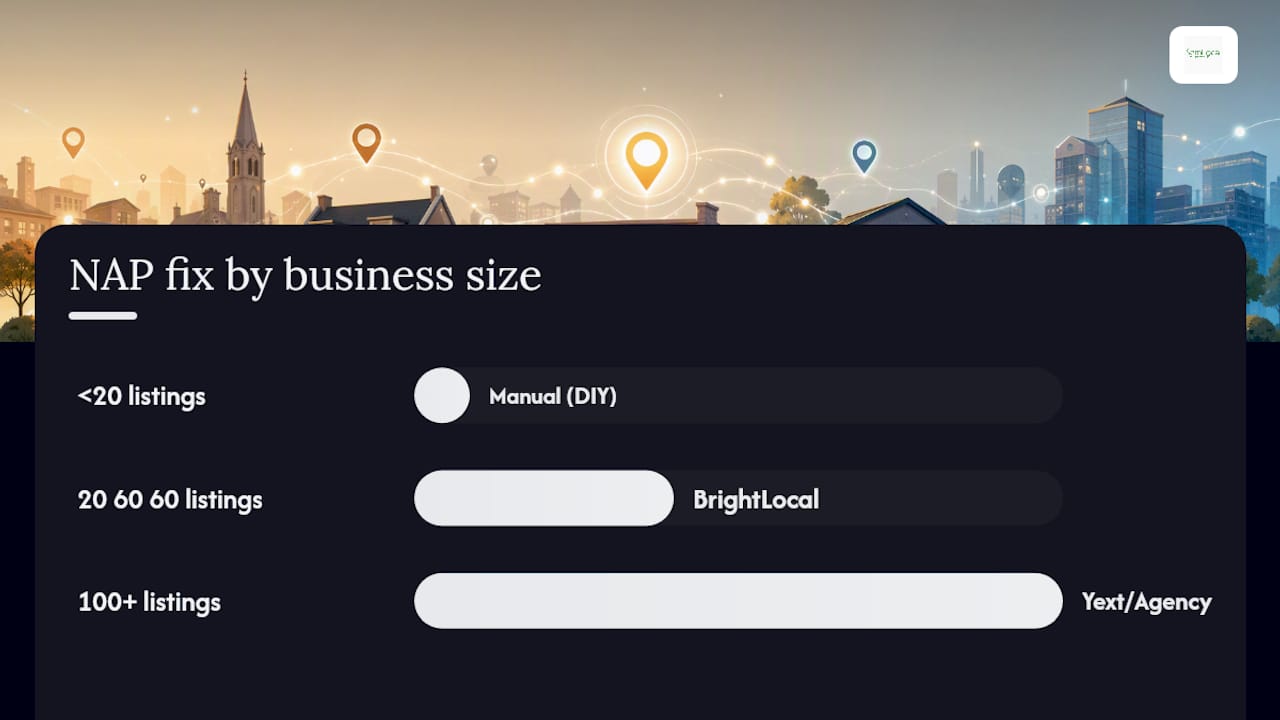
Yext, Moz Local, and BrightLocal each offer different models. Yext pushes data directly to its publisher network and locks listings against aggregator overwrites. Moz Local focuses on the major US and UK aggregators. BrightLocal provides citation building and tracking with a UK-specific directory set. Choose based on the scale of your problem and your budget for ongoing maintenance.
Does call tracking break NAP consistency?
Dynamic Number Insertion (DNI) and call tracking are a genuine concern, but the risk is manageable with the right setup. DNI replaces the phone number displayed on your website for a visitor session, using JavaScript to swap in a tracking number. Because the swap happens in the browser and not in the page’s source code or schema, search engine crawlers typically see the canonical number, not the tracking number.
Best practice for call tracking without damaging NAP:
- Keep your canonical number in the visible HTML footer and in your LocalBusiness JSON-LD schema. DNI should operate above the schema layer.
- Never publish a tracking number as the primary number on your GBP or on any directory listing.
- If you need a tracking number on a specific directory for attribution, add it as a secondary number where the platform allows, and keep the canonical number as primary.
- Audit your schema after implementing DNI using Ujjwal Tiwari’s NAP Checker to confirm the canonical number is still what crawlers see.
Do not:
- Replace your GBP primary number with a tracking number
- List a tracking number as the only number on Yell or other directories
- Use different tracking numbers on different directories without a canonical fallback
Pro Tip: If you use a platform like CallRail, set up a “swap target” that replaces only the visible on-page number for human visitors. The number in your schema and GBP stays untouched. That separation protects your NAP signals while still giving you call attribution data.
How long does a NAP cleanup take, and what does it cost?
Timelines and costs vary by the size of your citation footprint and the method you choose.
Typical timelines:
- Small single-location business, DIY: 3–10 days to update Tier 1 and Tier 2 manually; allow 2–4 weeks for aggregator propagation to reflect changes across directories.
- Larger single-location or multi-location, aggregator-assisted: 2–8 weeks from submission to widespread propagation, depending on the aggregator’s update cycle.
- Stubborn or high-volume profiles: up to 12 weeks if aggregator data sources need direct correction.
Typical cost ranges (UK market):
- DIY: time cost only. Expect 4–12 hours for a thorough single-location audit and manual fix.
- BrightLocal or Moz Local managed listings: monthly subscription fees that cover citation tracking and aggregator distribution.
- Yext: annual subscription with publisher network access; pricing varies by plan and number of locations.
- Agency-managed cleanup: typically quoted as a one-off project fee or included within a local SEO retainer.
The cost of doing nothing is harder to quantify but real: missed calls from wrong numbers, lost map pack positions, and AI platforms recommending a competitor whose data is cleaner.
Your priority checklist for this week
Run these tasks in order. The first three deliver the highest return per hour spent.
- Write down your canonical NAP (name, address, phone) in a shared document.
- Update your website footer, contact page, and LocalBusiness JSON-LD schema to match exactly.
- Log in to your Google Business Profile and verify every field against your canonical NAP.
- Check Apple Maps Business Connect and Bing Places and correct any discrepancies.
- Run a free scan using Visiblytics or Bree Sharp to get a baseline consistency score.
- Open your tracking spreadsheet and log every mismatch found.
- Fix Yell and any other Tier 2 directories where you have direct login access.
Secondary tasks (week 2 onwards):
- Audit industry-specific directories relevant to your sector (Checkatrade, NAPIT, RICS, etc.)
- Identify and merge or remove duplicate GBP listings
- Submit corrections to data aggregators if your profile is widely distributed
- Add consistent service-area notes to GBP if you serve multiple towns
Verify changes by re-running your audit tool 4–6 weeks after submission and updating your spreadsheet with the new match status.
Semlocal’s field-tested tips from UK client work
After working with UK service businesses across multiple sectors, a few patterns appear in almost every citation audit.

Use your website as the primary scraped source. Aggregators and crawlers reference your site more than any other single source. If your schema and visible text disagree, you are sending conflicting signals from the very first point of reference. Fix the site first, always.
Schedule audits every 3–6 months. Citation data degrades. Aggregators push stale records, businesses move, phone numbers change. A quarterly or biannual audit catches drift before it compounds.
Common pitfalls we see repeatedly:
- A tracking number published on Yell as the primary number, with the canonical number only in GBP
- Unit or suite numbers missing from directory listings but present on the website
- Post-rebrand listings left unclaimed with the old trading name
- Schema not updated after a website redesign, leaving the old address in JSON-LD
Pro Tip: After any aggregator push, wait four weeks and then run a fresh scan with Visiblytics or BrightLocal. Aggregators do not always win the overwrite battle — some directories pull from competing sources and revert to old data. Catching a reversion early saves weeks of compounding drift.
For a broader view of how AI-driven search is changing local visibility, an AI search audit can show you how consistently your business data appears across AI platforms alongside traditional directories.
An editorial perspective on NAP consistency
Most guides treat NAP consistency as a technical checkbox. The reality is more interesting. The businesses that benefit most from cleaning up their citations are not the ones with the worst data — they are the ones in competitive local markets where every ranking signal counts. A plumber in a city with 40 competitors does not need perfect NAP to rank; they need better NAP than the 39 others. That is a much more achievable bar.

What gets underestimated is the AI dimension. When a customer asks ChatGPT or Gemini to recommend a local electrician, those platforms pull structured data from directories and GBP. A business with clean, consistent citations across Tier 1 and Tier 2 sources is far more likely to be recommended confidently than one with conflicting data. The citation signal that used to matter primarily for Google Maps now matters for every AI-powered recommendation surface. That is a meaningful shift, and most local businesses have not caught up with it yet.
The other thing practitioners underestimate is how quickly citation data degrades after a move or rebrand. Aggregators hold onto old records for a long time. A business that moved premises 18 months ago and did a manual GBP update but nothing else is almost certainly still sending wrong address data to a significant portion of its citation footprint. The fix is not complicated. It just requires a systematic approach rather than a one-off correction.
How Semlocal helps you get this right
NAP consistency is the kind of task that looks simple until you are three hours into a spreadsheet and still finding mismatches on directories you did not know existed. Semlocal handles the full process for UK service businesses: Google Business Profile management, citation audits, aggregator submissions, and call-tracking setup that keeps your canonical number intact.
We audit your existing citation footprint, identify every mismatch, and fix listings across Tier 1 and Tier 2 directories. For businesses with a larger distribution, we manage aggregator pushes and monitor for data reversion. Every engagement is built around measurable outcomes: cleaner data, stronger map pack placement, and more calls from customers who can actually reach you. To get a clear picture of where your NAP stands right now, request a local SEO audit and we will show you exactly what needs fixing.
Sources
The references and tools below are the most reliable starting points for UK-based citation work.
Key references:
- Google Business Profile
- NAP Checker — Free Local SEO NAP Consistency Tool | Bree Sharp
- Local search ranking factors – Moz
Audit tools:
For agencies managing multiple clients, the top SEO tools for agencies guide covers how to integrate citation tracking into a broader local SEO workflow.