Fix your master data first, then publish one authoritative location page per real storefront. Everything else, from Google Business Profile visibility to AI recommendations, follows from those two moves. Multi location SEO fails most often not because businesses skip tactics, but because they scale sloppy foundations across dozens of branches at once.
Before you touch content or citations, prioritise these three things:
- Clean and centralise your master location data. One wrong phone number replicated across 40 branches multiplies your problem 40 times over.
- Publish one high-quality location page per real storefront. Templated, swap-the-name pages compete against each other instead of ranking.
- Claim and verify every Google Business Profile properly. This is where most local enquiries actually convert, so it deserves first-line attention.
Pro Tip: Audit your ten worst-performing locations before you touch your best ones. Fixing weak branches usually reveals the systemic data or governance problem dragging down the whole estate.
Get this right and you’ll see fewer self-competing pages, cleaner map pack visibility, and a better chance of being the business AI platforms recommend when someone asks for help nearby.
Key Takeaways
Multi location SEO succeeds when clean master data, one authoritative page per storefront, and consistent Google Business Profile management work together as a governed system.
| Point | Details |
|---|---|
| Fix data before scaling | Centralise NAP in one master repository before publishing new location pages or citations. |
| One page per real storefront | Use the hub-and-spoke model; regional hubs for overlapping demand, dedicated pages only for staffed branches. |
| Schema proves the entity is real | Add LocalBusiness schema with geo-coordinates and a sameAs link to each verified GBP. |
| Track by location, not in aggregate | Use unique UTMs and call tracking numbers per branch to attribute enquiries correctly. |
| Consistency beats volume | AI and search platforms reward accurate, well-governed location ecosystems over sheer page count. |
Table of Contents
- Why multi location SEO works differently from single-site SEO
- What are the core components of a multi-location SEO programme?
- How do you build high-performing location pages at scale?
- How do you optimise Google Business Profiles across multiple locations?
- Which structured data signals prove a location is real?
- How do you keep NAP consistent across hundreds of citations?
- How do you manage reviews across dozens of locations?
- Where do local backlinks and partnerships come from?
- Should service-area businesses build pages or use GBP settings?
- How should teams govern a growing location ecosystem?
- How do you measure performance by location?
- What mistakes most often sink multi-location SEO?
- Which tools actually help run this at scale?
- What’s the priority roadmap for the next 12 months?
- Why does clarity and authority matter more than page count?
- How Semlocal approaches multi-location SEO
- Frequently asked questions
- Sources
Why multi location SEO works differently from single-site SEO
Single-location SEO optimises one page for one entity. Multi location SEO manages dozens or hundreds of entities that must each rank independently while reinforcing the same brand. Google’s local algorithm still weighs relevance, distance and prominence, but at scale those factors interact with consistency across your entire footprint, not just one page’s optimisation.
- Relevance now depends on whether each location page reflects genuinely local services, not a copy-pasted template.
- Distance matters per searcher, so every branch needs its own accurate geo-signals rather than one central address doing the work.
- Prominence compounds: inconsistent NAP data or thin pages at 20 locations damage trust signals for the other 80.
There’s a newer axis too. AI platforms like ChatGPT and Gemini pull from accurate business data, review quality and consistent citations when deciding which business to recommend, so the governance discipline multi-location brands need now extends well beyond traditional rankings.
What are the core components of a multi-location SEO programme?
A working programme rests on a handful of interlocking pieces, not a long list of disconnected tactics. Miss one and the others underperform.
- Master data repository holding the single source of truth for every branch’s name, address, phone number and hours.
- Location pages, one per real storefront, built from a consistent but locally unique template.
- Google Business Profiles, verified and fully optimised for every branch.
- LocalBusiness schema on every page, matching what’s published on Google.
- Citations and aggregator listings, kept consistent across the platforms that matter.
- Review generation and response workflows per location.
- Local backlinks and community partnerships that build geographic authority.
- Tracking and attribution so you know which branch drives which enquiry.
- Governance, defining who owns what and how changes get approved.
Spend your first hour ticking off: does every location have a verified GBP, a live location page, and matching NAP data across your top three citation sources? If any answer is no, that’s your starting point. Fix data and page quality before you scale content volume. Widening the top of a leaky funnel wastes budget.
How do you build high-performing location pages at scale?
A modular template solves the tension between consistency and uniqueness. Structure each page with a hero section stating the branch name and core service, followed by local proof (reviews, a photo of the actual team or storefront), a services list, a short team introduction, location-specific FAQs, a map and directions, and a clear contact or booking call to action.

Hub-and-spoke governance keeps this from sprawling. Build a regional hub page when several branches share overlapping search demand but individually lack the volume to justify a standalone page. Build a dedicated location page only where the branch is a genuinely staffed facility with its own address, phone number and distinguishable services, a rule practitioners increasingly treat as the line between authoritative pages and doorway pages.
A doorway page swaps in a town name and little else. An authoritative page names actual staff, cites a specific local project, and answers questions unique to that branch’s customer base, like parking or accessibility. You don’t need to write every page from scratch: a shared template with dynamically populated local variables, staff bios, review pull-throughs, hyperlocal FAQ blocks, keeps pages consistent in structure while genuinely distinct in content.
Pro Tip: Add one hyperlocal detail per page that couldn’t apply to any other branch, a nearby landmark, a specific parking note, a named team member. That single detail often separates a page that ranks from one that doesn’t.
How do you optimise Google Business Profiles across multiple locations?
Google Business Profile remains the single highest-leverage asset in your multi-location toolkit, largely because it’s where searchers convert. Get the setup right before anything else:
- Claim every location, using bulk verification for portfolios of ten or more branches to avoid a manual bottleneck.
- Verify each listing against your master data, not against whatever was entered years ago by a previous manager.
- Align every field, name, address, phone, opening hours and category, with what’s published on your location pages and structured data.
- Add UTM-tagged links in the website field so you can attribute calls and clicks back to the specific branch in your dashboard.
Beyond setup, cadence matters more than most managers expect:
- Upload fresh photos monthly: exterior, interior, team, and completed work where relevant.
- Post updates weekly at minimum, even short ones, since inactive profiles lose visibility over time.
- Respond to every review within 48 hours, positive or negative.
A guide to the setup mechanics is worth bookmarking if your team is new to Google Business Profile verification.
Which structured data signals prove a location is real?
LocalBusiness schema tells search engines and AI systems that a location genuinely exists, rather than being a marketing page dressed up as one. Every location page needs its own schema block including business name, full address, phone number, geo-coordinates, opening hours and a sameAs property linking to the verified Google Business Profile or Wikidata entry.
The sameAs link matters more than it looks. It ties your page directly into the knowledge graph, reinforcing that the entity on your website and the entity Google already knows about are one and the same.
Keep schema per-page and unique, never a copy-pasted block with the town name swapped. Contradictions between your schema and your GBP listing, a different phone number or category, confuse both search engines and AI tools. Finally, confirm every location page sits in your XML sitemap with a self-referencing canonical tag, so nothing gets orphaned or accidentally deduplicated against another branch.
How do you keep NAP consistent across hundreds of citations?
Centralise name, address, phone number, hours, category and website URL in one master spreadsheet or data platform, then push updates outward rather than editing citations individually. That single source of truth prevents the drift that happens when ten people manage forty locations by hand.
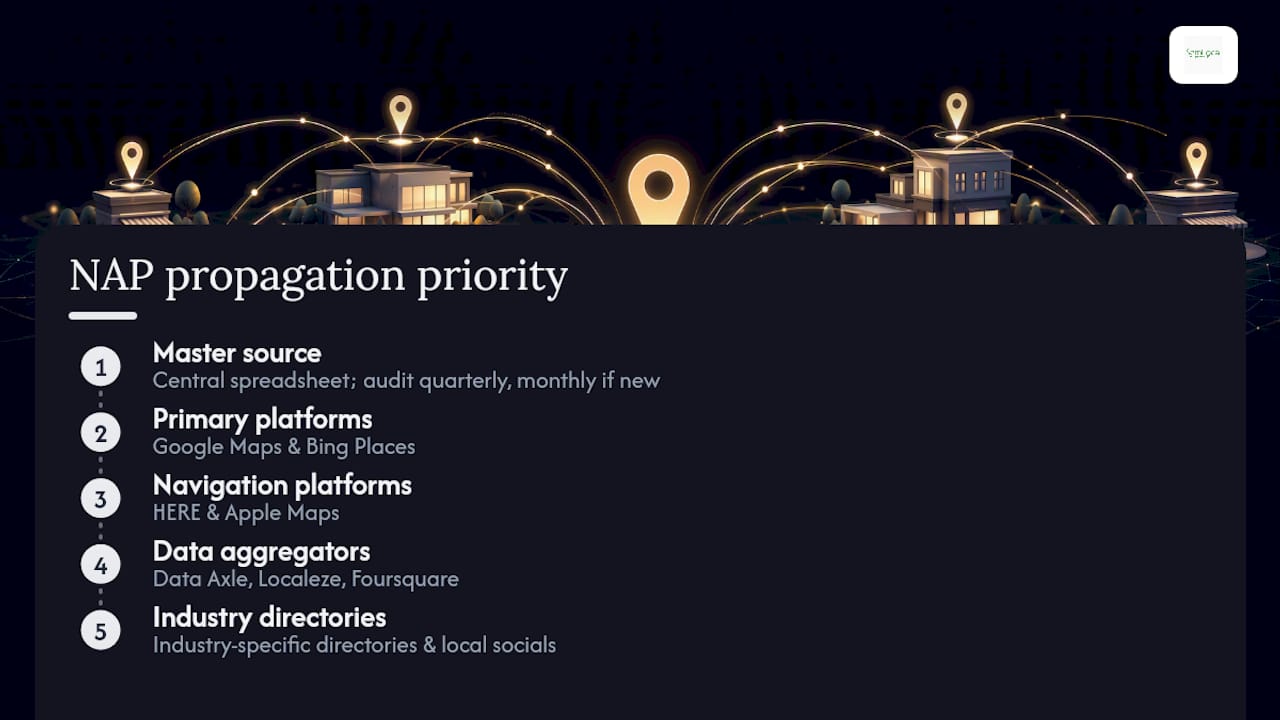
Prioritise your update effort by platform value. Google Maps and Bing Places come first, followed by navigation platforms like HERE and Apple Maps, then data aggregators such as Data Axle, Localeze and Foursquare, and finally industry-specific directories and local social platforms relevant to your sector.
Audit citations quarterly at minimum, monthly if you’re actively opening new locations. When discrepancies appear, correct the master data first, then propagate the fix outward rather than patching each directory individually.
How do you manage reviews across dozens of locations?
Volume, freshness and sentiment all feed into how AI platforms and Google decide which branch to recommend, so review generation deserves a proper workflow rather than ad hoc requests.
A simple post-visit text or email works well: “Thanks for visiting [Branch Name]. Could you share a quick Google review? It takes two minutes and genuinely helps our local team.” For responses, keep a two-track template: thank positive reviewers by name and mention something specific they raised; for negative reviews, acknowledge the issue without excuses, state what you’re doing about it, and invite them to continue the conversation offline.
- Assign review monitoring to a named person per region, not “whoever has time.”
- Reply to every review within 48 hours.
- Track review velocity per branch monthly, a sudden drop often signals a service issue before it shows up anywhere else.
Pro Tip: A branch with 40 recent reviews at 4.6 stars will often outperform one with 200 reviews that stopped growing two years ago. Recency and pace matter as much as total volume.
Where do local backlinks and partnerships come from?
Local backlinks build the geographic authority that generic content links can’t replicate. Sponsor a youth sports team near your busiest branch, pitch a local news outlet on a story about your team’s community work, join your local chamber of commerce, and get listed in trade-specific directories relevant to your industry.
Story-led opportunities work best: a branch hitting a milestone, a staff member’s local achievement, or a seasonal community event tied to that specific location. Prioritise outreach by branch value, focus link-building effort on locations with the highest revenue potential or the weakest existing local signals, rather than spreading effort evenly across every site.
Should service-area businesses build pages or use GBP settings?
Not every branch deserves a dedicated page, and not every business needs a physical storefront listed publicly. Run this checklist before building anything:
- Does the branch have real vans, staff, or a defined service territory?
- Is there measurable local search volume for that specific area?
- Does that territory have genuinely unique customer needs (postcode-specific regulations, distinct competitor landscape)?
If yes to all three, build an organic landing page. If the answer is largely no, use Google Business Profile’s service-area setting and hide the physical address, appropriate for mobile-only operators without a public-facing storefront. A common misconception is that hiding your address damages visibility. It doesn’t. Google treats correctly configured service-area businesses fairly in local results, provided the service radius is accurate and consistent with your GBP category.
How should teams govern a growing location ecosystem?
As your footprint grows past a handful of branches, informal management breaks down fast. Define roles clearly: corporate marketing owns the master data and templates, regional managers approve local content variations, individual location managers submit updates (new staff, seasonal hours) through a controlled process, and your agency partner, if you use one, executes technical changes.
Your master data repository needs a clear update cadence, weekly for GBP posts and reviews, monthly for broader content refreshes, and a defined owner for each field so nobody overwrites another team’s edit.
Set explicit criteria for when a new location page gets created (a real staffed facility, distinct address, measurable local demand) and when a page gets decommissioned (branch closure, consolidation into a regional hub). Without these rules, pages start competing with each other instead of the competition.
Pro Tip: Name pages and URLs consistently from day one, /locations/city-name rather than a mix of formats. Retrofitting naming conventions across 200 pages later is a miserable, avoidable project.
How do you measure performance by location?
Attribution is where most multi-location programmes lose the plot, mixing branch performance into one aggregate number tells you nothing useful. Build a consistent UTM naming convention across every channel: utm_source=gbp&utm_medium=organic&utm_campaign=location-manchester, repeated identically for every branch so your reports actually compare like with like.
Your dashboard should track, per location: website visits, calls, form conversions, GBP actions (calls, direction requests, website clicks) and, where possible, revenue. Looker Studio handles this well, pulling GBP insights, Google Analytics and call tracking data into one view per branch.
- Assign a unique tracked phone number to every location and connect it to your CRM.
- Tag every ad and GBP link with location-specific UTMs.
- Review the dashboard monthly, flagging any branch whose enquiry volume drops without an obvious cause.
Skipping unique numbers per branch is the fastest way to misattribute enquiries and make decisions on bad data.
What mistakes most often sink multi-location SEO?
- Doorway pages. Detect by checking if two location pages are more than 70% identical text; prevent with the hyperlocal content blocks described earlier.
- Inconsistent NAP. Detect through a quarterly citation audit; prevent with the master data repository approach.
- Duplicated on-page content. Detect via a site-wide content similarity check; prevent by enforcing unique local proof on every page.
- Lost governance. Detect when nobody can say who approved a recent page edit; prevent with the roles template above.
- Ignoring backlinks and reviews. Detect via flat or declining review velocity; prevent with the monitoring cadence covered earlier.
Which tools actually help run this at scale?
You don’t need every tool on this list, but each solves a specific bottleneck once you’re managing more than a handful of locations.
- Semrush Local and BrightLocal handle listings management and citation tracking across your full footprint from one dashboard.
- Whitespark and GeoRanker specialise in finding citation overlaps and directory gaps, particularly useful once you’re past ten locations and manual checking becomes unworkable.
- CallRail provides the unique tracking numbers and call recording that make location-level attribution possible.
- Looker Studio pulls GBP, Analytics and call data into a single reporting view per branch.
- Schema.org’s own documentation and validator tools confirm your LocalBusiness markup is correctly structured before it goes live.
Manual management works fine below five or six locations. Past that, the time cost of manual citation checks and reporting usually exceeds what these platforms cost.
What’s the priority roadmap for the next 12 months?
- 0 to 90 days: clean master data, publish location pages for your top-priority branches, verify every GBP, and get basic UTMs and call tracking live.
- 90 to 180 days: expand remaining location pages, launch a structured review acquisition programme, begin local backlink outreach, and roll out schema across the full estate.
- 6 to 12 months: automate governance workflows, formalise reporting cadences, run optimisation loops on underperforming branches, and set clear criteria for expanding into new locations.
Track visits, calls, form conversions and GBP actions at every phase, watching for the point where a branch’s numbers plateau, that’s your signal to revisit its page or review strategy rather than assume the work is done.
Why does clarity and authority matter more than page count?
Search engines and AI platforms both build trust from the same triangle: your business data (GBP, citations), your website content, and third-party corroboration (reviews, press, directories). When those three agree, AI recommendation engines are far more confident recommending your specific branch over a competitor’s.
High performers in this space share one trait: they treat clarity and authority as the metric, not the total number of geographic URLs live on the site. A brand with 40 tightly governed, accurate location pages consistently outperforms one with 150 thin, inconsistent ones.
- Prioritise fixing data accuracy across existing pages before adding new ones.
- Treat every new location page as a commitment to ongoing maintenance, not a one-off publish.
- Consolidate or redirect underperforming pages rather than leaving them live and stale.
Pro Tip: If you’re choosing between publishing five new location pages or fixing schema and NAP errors on your existing fifty, fix the fifty first. AI systems reward consistency over volume.
How Semlocal approaches multi-location SEO
Semlocal manages the full stack for multi-location brands, verified GBPs, location pages, structured data and AI optimisation, as one governed system rather than disconnected tasks handed to different freelancers. Clients get a clear reporting cadence and a single point of accountability, with every recommendation tied to enquiries and bookings rather than vanity ranking positions. If your locations are already live but underperforming, Google Business Profile optimisation is usually the fastest place to see measurable movement, often within the first reporting cycle.
Frequently asked questions
What is multi location SEO?
Multi location SEO is the practice of optimising search visibility for a business with several physical branches, managing location pages, Google Business Profiles, citations and reviews for each site rather than a single storefront.
How many location pages should a multi-location business have?
Only as many as there are genuinely staffed, addressable branches. Use regional hub pages for areas without a dedicated storefront rather than inventing thin pages to chase search volume.
Does multi-site SEO require different schema than single-location SEO?
Yes. Each location page needs its own LocalBusiness schema block with unique address, geo-coordinates and opening hours, plus a sameAs link to that branch’s verified GBP.
How often should NAP citations be audited across locations?
Quarterly at minimum, and monthly if you’re actively opening new branches or have recently rebranded.
Can service-area businesses skip building location pages?
Yes, if there’s no staffed facility and no distinct local search demand, Google Business Profile’s service-area setting with a hidden address is usually the better choice than a thin organic page.
Sources
- Multi-Location SEO: How To Win Google & AI Search Visibility At Scale
- Multi-Location SEO: How to structure geographic pages at scale
- Multi-location local SEO: A guide to entities, schema and discoverability