Local citations still matter. They remain foundational hygiene for UK local search visibility, and skipping them leaves gaps in how Google, Bing and AI platforms verify your business. Standardise your name, address and phone number (NAP) first, then claim Google Business Profile, Bing Places, Apple Maps, Yell and Thomson Local before touching anything else.
TL;DR:
- Claim and verify your Tier 1 listings—Google Business Profile, Bing Places, and Apple Maps—before expanding to high-value directories like Yell and Thomson Local.
- Build 12 to 30 high-quality citations, ensuring NAP consistency and complete profiles, to establish trusted signals for local search rankings.
- Conduct biannual audits focusing on NAP accuracy, duplicates, category relevance, and outdated information to maintain citation integrity.
- Add LocalBusiness schema to your website and ensure aggregation feeds like Foursquare and Bing Places are accurate to support AI-driven local search and voice assistants.
- Prioritize sector-specific directories such as Gas Safe or NICEIC for trades or NHS listings for healthcare to boost trustworthiness and ranking potential.
Table of Contents
- What are the priority citation platforms for UK businesses?
- How do you build local citations step by step?
- Which industry and local directories carry extra weight?
- How often should you audit your citations?
- Do citations matter for AI search and voice assistants?
- Where can you find a quick citation checklist to start today?
- What field experience taught me about UK citations
- Get your citations managed properly with Semlocal
- Sources
- FAQ
What are the priority citation platforms for UK businesses?
A local citation is any online mention of your business name, address and phone number. Structured citations sit in directory fields; unstructured ones appear in page content, like a mention in a local news article. Both count, but structured citations are what you control and build deliberately.
UK businesses don’t need to chase every directory going. Volume matters far less than consistency, and most small businesses only need 12 to 30 high-quality citations done properly. Here’s how to prioritise them:
- Tier 1 (claim first): Google Business Profile, Bing Places, Apple Maps Connect. These feed Google Maps, Microsoft’s ecosystem and Siri/Apple search directly, and verification here is what unlocks the map pack.
- Tier 2 (high-value UK generalists): Yell.com, Thomson Local, FreeIndex, Foursquare. These are the UK directories that repeatedly rank as most cited across local SEO audits, and several feed data aggregators used by AI tools.
- Tier 3 (reputation and visibility): Trustpilot, TripAdvisor. Not pure NAP directories, but they carry review signals that overlap with local ranking factors.
- Tier 4 (selective, sector-specific): trade bodies, chambers of commerce, and niche directories relevant to your industry.
Most Tier 1 and Tier 2 listings are free to claim; paid tiers within directories like Yell or Thomson Local usually buy enhanced listings or advertising, not the citation itself. Claim the free version everywhere before considering an upgrade.
How do you build local citations step by step?
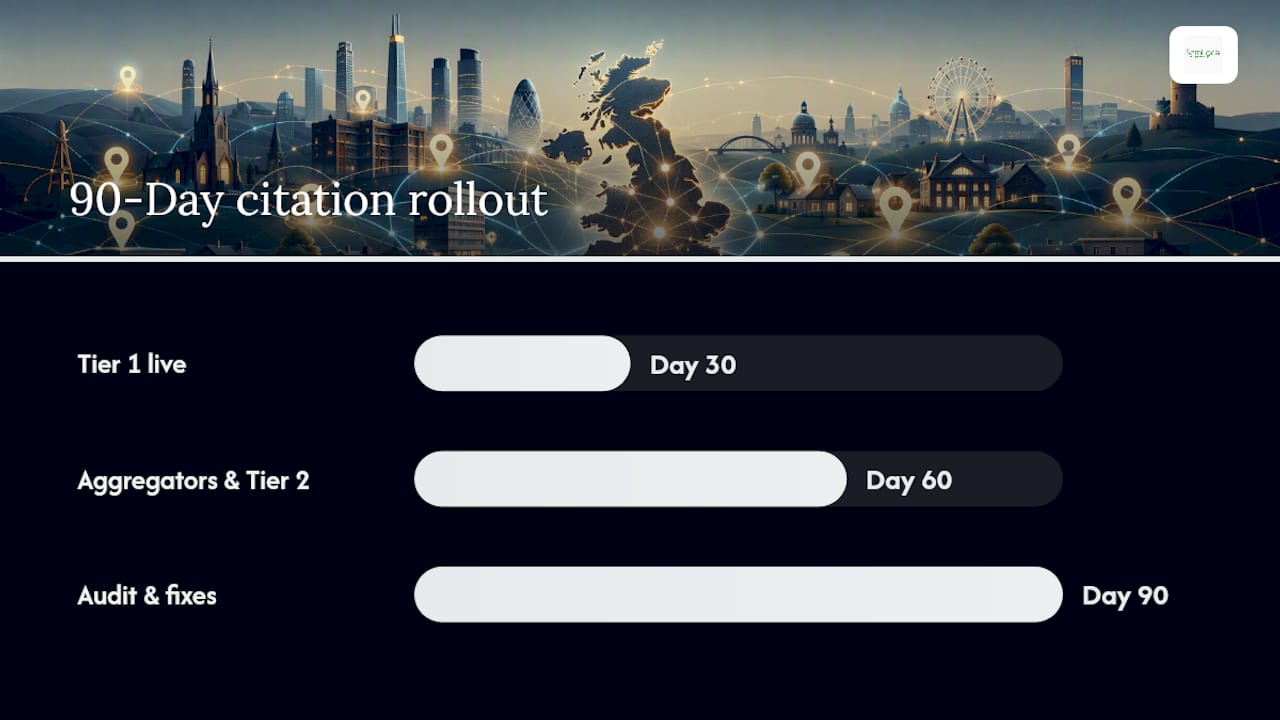
A 90-day build works because citations take time to index and Google needs consistent signals before it trusts them. Indexation alone can take weeks, so front-load the highest-value work and let the rest settle.
- Lock your canonical NAP. Write it exactly once: business name, full address with postcode, and phone number in one consistent format (e.g. “01234 567890”, not “(01234) 567 890” in one place and “+44 1234 567890” elsewhere). Save it in a single document everyone copies from.
- Claim and verify Tier 1. Start with Google Business Profile, then Bing Places, then Apple Maps Connect. Verification methods vary (postcard, phone, email), so budget a few days for each.
- Submit to Foursquare and major aggregators. Foursquare in particular feeds several downstream platforms and AI data sources.
- Complete every profile fully. Categories, opening hours, description, photos, all filled in, not left blank. Thin profiles rank worse than no profile at all.
- Document every login. Record the email, password, verification date and method for each listing as you go.
Pro Tip: Keep a single master spreadsheet with every listing, the login used, the date claimed and a notes column. It sounds basic, but it’s the difference between fixing a duplicate in five minutes and spending an afternoon hunting for who set up an old profile three years ago.
By day 30, Tier 1 should be live and verified. By day 60, aggregators and Tier 2 should be submitted. By day 90, run your first audit and fix anything that’s drifted.
Which industry and local directories carry extra weight?
Generic directories help, but sector-specific listings often carry more trust because they come with implied vetting. A Gas Safe or NICEIC listing tells a customer, and Google, that a trade has been checked, not just registered.
- Trades: Gas Safe Register, NICEIC. These carry .org.uk authority that generic directories can’t replicate.
- Hospitality: TripAdvisor, Trustpilot, sometimes county tourism boards.
- Healthcare: NHS service pages, CQC registration listings.
- B2B and professional services: LinkedIn company pages, Companies House-derived directories.
- Local bodies: chamber of commerce membership, Federation of Small Businesses (FSB) directory listings.
Join a trade body purely for the citation value when the membership fee is modest and the sector expects it. A plumber without Gas Safe registration listed anywhere looks incomplete to both customers and search engines.
How often should you audit your citations?
Run a full audit every six months at minimum; quarterly if you’ve recently rebranded, moved premises or changed your phone number. Check four things every time: NAP consistency, duplicate listings, correct primary category, and phone number formatting across every platform.
- Search your business name plus old addresses to catch duplicates from a previous location.
- Check whether your primary category still matches what you actually do, not what it was five years ago.
- Look for stale citations pointing to a closed branch or a number that’s been reassigned. Old, inconsistent citations can actively drag down rankings, not just fail to help.
Pro Tip: Avoid bulk-paid citation packages promising 100+ listings overnight. Many push low-quality, rarely-checked directories that add inconsistency rather than authority, and untangling them later costs more than doing it properly the first time.
Do citations matter for AI search and voice assistants?
Yes, and this is where UK strategy is shifting fastest. AI platforms and voice assistants don’t crawl directories the way Google’s search index does. They pull from structured data and aggregator feeds, so your website needs to be the clearest, most authoritative source of your own NAP data.
Adding LocalBusiness JSON-LD schema to your website gives AI tools and structured data pipelines a machine-readable version of your business details, reducing the chance of a wrong address or number surfacing in an AI-generated answer. Foursquare and Bing are named repeatedly as key aggregator feeds worth prioritising here.
- Add LocalBusiness schema to your homepage and contact page.
- Confirm Foursquare and Bing Places are claimed and accurate, since both feed downstream AI data sources.
- Treat your own website as the single source of truth, and make every other citation match it exactly.
Where can you find a quick citation checklist to start today?
Work through this order: claim Google Business Profile, verify it, submit to Foursquare and Bing Places, add relevant industry listings, then schedule your first audit for day 90.
- Standardise NAP in one document before touching any platform.
- Claim Tier 1 first: Google Business Profile, Bing Places, Apple Maps Connect.
- Add Tier 2 and sector-specific listings once Tier 1 is verified and live.
- Add LocalBusiness JSON-LD schema alongside your citation work, not as an afterthought.
What field experience taught me about UK citations
Fixing NAP inconsistencies before touching anything else consistently speeds up Google Business Profile recovery after a suspension or edit, and it shows up in map pack visibility faster than any other single change. That ordering isn’t optional, it’s the difference between weeks and months.
Some providers lean hard into schema and aggregator sync because directories alone won’t carry a business through AI-driven search much longer. If you’re stretched for time, a proper audit is worth the outlay before your citations drift further out of sync.
— Geoff
Get your citations managed properly with Semlocal
Semlocal is the alternative to a traditional agency for local citations UK businesses have relied on for years, minus the slow onboarding and generic directory dumps. Where most providers stop at submitting your details to a handful of sites, Semlocal manages the full stack: Google Business Profile optimisation, citation building across the right UK tiers, LocalBusiness schema implementation, and AI visibility work that keeps your data accurate wherever customers are searching, including inside AI platforms like ChatGPT and Gemini.
An audit engagement typically starts with a scope review of your existing listings, a duplicate and consistency check across Tier 1 and Tier 2 platforms, and a schema implementation pass on your website. You get a clear picture of what’s broken and a fixed plan for correcting it, not a vague promise of “more visibility”. If your citations haven’t been touched in a while, or you’ve never had a proper audit, get a Google Business Profile management quote from Semlocal and find out exactly what’s costing you map pack visibility right now.
Sources
For deeper detail on any of the points above, these sources are worth reading directly: Moz’s explainer on local citations covers how citations fit alongside reviews and on-site content; WordStream’s citation building guide covers verification timing; Bytewise’s UK-specific guide and Brambla’s 90-day framework both focus specifically on the UK market.
- How to Build Local Citations & Boost Your Visibility Online | WordStream
- Local Citations Guide for UK Small Businesses | Brambla
FAQ
Do local citations still help SEO in 2026?
Yes. Citations remain one signal among several that Google and Bing use to verify a business, alongside reviews and on-site local content, according to Moz. They’re foundational hygiene rather than a standalone ranking hack.
How many citations does a UK small business actually need?
Most small businesses need somewhere between 12 and 30 high-quality citations, not hundreds. Consistency across a shorter list beats volume across a long one every time.
Which platforms should I claim first?
Start with Google Business Profile, then Bing Places, then Apple Maps Connect, before moving to Yell, Thomson Local and Foursquare. This order matters because indexation takes time and Tier 1 platforms carry the most weight.
How often should I audit my citations?
Run a full check every six months, checking NAP consistency, duplicates and category accuracy each time, based on common UK audit guidance. Quarterly checks suit businesses that have recently rebranded or moved.
Can Semlocal manage my citations for me?
Yes. Semlocal handles Google Business Profile management, citation building and LocalBusiness schema implementation as part of its local SEO services. Current pricing is available directly on the Semlocal site.