Local citation management is the ongoing process of auditing, correcting and synchronising your business name, address and phone number so search engines and AI tools reliably find and recommend you. If you do nothing else after reading this, run an audit of your existing listings and claim your Google Business Profile today. Every AI-driven recommendation and every map result starts with that data being correct.
TL;DR:
- Accurate and consistent citation data across major platforms like Google, Apple Maps, Bing, and key industry directories is essential for AI algorithms to trust and recommend your business.
- Managing citations manually suits single-location businesses with few listings, while larger or multi-location businesses should consider semi-automated tools or a managed service to maintain data integrity efficiently.
- Prioritize fixing your Google Business Profile, Apple Maps, and Bing Places first, as these influence most AI and map-based recommendations, then expand to regional and sector-specific directories.
- Regular audits, at least quarterly, are necessary to prevent data drift, address errors promptly, and track proof of changes to ensure ongoing citation accuracy.
- Building strong, third-party mentions in local media, industry roundups, and structured data like schema markup enhances AI recognition and boosts organic visibility over time.
Table of Contents
- What is local citation management and why does it matter for AI search?
- Manual, semi-automated or managed: which citation model fits you?
- Which tools and directories actually move the needle?
- How to audit and clean up your business citations step by step
- The ongoing maintenance checklist for local listings
- How AI recommendation engines actually weigh your citations
- When does citation work stop being maintenance and start being strategy?
- Get your citations and Google Business Profile managed properly
- Sources
- FAQ
What is local citation management and why does it matter for AI search?
A citation is any online mention of your business’s name, address and phone number, known as NAP. It might sit on a directory page, a chamber of commerce listing, a news article, or a supplier’s “find us” page. Local citation management is the discipline of creating, correcting and maintaining those mentions across the web so they all say the same thing.
Citations come in two forms. Structured citations live on dedicated business listing platforms, think Google Business Profile, Apple Maps, Bing Places, Yelp, or an industry-specific trade directory, with your NAP sat in defined fields. Unstructured citations turn up inside ordinary web content: a local newspaper mentioning your café’s address in a review, or a blogger listing your plumbing firm in a “best of the area” roundup.
Search engines and AI systems both treat citations as verification data, not just navigation aids. When Google, Bing or an AI assistant like ChatGPT or Gemini finds your business name, address and phone number matching across dozens of independent sources, that consistency reads as trustworthy. When they find three different phone numbers and two different spellings of your street name, the signal reads as unreliable, and unreliable businesses get recommended less often. AI models cross-reference third-party mentions rather than taking your own website’s word for it, so a mismatch buried on a directory you forgot existed can quietly undermine your visibility.
The damage from inconsistency is rarely dramatic. It is cumulative:
- An old address on a defunct directory confuses Apple Maps into showing a previous location.
- A missing suite number splits your reviews and citations across “two” locations in Google’s eyes.
- A phone number typo on one aggregator-fed directory propagates the error to dozens of smaller sites automatically.
- Inconsistent business name formatting (with or without “Ltd”, abbreviations) weakens the entity match AI tools rely on.
None of these look serious in isolation. Together, they are exactly why citation accuracy tips matter as much as citation building itself.
Manual, semi-automated or managed: which citation model fits you?
Every business ends up choosing between three approaches to managing local listings, and the right one depends on how many locations you run and how much time you have to spend on it. Industry breakdowns of citation management generally split the options the same way: do it yourself, use software to speed it up, or hand it to a service.
- Manual management. You search for your business name and number, find every listing by hand, and update each one directly through its own dashboard. This works well for a single-location business with under twenty citations to police, and it costs nothing but time. The catch is that time adds up fast: checking, logging into, and correcting even thirty directories individually easily eats a full working day, and that labour scales badly once you open a second site or add new services.
- Semi-automated tools. Citation-tracking and syncing software finds your existing listings, flags inconsistencies, and pushes updates to aggregators in bulk rather than directory by directory. This suits a growing business with two to ten locations that wants speed without handing over full control. The limitation is that these tools rarely fix everything themselves. Sites outside the major data aggregators, industry-specific directories, and any listing that requires a phone call or manual claim still need a human to finish the job.
- Managed citation services. A specialist team builds, corrects, monitors and re-verifies your listings on an ongoing basis, typically reporting back with proof of what changed and when. This fits multi-location businesses, franchises and time-poor owners who would rather spend their week serving customers than logging into forty directory dashboards. Cost is naturally higher than either DIY option, but the ongoing maintenance, catching new duplicate listings, third-party edits, and aggregator drift, is exactly the part manual and semi-automated approaches tend to let slip.
None of the three is universally “best”. A single-site trades business with a stable address can run manual checks quarterly and be fine. A five-location franchise chasing consistent AI visibility across every branch usually can’t justify the internal hours a managed alternative would save.
Which tools and directories actually move the needle?
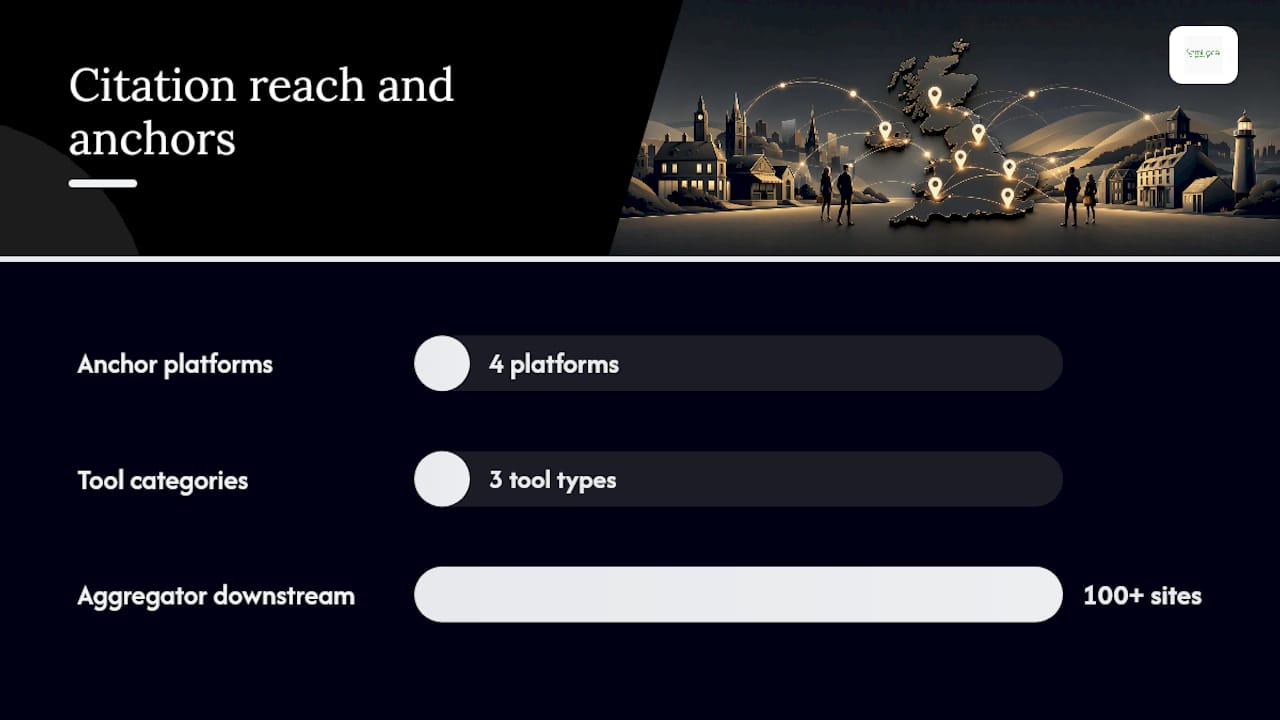
Start with the handful of platforms that feed almost everything else. Your Google Business Profile, Apple Maps listing, Bing Places entry and Facebook Page act as the anchor citations most other directories and AI tools check against. Get those four right before chasing smaller listings.
Beyond the universal players, industry and location-specific directories carry real weight for AI and search alike:
- Trade and professional bodies (a local chamber of commerce, a trade association directory for tradespeople, an accountancy or legal register).
- Sector-specific listing sites (Checkatrade or similar trade platforms, TripAdvisor for hospitality, Rightmove-adjacent listings for property services).
- Regional business directories tied to your town or county, which local journalists and AI roundup tools often scrape for recommendations.
A single submission rarely stays in one place. Many of the smaller directories you’ve never heard of pull their data from a handful of large aggregators, so one aggregator submission can feed well over a hundred downstream sites over the following months. That is powerful when your NAP is correct and painful when it isn’t, because an error propagates just as efficiently as an accurate record does.
For the tools themselves, expect three broad categories: citation finders that scan the web for existing mentions of your business, synchronisation platforms that push corrections out to multiple directories from one dashboard (some, like the MetaSync WordPress plugin, work directly from your website’s own listing data), and index checkers that confirm whether a correction has actually gone live. Whichever tool or provider you use, ask for the same proof every time: a live listing URL, a timestamped screenshot, and an audit log showing what was changed and when. Anyone unwilling to provide that evidence isn’t managing your citations properly, they’re guessing.
How to audit and clean up your business citations step by step
A citation audit is not a one-afternoon job, but it follows a fixed sequence that makes the work manageable even for a one-person marketing team.
- Build your canonical NAP record first. Decide, once and for all, the exact business name, full address (including suite or unit numbers), and phone number format you want everywhere. Store it in a single document. Every future correction gets copied from this record, never typed fresh each time.
- Discover your existing citations. Search your business name and phone number in quotation marks, check the major platforms directly, and run a citation finder tool to surface listings you didn’t know existed. Old locations, rebrands and duplicate entries turn up here more often than owners expect.
- Log every discrepancy before fixing anything. Build a simple spreadsheet: directory name, current listing URL, what’s wrong, what it should say. This stops you missing listings and gives you a record to check against later.
- Claim, correct and verify. Claim any unclaimed listing (this alone stops competitors or automated bots editing it), correct the NAP to match your canonical record, and screenshot the live result. That screenshot, dated and filed, is your proof the change actually happened, not just that you submitted a request.
- Prioritise by impact. Fix your Google Business Profile, Apple Maps and Bing Places entries first, since they feed the most AI and map-based recommendations. Move down to industry directories and lower-traffic sites afterwards.
- Re-check indexation two to four weeks later. Some corrections apply instantly; others take time to propagate through aggregators. Confirm the fix actually held before ticking it off.
- Measure the outcome. Track phone calls, Google Business Profile “direction requests” and map impressions before and after the audit. A jump in these numbers is the real evidence the work paid off, not just a tidier spreadsheet.
Pro Tip: Keep a single “master audit log” spreadsheet permanently, rather than starting a fresh one each quarter. Recording every fix with its date and proof URL means you can spot patterns, like one directory that keeps reverting your listing after every update, instead of relitigating the same fix every three months.
The ongoing maintenance checklist for local listings
Citation work doesn’t end once your directories match. A short recurring routine keeps drift from creeping back in.
- Standardise your business name exactly as it appears on your Google Business Profile everywhere else, and resist the temptation to stuff a keyword into the name field. Google and most directories penalise or reject names that don’t match your legal trading name.
- Run a full audit every quarter, but fix anything that changes immediately, a new phone system, an office move, a rebrand, rather than waiting for the next scheduled check.
- Monitor automated feeds and aggregator-fed directories monthly. These update in bulk and can silently reintroduce an old address if your canonical record isn’t the version they’re pulling from.
- Add Schema (JSON-LD) to your website, and keep the NAP fields inside it identical to your Google Business Profile. Mismatched schema is one of the more common, and more overlooked, causes of entity confusion.
- Document proof for every change: URL, screenshot, date. Third-party edits happen more often than owners assume. Suggested edits on Google Business Profile, in particular, can alter your listing without your direct action.
A single aggregator correction can ripple out to more than a hundred downstream directories within a few months, which is exactly why a quarterly cadence catches problems before they multiply rather than after.
How AI recommendation engines actually weigh your citations
AI assistants don’t simply read your website and take your word for it. They cross-reference independent mentions across the web, weighting third-party corroboration more heavily than anything you say about yourself. That shift is the single biggest change in how local citations function for AI-driven discovery compared with traditional search alone: a listing that only exists on your own domain carries far less weight than the same fact repeated independently across five or six trusted sources.
Three tactics increase your odds of being the business an AI tool actually surfaces:
- Targeted local PR: a mention in a regional news piece or a genuine “best of” roundup counts as third-party corroboration in a way a paid directory listing rarely matches.
- Niche industry roundups: getting listed in a sector-specific “top providers” article does double duty, human readers see it, and AI models scrape it as a citation.
- Wikidata and schema markup: structured, machine-readable entries reduce ambiguity about who you are, which matters more to an AI model parsing entity relationships than it does to a human scanning a page.
Expect this to work on a slower timeline than a standard citation fix. Where a directory correction might show up within days, earning genuine third-party mentions and having AI tools incorporate them typically plays out over weeks to a few months, and results are harder to track cleanly since there’s no single dashboard for “AI mentions” the way there is for map impressions.
Pro Tip: Ask any AI-focused optimisation the same question you’d ask a citation vendor: show me the proof. A verifiable live URL for each new mention, a screenshot at the time it went live, and a note on when it was checked again. If a provider can’t produce that trail, treat their AI visibility claims with real scepticism.
When does citation work stop being maintenance and start being strategy?
For most single-location businesses, citation management is maintenance, not strategy. A tidy Google Business Profile, a handful of correct directory listings, and a quarterly check are enough to stop errors compounding. Treat it as background hygiene, not a growth lever, and you’ll spend your time where it actually matters, on the phone with customers.
The calculus changes once you’re running multiple locations, a franchise, or a brand where inconsistent listings are actively costing enquiries. That’s usually visible before anyone runs the numbers: duplicate map pins for the same address, a support inbox full of “I called the number on Google and it didn’t work”, or a noticeable gap between how well you rank and how often you’re actually recommended by AI tools. At that point, the maintenance burden outweighs what any small team can absorb alongside their day job, and it becomes a genuine investment decision.
If you do outsource, insist on the same proof standard you’d demand of yourself: live listing URLs, dated screenshots, and a running log of what changed and why. Reporting that only shows “citations submitted” without evidence they went live and stayed correct isn’t reporting. It’s a promise.
— Geoff
Get your citations and Google Business Profile managed properly
There’s a real difference between running the audit yourself once a quarter and having someone watch your listings every week. There are services that offer fully managed Google Business Profile and local citation management, finding, correcting and monitoring your NAP across the directories that actually feed AI recommendations and map results, and provide proof of every change rather than a vague monthly summary.
This suits you if you’re running more than one location, you don’t have the spare hours to log into forty directory dashboards, or you’ve noticed your phone isn’t ringing as often as your rankings suggest it should. Semlocal handles the Google Business Profile management piece alongside citation corrections, so your primary listing and your wider directory footprint stay aligned instead of drifting apart. For readers weighing partner options in this space, BabyLoveGrowth’s white-label services cover related citation and AI-visibility workflows worth comparing.
If your listings need attention now, start with a Google Business Profile optimisation review and see exactly what needs fixing before committing to anything further.
Sources
A handful of references are worth keeping close as you build out your own citation process:
FAQ
What does local citation mean?
A local citation is any online mention of your business’s name, address and phone number, whether on a dedicated directory listing or inside a piece of unstructured content like a news article or blog roundup.
What is citation management?
Citation management is the ongoing process of creating, correcting and monitoring those mentions across the web so your NAP stays consistent everywhere it appears.
What are some good local citation sites in the UK?
Beyond Google Business Profile, Apple Maps and Bing Places, UK businesses typically benefit from listings on sector-specific directories like Checkatrade for tradespeople, TripAdvisor for hospitality, and local chamber of commerce or trade association directories relevant to their industry.
Is there a free citation manager?
Some citation-finding tools offer free scans that show where your business is already listed, though correcting and monitoring those listings at scale usually requires either paid software or manual work; a managed service like Semlocal removes that manual burden entirely.