A hotel AI receptionist is an autonomous, AI-powered conversational agent that handles guest communications and front-desk tasks around the clock, without human intervention. Think of it as a virtual receptionist in hotels that picks up every call, answers every query, and updates your property management system in real time. Unlike a basic chatbot following a rigid script, a hotel AI receptionist uses natural language processing to hold open-ended, context-aware conversations, understanding questions it has never encountered before.
Core capabilities include:
- Answering calls and live chat enquiries 24/7, with zero hold times during peak periods
- Quoting room rates, checking availability, and taking reservations
- Verifying guest data and providing property-specific information
- Writing directly into your PMS during live calls, updating availability and guest preferences in real time
- Handling multiple simultaneous interactions, so no caller is left waiting
- Supporting guests in multiple languages
The distinction from a traditional chatbot matters. Chatbots follow pre-written decision trees. An AI receptionist holds genuine multi-turn conversations, adapts to context, and takes real action rather than simply routing enquiries.
Table of Contents
- What are the main benefits of AI receptionists for UK hotels?
- How should you implement an AI receptionist in your hotel?
- How do human staff and AI receptionists work together?
- How Semlocal supports UK hotels with AI receptionist solutions
- What are the challenges and limitations of hotel AI receptionists?
- Which vendors and technologies are available in the UK market?
- Real-world impact: what hotels are seeing in practice
- Key takeaways
What are the main benefits of AI receptionists for UK hotels?
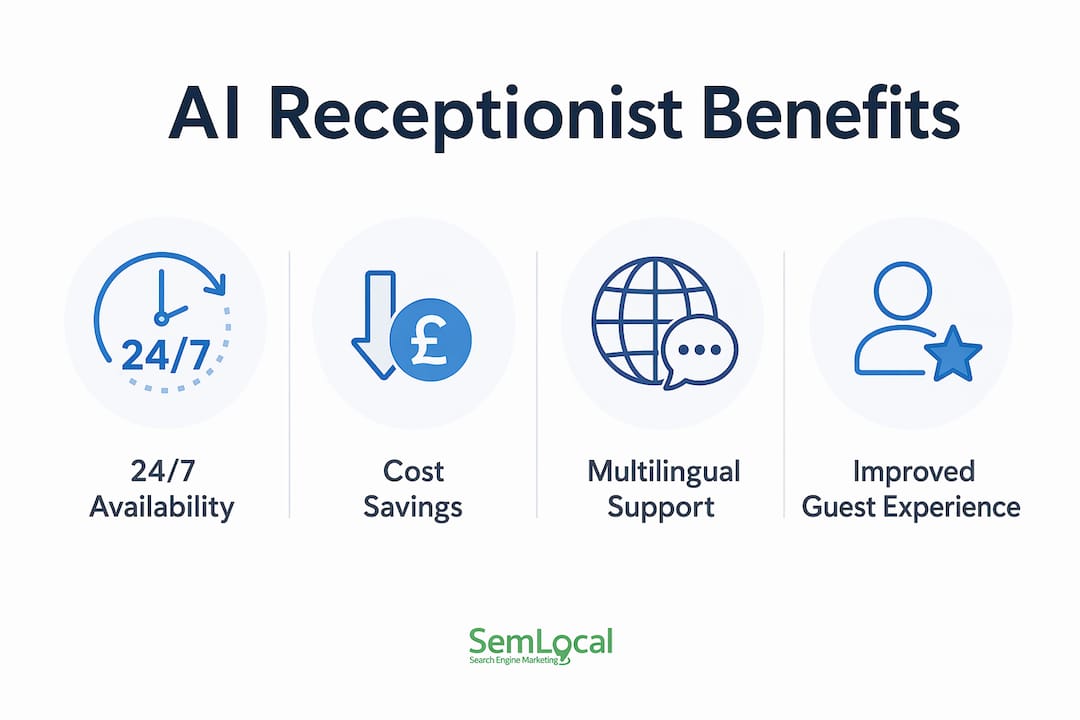
The most immediate benefit is availability. Your front desk cannot physically answer every call at 2AM on a bank holiday weekend, but an AI receptionist handles peak call volumes with zero hold times, every time. Guests get answers instantly, regardless of how busy the property is.
The financial case is equally clear. Human receptionists have substantial costs including benefits and training. AI runs on a subscription model at a fraction of that cost and scales without additional headcount. For multi-site operators or seasonal properties, that flexibility is particularly valuable.
Guest experience improves too. Multilingual support and consistent service quality around the clock matter in competitive UK hospitality markets, where a slow response can push a potential guest to book elsewhere. Faster answers, personalised property information, and no dropped calls all contribute to stronger reviews and repeat bookings.

A common misconception is that AI receptionists replace your team. They do not. They handle the transactional volume so your staff can focus on the interactions that genuinely require a human presence.
How should you implement an AI receptionist in your hotel?
Start small. Incremental deployment beginning with high-return, low-risk tasks such as front-desk intake and common queries builds operational momentum and staff confidence before you expand to more complex guest experience roles.
Practical steps to get right from the start:
- Map your highest-volume, most repetitive enquiry types first (room availability, check-in times, parking, Wi-Fi)
- Integrate the AI with your property management system before going live
- Train the system on your specific property knowledge base, including house rules and local recommendations
- Set clear escalation paths so complex or emotional situations transfer to a human immediately
- Brief your team on what the AI handles and what it does not, so they feel supported rather than sidelined
Pro Tip: Do not automate everything at once. Guests notice when AI handles a sensitive complaint poorly. Keep human staff in the loop for complaints, accessibility requests, and VIP interactions from day one.
Privacy and data security deserve attention before deployment. Confirm your chosen system complies with UK GDPR, stores guest data on UK or EU servers, and carries clear data retention policies. Ask vendors directly about encryption standards and third-party data sharing.
How do human staff and AI receptionists work together?
AI works best as a scalable support layer that absorbs routine front-desk volume, not a replacement for your team. The human-in-the-loop model is the approach endorsed by industry leaders: AI manages transactional tasks, freeing staff to handle the complex, emotional interactions where human empathy genuinely makes the difference.
What AI handles well:
- Reservation enquiries and rate quotes
- Check-in and check-out instructions
- Frequently asked questions about facilities, parking, and policies
- After-hours calls and overflow during peak periods
What remains firmly human:
- Complaints requiring empathy and judgement
- VIP and loyalty guest recognition
- Upselling through genuine conversation
- Accessibility and medical needs
According to Bettina Deynes, Global Chief Human Resources Officer at Carnival Corp, “the human in the loop is paramount” in hospitality. The people delivering the guest experience create the memorable moments that no AI can replicate.
How Semlocal supports UK hotels with AI receptionist solutions
Semlocal works with UK hotels and service businesses to make sure they are visible and chosen wherever guests are searching, whether that is Google Maps, Local Services Ads, or AI platforms like ChatGPT and Gemini. As AI search visibility becomes central to how guests discover and book properties, being present in those results is no longer optional.
Semlocal’s services for UK hotels include:
- Fully managed Google Business Profile optimisation to dominate the local map pack
- Local SEO that ranks your property where guests are actively searching
- AI optimisation so your hotel is recommended when travellers ask AI assistants for suggestions
- Targeted paid ads reaching guests ready to book
- Real enquiry focus: more calls, more bookings, and a clear return on every pound invested
Every service Semlocal delivers is built around measurable outcomes, not vanity metrics. If you want your hotel to show up first and get chosen, Semlocal handles the complete local presence end to end.
Ready to put your hotel in front of more guests? Get more bookings with Semlocal’s proven local lead generation services.
What are the challenges and limitations of hotel AI receptionists?
No technology is without limits, and hotel managers should go in with clear expectations.
- Emotional complexity: AI cannot read distress, frustration, or nuance the way a trained staff member can. Complaints and sensitive situations still need a human.
- System integration: Connecting an AI receptionist to legacy property management systems can require technical work upfront. Older PMS platforms may not support direct API integration.
- Guest acceptance: Some guests, particularly older travellers, prefer speaking to a person. Offering a clear option to transfer to a human is not optional; it is good practice.
- Accuracy depends on training data: An AI is only as reliable as the information it has been given. Outdated room details or incorrect policies will produce wrong answers at scale.
- UK GDPR compliance: Collecting and processing guest data through an AI system carries legal obligations. Non-compliance carries real financial and reputational risk.
Which vendors and technologies are available in the UK market?
The UK market has seen rapid growth in hotel automation technology, with several categories of solution now available to property managers.
Voice-based AI receptionists handle inbound phone calls, take reservations, and write data directly into the PMS. Multi-channel platforms extend this across WhatsApp, email, and web chat. Some providers focus specifically on hospitality, training their models on industry-specific knowledge such as room types, rate structures, and check-in workflows. Others offer broader business phone AI that hotels can configure for their needs.
When evaluating vendors, prioritise UK GDPR compliance, native PMS integration (particularly with systems common in British hotels such as Opera and Mews), multilingual capability for international guests, and transparent pricing with no long-term lock-in.
Real-world impact: what hotels are seeing in practice
Hotels deploying AI receptionists consistently report three outcomes: fewer missed calls, lower front-desk pressure during peak periods, and faster response times for after-hours enquiries. Properties running AI alongside their existing team find that staff can focus on higher-value roles as experience-builders rather than spending shifts answering the same questions repeatedly.
Economy and midscale properties benefit most immediately from automated check-in and instant query handling. At the luxury end, offloading administrative volume gives concierge teams more time for the personalised service that defines the guest experience at that level. The common thread is that AI handles the predictable, repetitive work, and people handle everything else.
Key takeaways
A hotel AI receptionist delivers the most value when it handles high-volume transactional tasks, freeing human staff for the empathetic, complex interactions that define great hospitality.
| Point | Details |
|---|---|
| Core definition | An AI receptionist is an autonomous conversational agent handling calls, reservations, and guest queries 24/7 via natural language processing. |
| Financial case | Human receptionists cost upwards of £30,000 annually; AI runs on a subscription model at a fraction of that cost. |
| Best deployment approach | Start with high-volume, routine tasks and expand incrementally, keeping humans in the loop for complex interactions. |
| Human staff remain central | AI absorbs transactional volume; staff focus on complaints, VIP care, and the personal moments guests remember. |
| UK compliance matters | Any AI system processing guest data must comply with UK GDPR, including data storage location and retention policies. |