Generative engine optimization (GEO) is the practice of structuring content and brand signals so AI systems cite your site in generated answers. It builds directly on SEO rather than replacing it, using the same technical foundations plus new tactics like answer-first writing and sourced statistics. The one thing to change today: write your key sections so the first sentence alone answers the question, backed by a real number or quote.
TL;DR:
- Achieving success in GEO requires foundational SEO, including crawlable pages, clear structure, and useful content, before applying answer-focused tactics.
- Structuring every section with a concise answer at the start and adding sourced statistics or quotations significantly increases the likelihood of being cited by AI systems.
- Consistent entity descriptions across platforms and regular updates to cornerstone pages improve visibility across different search engines and AI models.
- Content must be designed for standalone retrieval to maximize citations, with emphasis on plain, well-structured HTML and accurate schema markup input.
- Since engines diverge in indexing, treating visibility as a portfolio and focusing on credibility through verifiable claims ensures lasting AI citation gains.
Table of Contents
- What is generative engine optimization?
- GEO, AEO and SEO: how they overlap and where they differ
- How generative engines pick, retrieve and cite content
- Practical GEO tactics you can apply today
- Technical checklist: making content crawlable and extractable
- How to measure and test GEO performance
- Risks, ethical notes and sustainable GEO practice
- Semlocal’s approach to AI visibility for local businesses
- Where GEO is actually heading
- Sources
- FAQ
What is generative engine optimization?
Generative engine optimization describes the work of getting your content quoted, summarised, or linked inside AI-generated answers, whether that’s ChatGPT, Google’s AI Overviews, Perplexity, or Gemini. You’ll also see it called answer engine optimization (AEO) or, less commonly, LLM optimisation (LLMO). The terms overlap enough that most practitioners use them interchangeably, though GEO tends to describe the broader discipline and AEO the narrower job of winning a specific answer box.
The term only exists because search behaviour changed. Gartner forecasts a 25% drop in traditional search engine volume by 2026 as AI chatbots and virtual agents absorb queries that used to land on a results page. When the answer is generated rather than listed, ranking eighth on page one stops mattering. Being the source an AI chooses to cite is what counts.
A few outcomes count as GEO success:
- Your product being named and linked when someone asks ChatGPT for a recommendation in your category
- Your statistic or definition appearing verbatim in a Google AI Overview
- Your brand showing up in Perplexity’s cited sources for a comparison query
- A local business profile surfacing when someone asks an AI assistant “who’s the best [trade] near me”
None of that happens by accident. It happens because content was written and structured in a way the model could retrieve, trust, and quote.
GEO, AEO and SEO: how they overlap and where they differ
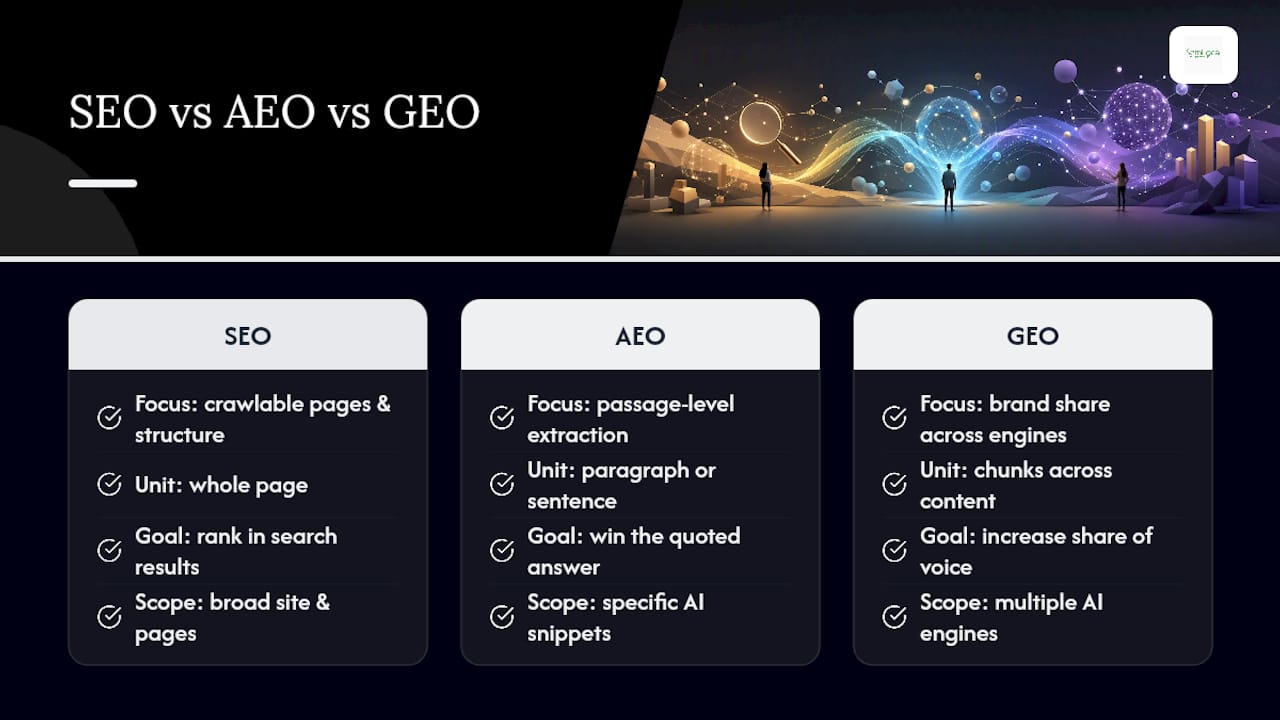
SEO remains the prerequisite. Google is explicit that optimising for generative AI features is fundamentally SEO work: crawlable pages, clear structure, and genuinely useful content still decide whether you’re eligible to appear in AI Overviews at all. Skip that foundation and no GEO tactic will rescue you.
AEO narrows the focus to passage-level extraction, winning the specific paragraph or sentence a system lifts into its answer. GEO widens the lens again, aiming at your brand’s overall share of voice across every engine a buyer might use, from ChatGPT to Gemini to Bing Copilot.
The practical difference is the unit of optimisation. Traditional SEO optimises a page to rank as a whole. GEO and AEO optimise the chunk, the individual heading and its following paragraph, because that’s the unit an AI system retrieves and quotes. Similarweb’s analysis notes that engines also index differently from each other, so a page that gets cited constantly in one engine can be invisible in another. Prioritise SEO fundamentals first, then layer chunk-level answerability on top, because the second is worthless without the first.
How generative engines pick, retrieve and cite content
Most generative engines rely on retrieval-augmented generation (RAG): a model doesn’t answer purely from memory, it runs a search, retrieves a set of passages, and drafts a response grounded in those passages. Modern systems often perform “query fan-out,” breaking one user question into several related searches and pulling candidate passages from each before synthesising the reply. That means your content isn’t competing for one query. It’s competing for every reasonable variant of that query the system generates.
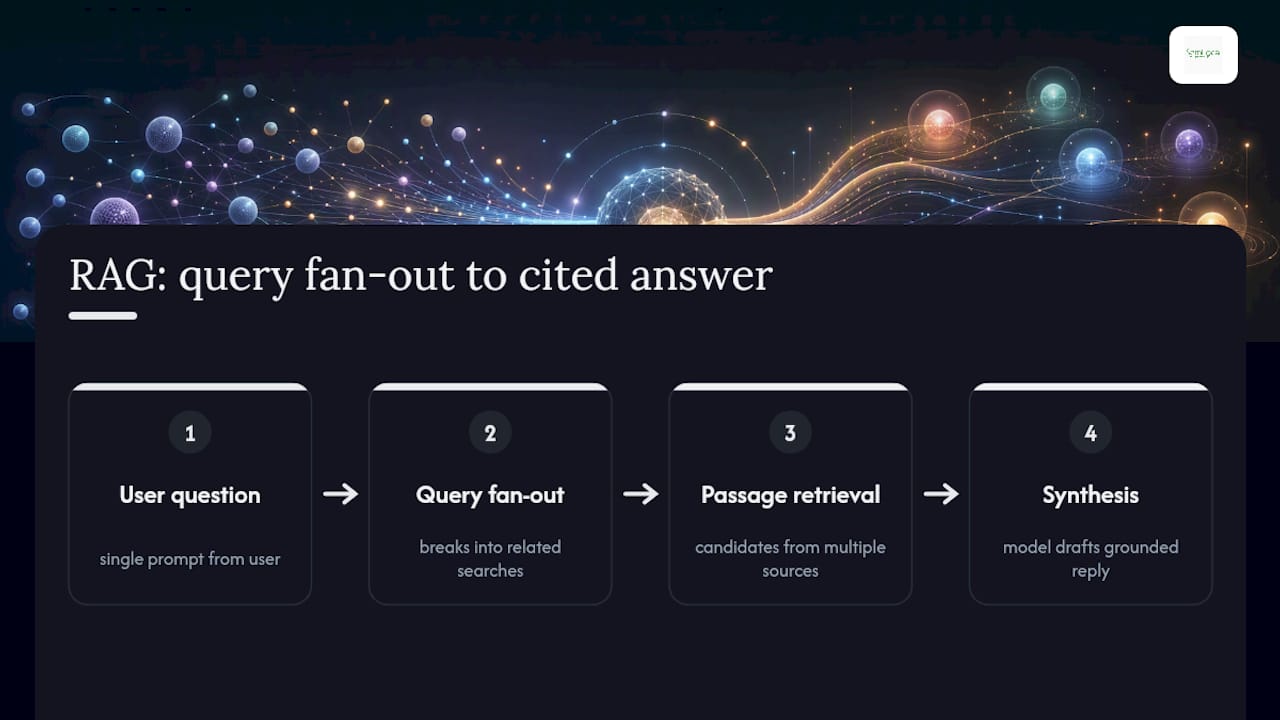
This is why self-contained sections matter so much. A retrieval system doesn’t read your whole article before deciding to cite it; it scores individual passages. If a paragraph makes sense only with three preceding sentences of context, it’s a poor retrieval candidate however good the surrounding page is. Each section needs to work as a standalone answer.
Index divergence compounds the challenge. One engine might build its index from a proprietary crawl, another might licence a third-party dataset, and a third might rely heavily on cached search results. A page that ranks well and gets cited constantly in Google’s AI Overviews can be entirely absent from Perplexity’s citations, not because the content is weaker but because that engine never indexed it the same way. Treat visibility across engines as a portfolio, not a single score.
Practical GEO tactics you can apply today
Six tactics consistently move the needle, and none of them require rebuilding your site.
- Lead every section and FAQ answer with a 30 to 60 word BLUF.
Answer the implied question in the first sentence, then expand. Retrieval systems weight the opening lines of a chunk heavily, so burying the answer in paragraph three costs you citations. - Add sourced statistics and short quotations wherever you make a claim. GEO-bench research found that adding citations, quotations, and statistics lifted visibility in generative engine responses by roughly 30 to 40% on the metrics tested. That’s the single highest-leverage change most content teams can make.
- Make quantified claims complete. A citable statistic needs a number, a population, a timeframe, and a source. “Many businesses saw growth” is unusable to a model; “conversions rose 18% over six months across 40 client accounts” is exactly what gets quoted.
- Keep entity descriptions consistent. Use the same business name, category, and location phrasing across your website, Google Business Profile, Wikipedia (where applicable), and social bios. Inconsistent descriptors make it harder for a model to confirm which entity you actually are.
- Build a presence on the platforms feeding these engines. Forums, review sites, and Q&A platforms often get pulled into retrieval sets directly, so a thin footprint there caps your citation potential regardless of how good your own site is.
- Refresh cornerstone content every few weeks, not once a year. GEO gains tend to fade faster than organic rankings do, so treat your best-performing pages as living documents.
Pro Tip: Rewrite your top five landing pages’ opening paragraphs as if they were the only sentence an AI would ever read. If that sentence alone doesn’t answer the searcher’s question with a real fact attached, it needs work.
Technical checklist: making content crawlable and extractable
Before any of the tactics above can work, an AI crawler has to be able to fetch and parse your page. Several widely used AI crawlers request raw HTML and don’t execute JavaScript, so content rendered entirely client-side can be invisible to them even though a human visitor sees it fine.
Run through this before assuming a content problem is actually a content problem:
- Confirm critical text, headings, and answers appear in the initial HTML response, not only after a JavaScript render; use server-side rendering or prerendering where your framework relies on client-side rendering.
- Check your firewall and bot-management rules aren’t silently blocking known AI crawler user agents alongside spam traffic.
- Use semantic HTML (proper heading hierarchy,
<article>,<section>) so structure is legible to both browsers and parsers. - Apply schema markup (FAQPage, Article, LocalBusiness, Product) where it genuinely describes your content, not as a blanket tactic.
- Skip the temptation to add an
llms.txtfile or manually “chunk” your content into artificial fragments. Google’s own guidance is explicit that neither special machine-readable files nor artificial chunking hacks meaningfully improve eligibility for generative AI features. That effort is better spent on genuinely useful, well-structured content.
If your CMS was built years before anyone discussed AI crawlers, this is the section to hand your developer.
How to measure and test GEO performance
Measure GEO across three layers: whether engines can crawl you at all, how often you get cited, and what sentiment or recommendation your brand receives when it does appear. Each layer needs a different tool and tells you something the others can’t.
Start with Search Console’s generative AI reports and Bing Webmaster Tools, which show whether Google and Bing are surfacing your pages in AI-generated results and how often. Layer in third-party AI visibility tools that track citation frequency across ChatGPT, Perplexity, and Gemini for your target queries, since neither Search Console nor Bing covers those engines.
Run genuine A/B tests on chunk structure: rewrite one section’s opening sentence into a tighter BLUF, leave a comparable section untouched, and compare citation frequency over a few weeks. Expect the uplift to be perishable rather than permanent. Citation gains from GEO changes tend to fade over time, which is the practical case for refreshing cornerstone content roughly every four to six weeks rather than treating a rewrite as a one-off job.
Risks, ethical notes and sustainable GEO practice
Optimising purely for machine extraction, at the expense of the human reading the page, tends to backfire. Content chopped into unnaturally short fragments to please a parser usually reads badly and converts worse, and a model trained to weigh coherence will eventually deprioritise it too.
The bigger risk is credibility. Fabricated statistics, inflated review counts, or brand mentions bought from low-quality UGC platforms can get you a short-term citation and a long-term reputation problem once anyone checks the source. Keep every quantified claim traceable to a real figure, cite it plainly, and put a genuine editorial review step in place before publishing. That’s what actually reduces the risk of an AI system either ignoring your content or, worse, hallucinating a distorted version of it.
Semlocal’s approach to AI visibility for local businesses
Some agencies work with service businesses, franchises, and local business owners across the UK aiming to be found on Google Maps, Local Services Ads, and increasingly on AI platforms like ChatGPT and Gemini. That last part is the newer challenge: a strong map pack ranking doesn’t automatically translate into being the answer an AI assistant gives when someone asks it for a recommendation.
Semlocal manages the full stack this requires: fully managed Google Business Profiles, Local SEO, paid ads, and dedicated AI optimisation work that treats generative engines as a distinct visibility channel rather than an afterthought. The case studies documenting client outcomes show what consistent, measured local marketing looks like when it’s built around real enquiries rather than vanity rankings. The principle carries over directly to GEO: consistent entity signals, genuine citations, and a presence that holds up whether a customer is scrolling Google Maps or asking Gemini for a recommendation nearby.
Where GEO is actually heading
Expect the engines to keep diverging rather than converging. ChatGPT, Gemini, and Perplexity are building separate indexes with separate retrieval quirks, so chasing a single “GEO algorithm” is a waste of effort. Treat this as a portfolio problem: some tactics will lift your visibility in one engine and do nothing in another, and that’s normal, not a failure.
The one signal that holds up everywhere is credibility. Citations, direct quotes, and specific statistics consistently outperform vague claims, because every engine is fundamentally trying to ground its answer in something verifiable. Test fast, measure what actually gets cited, and refresh your best pages before the gains quietly fade.
— Geoff
FAQ
Is generative engine optimization a real thing?
Yes. It’s an increasingly standard practice among marketers as AI-generated answers absorb a growing share of search behaviour, and Gartner projects traditional search volume will fall 25% by 2026 as a result.
How do I learn SEO as a beginner?
Start with Google’s own documentation, particularly its guidance on generative AI feature eligibility, then practise applying answer-first structure and sourced claims to real pages rather than studying theory alone.
Is GEO replacing SEO?
No. GEO builds on SEO rather than replacing it; crawlability, technical health, and genuinely useful content remain the eligibility requirement before any GEO tactic can work.
Is SEO going away because of AI?
No. Search volume is shifting toward AI-generated answers, but the underlying discipline, structured, crawlable, trustworthy content, is exactly what both traditional rankings and AI citations depend on.
Ready to make sure your business shows up in both the map pack and the AI answer? Explore Semlocal’s local visibility management and get your Google Business Profile, Local SEO, and AI visibility handled end to end.