TL;DR:
- A hybrid AI and human receptionist model offers UK small service businesses a lower-cost and more available call handling solution. AI handles routine inquiries around the clock, while humans manage complex, emotional, or in-person interactions. Proper integration, call routing, and escalation paths are essential to maximize benefits and customer satisfaction.
For most UK small service businesses, a hybrid model delivers the best outcome: an AI receptionist handles routine calls around the clock, while a human manages complex or emotional situations. AI reception typically costs a fraction of a staffed call centre, answers calls instantly without hold times, and operates 24/7 without overtime pay. The virtual receptionist market has grown sharply as vendor maturity has improved, making deployment practical for businesses with as few as five staff. The exception is when calls are predominantly high-empathy (bereavement, crisis, complex complaints) or require in-person reception, in which case a human-led model remains the stronger choice. GDPR compliance applies to both options, but the data-handling obligations differ significantly between them.
Table of Contents
- How do AI receptionists and call centres compare at a glance?
- What does an AI receptionist actually do for a small business?
- What is a traditional call centre and how does it differ in practice?
- How do the two options compare across every key decision factor?
- When does a traditional call centre still make more sense?
- When is an AI receptionist the clear choice?
- What does a research-backed hybrid model look like for UK small businesses?
- Worked UK cost example: a local plumber
- How do you choose the right option for your business?
- What does implementation actually look like, and how long does it take?
- Key takeaways
- The case for getting the routing right, not just the technology
- How Semlocal helps UK service businesses get this right
- Useful sources and further reading
How do AI receptionists and call centres compare at a glance?
The table below covers the ten dimensions that most affect the procurement decision for a UK small service business.
| Dimension | AI receptionist | Traditional call centre | Hybrid model |
|---|---|---|---|
| Typical monthly cost (GBP) | £50–£300 for AI receptionists; £500–£3,000+ for traditional call centres | £500–£3,000+ (human) | |
| Answer speed / hold time | Under 2 seconds | 30–120 seconds | Under 2 seconds (AI); variable (human) |
| 24/7 availability | Yes, always | Premium add-on cost | Yes (AI layer) |
| Consistency / quality | identical quality | Varies by agent and shift | Consistent on routine; variable on complex |
| Best for | Routine scheduling, FAQs, lead capture, after-hours | Complex, emotional, high-value calls | Most UK small service businesses |
| Scalability & peak handling | Unlimited simultaneous calls | Requires hiring or scheduling | AI absorbs peaks; humans handle edge cases |
| Setup & integration effort | Hours to days | 1–4 weeks | 1–3 weeks with CRM/calendar integration |
| CRM/calendar integration | Yes, native or API | Limited; manual logging common | Full integration on AI layer |
| Data, reporting & GDPR | Structured transcripts; PII held by vendor — requires DPA | Call recordings; PII with centre — requires DPA | Split PII obligations; document both |
| Human escalation path | Configurable warm handoff | Always human | Defined triggers; transcript passed on transfer |
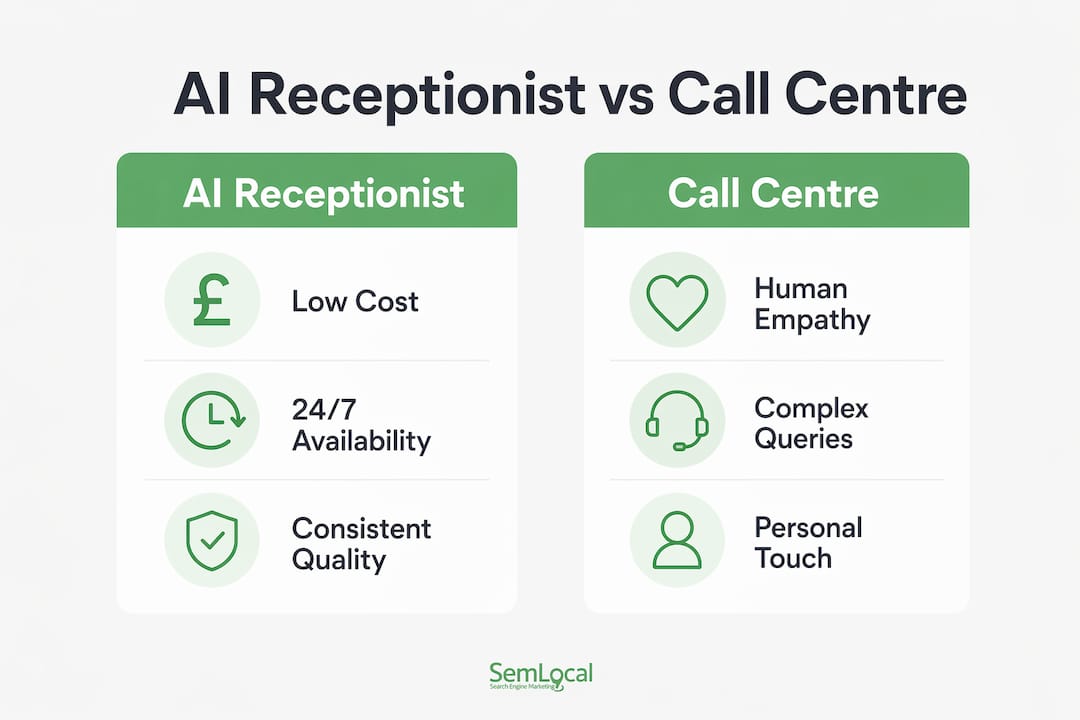
For most UK small businesses, the hybrid model captures the cost and availability advantages of AI while preserving human judgement where it genuinely matters.
What does an AI receptionist actually do for a small business?
An AI receptionist is a voice-first automated front desk. It answers inbound calls, qualifies leads, books appointments, routes enquiries, and logs every interaction to your CRM, all without a person picking up the phone. Modern systems handle multiple calls simultaneously and operate every hour of every day.
The practical capabilities a buyer should expect:
- Instant answer: calls picked up in under two seconds, with no hold queue
- Lead qualification: asks your defined intake questions and scores or routes based on answers
- Appointment booking: reads live calendar availability and confirms bookings in real time
- FAQ handling: answers your most common questions consistently, every time
- CRM logging: writes call summaries, caller details, and outcomes directly to your CRM
- Transcripts and analytics: every call is transcribed and searchable; dashboards show call volume, booking rate, and escalation frequency
- Concurrent calls: handles ten callers at once as easily as one, with no degradation in quality
- Multilingual support: many platforms handle multiple languages natively
The single biggest determinant of value is integration quality. An AI receptionist connected to your CRM and calendar is a genuine front-desk replacement for routine calls. Without that integration, it is little more than an automated answerphone. Expect to invest time in your knowledge base, call flows, and escalation rules before going live. Early tuning in the first two to four weeks is normal and necessary.
What is a traditional call centre and how does it differ in practice?
A traditional call centre is a team of human agents who answer calls on your behalf. They may be in-house staff or an outsourced provider. Agents follow scripts, take messages, route calls, and handle enquiries that require judgement, empathy, or physical presence.
The practical strengths of a human-staffed model:
- Emotional intelligence: agents read tone, respond to distress, and adapt in ways no current AI matches
- Flexible judgement: handles genuinely ambiguous situations that fall outside any script
- Relationship building: regular callers can speak to the same person, which matters in high-trust sectors
- In-person tasks: if agents are on-site, they can greet visitors, manage waiting areas, and coordinate with colleagues face to face
The practical constraints are equally real:
- Concurrent call limits: one agent handles one call; a busy period means hold times or missed calls
- Shift hours: true 24/7 coverage requires shift premiums and is rarely cost-effective for small businesses
- Training and turnover: agent turnover runs 30%–45% annually in the industry, which means recurring recruitment and retraining costs
- Consistency variability: quality depends on the individual agent, their workload, and the time of day
- Scaling lag: adding capacity means hiring or renegotiating contracts, which takes weeks
The core difference in caller experience comes down to this: a human agent can sense that a caller is upset and respond accordingly; an AI agent will follow its script regardless. For the majority of calls to a UK plumber, cleaning company, or accountancy practice, that distinction rarely matters. For a bereavement service or a mental health clinic, it matters enormously.
How do the two options compare across every key decision factor?
Cost
AI receptionists cost significantly less than human-staffed reception on a monthly basis. Typical UK AI plans run from roughly £50 to £300 per month depending on call volume and features. A staffed call centre contract for a small business typically starts at £500 per month and rises steeply with hours and volume. The per-call cost gap is substantial: human-handled calls run several pounds each when you factor in agent time and overhead; AI-handled calls cost a fraction of that.
A complete total cost of ownership comparison should include: monthly subscription or usage fees, CRM and calendar integration setup, any human fallback costs, and ongoing tuning time. The hidden costs in the human model are turnover and retraining. The hidden cost in the AI model is the integration work upfront.
Availability and speed
AI receptionists answer calls in under two seconds and never go offline. A staffed call centre typically has answer times of 30–120 seconds during busy periods, and after-hours coverage carries a premium. For UK service businesses where a significant share of calls arrive outside standard office hours, that gap translates directly into missed bookings.
Quality and consistency
An AI receptionist delivers identical quality on call one thousand as it does on call one. It never rushes, never forgets to capture an email address, and never has a bad afternoon. A human agent brings warmth and genuine empathy, but also variability. Caller satisfaction for well-configured AI on routine calls is high, often because callers who previously reached voicemail are simply glad someone answered. Satisfaction drops when callers have complex or emotional needs and the AI cannot adapt.
Scalability and peak handling
AI scales instantly. If a marketing campaign doubles your inbound call volume overnight, the AI handles every call simultaneously without any configuration change. A call centre requires advance forecasting, capacity negotiation, and often a higher monthly minimum to guarantee agent availability. Underestimate and callers sit on hold; overestimate and you pay for idle capacity.
Setup and integration
Most AI receptionist platforms can be configured in hours for a basic deployment. A full integration with your CRM, calendar, and booking system typically takes one to three weeks. Call centre onboarding runs one to four weeks and requires script writing, agent training, and quality assurance sessions. Changes to call handling take effect instantly in an AI system; in a call centre, they require retraining.
Data, reporting and GDPR
Every AI receptionist call generates structured data automatically: transcripts, caller details, booking outcomes, and lead scores flow into your CRM without manual effort. Call centres provide call logs and recordings, but structured insight typically requires manual review or paid QA add-ons.
Both models involve processing personal data on behalf of your business, which means GDPR obligations apply. A brief compliance checklist:
- Confirm the vendor has a signed Data Processing Agreement (DPA) in place.
- Verify where call data and transcripts are stored (UK or EU servers preferred).
- Check the vendor’s data retention policy and your right to deletion.
- Confirm callers are notified that their call is being recorded or processed by AI.
- Review the vendor’s security certifications (ISO 27001 or equivalent).
The handoff quality matters more than the voice quality. A well-built AI system resolves routine queries instantly and, the moment it reaches its limit, transfers the caller to a person with the full transcript and an intent summary. Nobody repeats themselves. That single design choice separates systems callers trust from systems callers resent.
Escalation and handover
A warm handoff passes the caller to a human along with the call transcript and a summary of what the AI has already established. This means the human agent starts the conversation informed, not cold. Without a defined escalation path, an AI receptionist that hits its limits will frustrate callers. With one, it becomes the first filter in a two-tier system that handles every call type well.
Pro Tip: Define your escalation triggers before you go live. Common triggers include: caller expresses distress, query involves a complaint, caller explicitly asks for a human, or the AI cannot resolve the request within two turns. Document these in your call flow, not as an afterthought.
When does a traditional call centre still make more sense?
There are genuine situations where a human-staffed model is the right answer, and it is worth being clear about them.
- High-empathy sectors: bereavement services, mental health support, crisis lines, and counselling practices require human emotional intelligence that AI cannot replicate reliably.
- In-person reception tasks: if your front desk also greets visitors, manages a waiting area, or coordinates with on-site colleagues, a phone-only AI system covers only part of the role.
- Very low call volumes: a sole trader receiving five calls per day may find a single part-time local receptionist more cost-effective than a managed AI deployment with setup fees.
- VIP relationship-led services: wealth management, high-value legal advisory, and similar practices where clients expect to speak to a named person from the first contact.
- Legal or compliance constraints: some regulated sectors require human oversight of intake conversations. Legal firms handling sensitive matters should confirm their regulatory obligations before automating intake.
- Highly ambiguous intake workflows: if your call handling involves significant judgement at the first point of contact (triage, clinical assessment, complex eligibility checks), a human agent is more reliable until those workflows can be documented and scripted.
Costing this honestly: if your business genuinely needs the above, factor in the full human cost including recruitment, training, holiday cover, and turnover before comparing it to an AI deployment. The gap is often smaller than it first appears.
When is an AI receptionist the clear choice?
For the majority of UK small service businesses, AI reception delivers better availability, lower cost, and richer data than a traditional call centre. The clearest wins:
- Routine scheduling businesses: plumbers, electricians, HVAC engineers, cleaning companies, and similar trades where most calls are booking requests or pricing enquiries.
- High after-hours call volume: businesses where a material share of calls arrive evenings and weekends. 24/7 AI coverage captures those calls without shift premiums.
- Multiple simultaneous callers: any business running a marketing campaign, a seasonal promotion, or a Local Services Ads campaign where call spikes are unpredictable.
- Multi-site or franchise operations: consistent call handling across locations without training variability between sites.
- Businesses with limited front-desk staff: solo practitioners and small teams where the owner currently answers the phone while serving clients.
- Multilingual caller base: AI handles multiple languages natively; a human call centre requires bilingual agents.
The operational prerequisites that must be in place to realise these benefits: a documented call flow, CRM or calendar access for the AI to write to, defined escalation contacts, and a willingness to invest two to four weeks in initial tuning. Skip the integration work and the benefits shrink considerably.
What does a research-backed hybrid model look like for UK small businesses?
The hybrid model has become the practical default for UK small service businesses that want both cost efficiency and call quality. The blueprint is straightforward: AI handles the frontline for all routine calls, with defined escalation thresholds that route complex or emotional calls to a human with full context.
A typical configuration for a UK plumbing business might look like this:
- AI handles: new booking requests, appointment confirmations, pricing FAQs, out-of-hours calls, overflow during busy periods, and lead capture from ad campaigns.
- Human handles: emergency callouts requiring immediate judgement, complaint calls, callers who explicitly request a person, and any call the AI flags as unresolvable.
Hybrid deployments typically deliver substantial total cost savings compared to a fully staffed model, according to CallSphere’s analysis, while preserving human quality where it genuinely matters.
The ROI rationale for a small UK service firm is straightforward. If your current call-handling cost (receptionist salary, call centre contract, or missed-call opportunity cost) runs to several hundred pounds per month, an AI layer that handles 70%–80% of that volume at a fraction of the per-call cost pays back its setup investment quickly. The variables that most affect the calculation are your escalation rate (what percentage of calls need a human) and your current cost per call.
Pro Tip: Before switching to AI, spend one week logging your actual call mix: how many calls are booking requests, how many are FAQs, how many require genuine judgement. That data tells you your likely AI-handleable percentage and makes your ROI estimate credible rather than theoretical. For workforce optimisation guidance on structuring this split, the linked resource covers practical routing frameworks.
Worked UK cost example: a local plumber
The following example uses realistic assumptions for a sole-trader plumber in the UK to illustrate how the numbers work.
Assumptions:
- 200 inbound calls per month
- 70% routine (booking requests, pricing, availability): handled by AI
- 30% complex or emergency: escalated to the owner’s mobile
- Current arrangement: owner answers all calls personally, missing roughly 40 calls per month outside working hours
| Cost item | Current (owner answers) | AI receptionist + human fallback |
|---|---|---|
| Monthly call-handling cost | negligible direct cost, but requires owner time | £150 AI subscription |
| Setup / integration (one-off) | — | £300–£500 |
| Human fallback (owner mobile, 30% of calls) | Already included | Already included |
| Missed calls per month | a moderate number | — |
| Estimated missed booking opportunity value can be significant | — lost | |
| Net monthly position | substantial opportunity cost | £150 + recovered bookings |
Simple payback: at a £400 one-off setup cost and £150 per month, the AI layer pays back within the first month if it captures even six previously missed bookings at an average job value of £80.
Sensitivity note: if your escalation rate rises above 50% (more than half of calls need a human), the AI handles less volume and the savings shrink. Conversely, if your after-hours call share is high, the captured booking value rises and payback accelerates.
The cost and quality analysis from DialPhone confirms that AI-handled calls cost a fraction of human-handled equivalents, which is what makes the economics work even at modest call volumes.
How do you choose the right option for your business?
Readiness checklist
Work through these before committing to any vendor:
- Document your call flows. Write down every call type you receive and the correct outcome for each. If you cannot document it, you cannot configure it.
- Confirm CRM and calendar access. The AI needs write access to your booking system. If your calendar is a paper diary, resolve that first.
- Name your escalation owners. Who receives the warm handoff? What are their hours? What happens if they are unavailable?
- Confirm GDPR readiness. Have you reviewed the vendor’s DPA? Do you know where your call data is stored?
- Define your pilot metrics. Agree on call capture rate, booking conversion, escalation rate, and caller satisfaction before you go live, not after.
Vendor questions to ask in demos
- Which CRM and calendar platforms do you integrate with natively, and what does a custom integration cost?
- What is your SLA for uptime and call answer time?
- How does the warm handoff work technically, and what context is passed to the human?
- Who holds caller PII, and what is your data retention and deletion policy?
- What does ongoing tuning and QA look like after go-live, and is it included in the fee?
- What is your pricing model: flat monthly, per-minute, per-call, or usage-based? Are there overage fees?
Red flags
- No native CRM integration and no clear API documentation.
- No warm-handoff capability: the AI simply ends the call or transfers blind.
- Opaque pricing with per-minute charges buried in the small print.
- No GDPR documentation or unwillingness to sign a DPA.
- No UK or local references from businesses in your sector.
Pro Tip: Ask every vendor for a live demo using your actual call scenarios, not their prepared examples. A vendor confident in their product will handle your real call types without hesitation. One that steers you back to a scripted demo is telling you something.
For practical guidance on AI call routing and how to structure your call flows before a vendor conversation, the linked resource covers the key decisions.
What does implementation actually look like, and how long does it take?
Setting realistic expectations upfront prevents the most common deployment failures. Here is a typical timeline for a UK small service business:
- Discovery (week 1): map your current call types, volumes, and outcomes. Identify your CRM, calendar, and any existing phone system. Define escalation triggers and owners. Semlocal conducts this as a structured session with your team.
- Integration and scripting (weeks 1–2): connect the AI to your CRM and calendar. Write and test call flows for each call type. Record or configure the AI voice and greeting. This is where most of the technical work sits.
- Pilot (weeks 2–5): go live on a defined call subset (often after-hours first). Monitor call capture rate, booking conversion, escalation rate, and caller satisfaction daily. Adjust scripts and escalation triggers based on real call data.
- Tuning and scale (ongoing): review performance monthly. Add new call types as confidence grows. Adjust escalation thresholds as you learn your actual call mix.
What your business must provide at each stage: CRM login credentials and calendar access, a named escalation contact and their availability hours, sample call recordings or written scripts, and a willingness to review the first two weeks of transcripts together.
Common blockers include: no documented call flows (the most frequent delay), CRM access permissions that require IT involvement, and escalation contacts who are unavailable during the pilot. Semlocal mitigates these by assigning an integration owner, running early QA on the first 50 calls, and phasing rollout so the AI starts on the lowest-risk call types first.
Key takeaways
For most UK small service businesses, a hybrid AI and human model delivers the best combination of cost, availability, and call quality.
| Point | Details |
|---|---|
| Hybrid model wins for most | AI handles routine calls 24/7 at low cost; humans manage complex or emotional calls. |
| Cost gap is significant | AI reception typically costs £50–£300 per month versus £500–£3,000+ for a staffed call centre. |
| Integration determines value | Without CRM and calendar access, an AI receptionist is little more than an automated answerphone. |
| GDPR applies to both models | Require a signed DPA from any vendor and confirm where caller PII is stored. |
| Semlocal builds and manages hybrid AI reception | Semlocal designs, deploys, and tunes custom AI voice agents for UK service businesses, with full CRM integration and defined escalation paths. |
The case for getting the routing right, not just the technology
There is a tendency in this space to frame the decision as AI versus humans, as though picking a side is the point. It is not. The real question is simpler: which call types in your business are predictable and routine, and which ones genuinely require a person?
Most small UK service businesses have a call mix that is 70%–80% routine. Booking requests, pricing queries, availability checks, appointment confirmations. These calls do not need a human. They need a fast, accurate, always-available system that captures the information and books the slot. An AI receptionist configured well does that better than a call centre agent who is juggling three other calls and finishing a shift.
Where I see businesses go wrong is not in choosing AI over humans. It is in deploying AI without doing the integration work first. A voice agent that cannot write to your calendar is not a receptionist. It is a very expensive voicemail. The businesses that get the best results spend the first week documenting their call flows and connecting their systems before they worry about the voice or the greeting.
The hybrid model is not a compromise. It is the correct architecture for most small service businesses. AI as the frontline gatekeeper, humans as the specialist tier. The human-AI balance for great customer experience is not about splitting calls arbitrarily; it is about routing by predictability and emotional weight. Get that routing right and both your costs and your caller satisfaction improve simultaneously.
How Semlocal helps UK service businesses get this right
Most UK small businesses that come to Semlocal are losing calls they do not know they are losing. Calls that arrive at 7pm, during a busy job, or when the owner is on-site. Those missed calls are missed bookings, and the cost compounds quietly every month.
Semlocal designs, builds, and manages custom AI voice agents for UK service businesses: plumbers, electricians, cleaning companies, estate agents, clinics, and more. Every deployment includes full CRM and calendar integration, defined escalation paths to your team, GDPR-compliant data handling, and ongoing tuning so performance improves over time. There is no generic off-the-shelf setup. Each agent is built around your actual call flows and your specific business.
A typical engagement starts with a discovery session, moves to a live pilot within two to three weeks, and delivers measurable results: higher call capture, more bookings, and a clear return on every pound invested. To see what this looks like for your business, book a discovery call and we will map your current call mix and show you exactly what an AI layer would handle.
Useful sources and further reading
- AI receptionists: better service, lower costs for small firms — cost savings and operational advantages for UK professional services
- The real benefits of AI receptionists for UK businesses — UK-focused implementation notes and GDPR considerations
- AI receptionist service overview — features, integrations, and standard deployment options from Semlocal
- AI receptionists: the UK small business guide — a deeper primer for small-business owners new to the category
- Customer support workforce optimisation examples for 2026 — practical routing frameworks and staffing transition guidance
- The human-AI balance needed for great CX — strategic guidance on balancing AI and human agents for customer experience
- AI call centre vs traditional call centre — detailed cost-per-call analysis and hybrid model benchmarks
- 37 AI receptionist statistics — market size and adoption data for the virtual receptionist sector
Recommended
- AI receptionists: the UK small business guide – AI Management Agency
- AI receptionist explained: the UK small business guide – SemLocal
- AI receptionists: better service, lower costs for small firms – AI Management Agency
- Intelligent virtual receptionist: UK small business guide – AI Management Agency