TL;DR:
- An AI receptionist answers calls, handles scheduling, and updates CRMs without human intervention. It benefits appointment-driven businesses by reducing missed calls and automating routine tasks quickly. Proper integration, phased deployment, and clear human-handoff rules are essential for successful implementation.
An AI receptionist is software that answers your business phone calls, understands what the caller wants, and takes action during the conversation — booking appointments, capturing leads, routing calls, or sending confirmations, all without a human on the line. For UK small and medium businesses, the verdict is clear: if your phone is your primary revenue channel and you are losing calls after hours, during busy periods, or to voicemail, an AI receptionist is a practical and deployable tool right now.
The businesses that benefit most are appointment-driven, high-call-volume, or after-hours-sensitive: dental practices, trades, hospitality, legal firms, and estate agents. Here is what a well-configured system handles from day one:
- Appointment booking and rescheduling directly into your live calendar
- Lead capture and qualification using your own intake questions
- Call routing to the right person, team, or on-call technician
- FAQ responses covering hours, pricing, location, and services
- SMS confirmations and reminders sent automatically after each call
- CRM updates logged in real time, with no manual data entry
Table of Contents
- How does an AI receptionist handle a call, step by step?
- What can an AI receptionist do — and where does it fall short?
- How does an AI receptionist compare to IVR, voicemail, and human answering services?
- What systems do you need to connect before going live?
- Which UK industries benefit most from an AI receptionist?
- How do you roll out an AI receptionist without it going wrong?
- What does an AI receptionist cost, and what return can you expect?
- How do you choose the right AI receptionist provider?
- A real deployment: what results look like in practice
- Key takeaways
- Why the conventional wisdom on AI receptionists gets it wrong
- Semlocal’s AIM Agency: from first call to fully managed AI receptionist
- Useful sources and further reading
How does an AI receptionist handle a call, step by step?
The moment a caller dials your number, the AI receptionist picks up — typically within seconds — and the entire interaction runs on a real-time “listen, think, speak” loop. Speech-to-text converts the caller’s words into text, a large language model (LLM) reads the intent and decides what to do next, and text-to-speech replies in a natural voice. The full pipeline runs in a fraction of a second end to end, which is fast enough to feel like a normal conversation rather than a robotic delay.
Here is the sequence in full:
- Call received. The caller dials your number, which forwards to the AI agent. It answers instantly with your business greeting.
- Speech-to-text. Every word the caller says is transcribed in real time. Modern voice models can achieve low word error rates in good acoustic conditions.
- Intent recognition. The LLM reads the transcript, identifies what the caller wants (book an appointment, report an emergency, ask about pricing), and maps it to your business rules.
- Dialogue management. The system asks clarifying questions if needed, collects the required information (name, date preference, service type), and confirms details before acting.
- Action execution. The AI writes the appointment to your calendar, logs the lead to your CRM, or routes the call to the right person — all during the live conversation.
- Confirmation and follow-up. The caller receives an SMS confirmation. Your team receives a call summary. The CRM record is updated automatically.
Secondary behaviours matter just as much as the core loop. When the AI cannot resolve a request — a genuinely complex complaint, a caller who asks for a person, or a detected emergency keyword — it performs a warm transfer to a human with full context already passed across. Simultaneous calls are handled without a queue: ten callers at once receive the same experience as one.
Pro Tip: Before going live, run at least 20 simulated test calls covering your most common scenarios, including edge cases like a caller who changes their mind mid-booking or uses a strong regional accent. A single-location soft launch for two to four weeks gives you real transcripts to audit before wider rollout.
What can an AI receptionist do — and where does it fall short?
An AI receptionist handles the routine, high-volume work that consumes your team’s time without requiring judgement. Integrated correctly, it can book, reschedule, and cancel appointments; answer FAQs; capture and qualify leads; send SMS confirmations; and update your CRM — all in a single interaction, without taking a message and calling back.
The limitations are real and worth stating plainly. AI receptionists should not handle deeply emotional calls, nuanced clinical or legal triage, bespoke negotiations, or situations where a caller is distressed and needs a human response. Complex payment disputes and sensitive complaints belong with your team. The technology is also not a set-and-forget solution for multilingual UK businesses: regional accents, local colloquialisms, and dialect variation require explicit configuration and ongoing transcription audits. An out-of-the-box system trained on standard received pronunciation will make errors on strong Scottish, Welsh, or Northern English accents until it has been tuned on real call data from your customer base.
Statistic to note: Fewer than half of consumers say they are comfortable interacting with AI on voice calls, according to research. Transparency about the AI and an easy path to a human are not optional extras — they are the conditions under which the technology earns caller trust.
The dependency on integrations is the single biggest differentiator between a voice bot and an operational receptionist. A system connected to your calendar, CRM, and phone platform can take real action. A system that is not connected can only take a message — which is still better than voicemail for some businesses, but a fraction of the value.
How does an AI receptionist compare to IVR, voicemail, and human answering services?
The short answer: an AI receptionist replaces rigid IVR menus and voicemail for most routine tasks, and outperforms both on caller experience. Human answering services still win on sensitive, high-stakes, or emotionally complex calls.

Traditional IVR forces callers through a fixed menu tree. Natural language understanding in an AI receptionist lets callers speak in their own words: “I need to move my appointment to Thursday afternoon” is understood and acted upon, rather than routed to a generic “press 3 for bookings” option. The caller experience difference is significant, particularly for older callers or those with accessibility needs who find menu trees frustrating.
The business impact comparison breaks down across four dimensions:
- Availability. AI operates 24/7/365 with no breaks, bank holidays, or sick days. IVR is available but cannot act. Voicemail captures nothing useful. Human services are limited by staffing hours.
- Simultaneous calls. AI handles unlimited concurrent calls. A human answering service queues callers. IVR routes but cannot resolve.
- Consistency. AI delivers identical tone, intake questions, and data capture on every call. Human services vary by operator.
- Per-interaction cost. AI has a fixed monthly or per-interaction cost regardless of call volume. Human services scale linearly with calls handled.
A hybrid model — AI for routine calls, human for complex or sensitive ones — is the right choice for most UK SMBs. The AI maintains consistent intake quality and captures every call; your team focuses on the interactions that genuinely require judgement and relationship-building. This also reduces staff burnout from repetitive call-handling, freeing your people for higher-value work.
What systems do you need to connect before going live?
Integration planning is where most deployments either succeed or stall. Before you configure a single prompt, map your existing systems and confirm API access for each.
Required integrations — numbered checklist:
- Phone or VoIP provider. The AI must receive calls via your existing number. Confirm your provider supports call forwarding or SIP trunking to the AI platform.
- Calendar or scheduling system. Google Calendar, Outlook, or a practice management system (e.g. Cliniko, Acuity) must expose available slots via API so the AI can book in real time.
- CRM. HubSpot, Salesforce, GoHighLevel, or your sector-specific CRM must accept new contact records and call logs via webhook or native integration.
- Helpdesk or ticketing system (where relevant). For trades or facilities businesses, integration with ServiceTitan or Jobber lets the AI create job records directly.
Common pitfalls to avoid:
- Voicemail inboxes with no export path — calls that fall to voicemail after the AI cannot be logged automatically
- Calendar systems where availability is not kept current, causing the AI to book slots that are already taken
- CRM fields that do not match the data the AI collects (e.g. a “lead source” field that has no option for “AI receptionist”)
- Missing webhook authentication, which blocks the AI from writing records securely
GDPR and data protection are non-negotiable for UK businesses. Confirm with any vendor: where call recordings and transcripts are stored (data residency must be UK or EEA for most use cases), how long data is retained and whether deletion requests can be fulfilled automatically, whether the platform is registered with the ICO, and how caller consent for recording is handled. A vendor that cannot answer these questions clearly is not ready for UK deployment. This article is general guidance — confirm your specific obligations with a qualified data protection adviser.
Which UK industries benefit most from an AI receptionist?
The greatest ROI comes where the phone is the primary revenue or booking channel and where calls go unanswered regularly. Six UK sectors stand out:
- Dental and healthcare practices. The AI handles appointment booking, rescheduling, and reminder calls against the practice calendar. New versus returning patient status is captured at the start of the call. Anything that sounds clinically urgent routes immediately to clinical staff.
- Trades (HVAC, plumbing, electrical). Emergency triage is the killer use case. The AI listens for keywords like “no heating,” “flooding,” or “burning smell” and routes those calls to the on-call technician immediately. Routine jobs are booked against the live dispatch board. Electricians and plumbers operating out-of-hours see the sharpest reduction in missed emergency calls.
- Legal firms. New-client intake — matter type, parties involved, contact details — is captured after hours and logged directly into case management systems. Conflict pre-screening can be configured, though a licensed solicitor must always make the final determination. See how AI receptionists work in legal practices for a detailed workflow.
- Hospitality and hotels. Reservation enquiries, room availability questions, and booking confirmations are handled without tying up front-desk staff. Hotel deployments show particular value during peak check-in periods and overnight.
- Estate agents. Buyer and seller leads captured after hours, with qualifying questions (budget, timeline, area) logged directly to the CRM before the agent starts their day.
- Cleaning and facilities management. Recurring booking requests, one-off enquiries, and complaint routing handled consistently across high call volumes.
The ROI pattern is consistent across these sectors: fewer missed calls, more bookings converted from first contact, and reduced administrative load on staff during peak periods.
How do you roll out an AI receptionist without it going wrong?
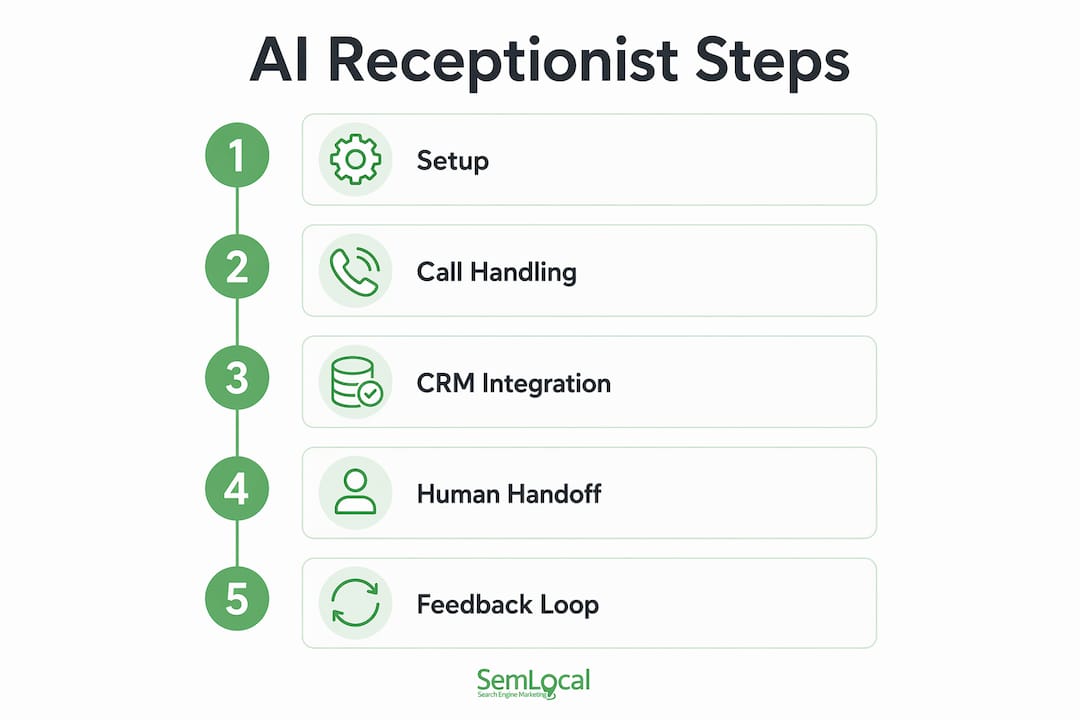
A phased rollout reduces risk and improves accuracy. Deploying everything at once is how implementations fail; the sequence below starts with the lowest-risk, highest-return tasks and builds from there.
Rollout checklist:
- Build the knowledge base. Document your services, hours, pricing rules, team names, and FAQs. This is the source the AI draws from — gaps here produce wrong answers.
- Map your business rules. Define what counts as an emergency, which calls must transfer to a human immediately, and what the AI should do if it cannot resolve a request.
- Set handoff triggers. Explicit rules: caller asks for a person, AI misunderstands twice in a row, caller uses distress language, or the request falls outside configured scope.
- Configure integrations. Test calendar booking, CRM logging, and SMS confirmation end to end before any live calls.
- Run simulated calls. Cover your 10–15 most common call types, plus edge cases. Audit every transcript.
- Soft launch at one location. Run the AI live for two to four weeks at a single site. Track answered rate, booking conversion, transfer rate, and caller satisfaction.
- Audit and iterate. Review transcripts weekly. Retrain on real call data. Pay particular attention to accent-related transcription errors and any intent misclassifications.
- Multi-site rollout. Once accuracy and booking rates meet your targets, expand with confidence.
A practical step-by-step rollout guide for UK small businesses covers each phase in detail.
Pro Tip: Assign one person internally to own QA during the pilot — someone who listens to five to ten calls per week, flags transcription errors, and feeds corrections back to the vendor. Without this, accent and jargon issues compound rather than improve.
What does an AI receptionist cost, and what return can you expect?
Pricing follows three shapes in the UK market. Pure AI subscriptions suit lower call volumes and carry the most modest monthly fees. Per-interaction pricing scales with call volume and suits businesses with unpredictable demand. Hybrid models — AI handling routine calls with human agents available for complex ones — carry higher monthly fees but deliver the broadest coverage.

What drives price upward: call volume, number of integrations, custom training requirements, SLA uptime guarantees, and whether human handoff is included. A basic AI-only plan for a small trades business with one phone number and calendar integration sits at the lower end of the market. An enterprise deployment with CRM integration, custom accent training, and a managed human overflow tier sits considerably higher.
The ROI calculation for appointment-driven businesses is straightforward. Here is a worked example using conservative assumptions:
Payback on setup costs often occurs within a few months for appointment-driven businesses with consistent call volume. The cost and service benefits for small firms are covered in detail in a dedicated analysis.
Key metrics to track during the pilot: calls answered rate, bookings created per week, transfer rate to human, and caller satisfaction (collected via post-call SMS survey or call-back).
How do you choose the right AI receptionist provider?
Prioritise integration compatibility, data protection, and clear human-handoff policies above all else. A system with a pleasant voice but no CRM integration or opaque GDPR practices is not fit for UK deployment.
Vendor evaluation checklist — numbered:
- Does the platform integrate natively with your CRM, calendar, and phone system, or does it require custom API work?
- Where are call recordings and transcripts stored? Is data residency UK or EEA?
- What is the data retention period, and can deletion requests be fulfilled automatically?
- Is the platform ICO-registered, and does it sign a Data Processing Agreement?
- What is the guaranteed uptime SLA, and what is the support response time for outages?
- Is there a pilot or trial period before a long-term contract?
- How is the AI trained on your business rules, and who owns that training data?
- What human-handoff options are available, and how is context passed to the human agent?
Questions to ask in a live demo:
- Show me a live booking against my calendar, including a slot conflict.
- Demonstrate transcription accuracy on a call with a strong regional accent.
- How does the system handle a caller who asks to speak to a person?
- Walk me through how you process a GDPR deletion request end to end.
AIM Agency designs, builds, and manages custom AI voice agents for UK service businesses, covering discovery, knowledge base creation, CRM and calendar integration, accent tuning, and a managed pilot. For businesses that want a done-for-you deployment rather than a DIY configuration, AIM Agency handles the full process from initial audit to live rollout.
A real deployment: what results look like in practice
A UK engineering services firm came to AIM Agency with a familiar problem: a high volume of inbound enquiries, a small team stretched across site work, and calls going unanswered during peak hours and after 5 PM. The business was losing leads to competitors who picked up the phone.
AIM Agency deployed a custom AI voice agent integrated with the firm’s CRM and calendar. The pilot ran for four weeks at a single contact number, with weekly transcription audits and handoff rules configured for complex technical enquiries and high-value client calls.
The outcome: missed calls dropped sharply, qualified leads were captured outside business hours for the first time, and the sales pipeline moved from reactive to predictable. The full case study is available at AIM Agency’s case study.
The implementation highlights: the pilot ran four weeks, integrations covered CRM lead logging and calendar booking, and handoff triggers were set for any caller who mentioned a specific named client or requested a technical specification. The AI handled all first-contact qualification; the human team handled relationship and proposal work.
Key metric: Qualified leads captured outside business hours grew from near zero to a consistent weekly figure, converting the phone from a daytime tool into a 24/7 revenue channel.
Key takeaways
An AI receptionist delivers measurable value for UK service businesses when it is correctly integrated with your CRM, calendar, and phone system — and deployed with clear human-handoff rules from day one.
| Point | Details |
|---|---|
| Integration determines value | A system without CRM and calendar connections can only take messages; full integration enables real-time booking and lead capture. |
| Phased rollout reduces risk | Start with a single-location pilot, audit transcripts weekly, and expand only after accuracy and booking targets are met. |
| GDPR compliance is non-negotiable | Confirm data residency, retention policy, and ICO registration with any vendor before signing a contract. |
| ROI is fastest for appointment-driven businesses | Trades, dental, legal, and hospitality businesses typically recover setup costs within one to three months through missed-call conversion. |
| AIM Agency for UK deployments | Semlocal’s AIM Agency designs, builds, and manages custom AI voice agents for UK service businesses, from pilot to full rollout. |
Why the conventional wisdom on AI receptionists gets it wrong
Most articles about AI receptionists focus on the voice quality — how natural it sounds, whether callers can tell it is AI. That is the wrong thing to optimise for first. The real bottleneck in every deployment is business logic: what the system does when a caller says something unexpected, how it handles a booking conflict, and whether it knows the difference between a routine enquiry and a genuine emergency.
Businesses that treat an AI receptionist as a voice upgrade to their existing voicemail will be disappointed. Businesses that treat it as a new front-desk employee — one that needs a proper induction, clear rules, and regular performance reviews — will see the results the technology actually delivers. The pilot phase is not a formality; it is where you discover that your “standard” booking process has twelve edge cases nobody documented, and where you fix them before they frustrate real callers.
The other thing most guides understate is the human-handoff design. Getting the AI to answer calls is straightforward. Getting it to recognise the right moment to hand off — and to do so with context already passed to the human — is what separates a good deployment from one that damages your brand. Define those triggers before you go live, not after your first complaint.
Semlocal’s AIM Agency: from first call to fully managed AI receptionist
If you have read this far and recognise your business in the use cases above, the next step is a discovery call with AIM Agency. Semlocal’s AI arm designs, builds, and manages custom AI voice agents for UK service businesses across hospitality, trades, legal, estate agency, and more. The engagement covers everything: knowledge base creation, CRM and calendar integration, accent tuning for UK regional voices, handoff rule configuration, and a managed four-week pilot before full rollout.
Clients move from missed calls to a predictable, measurable booking pipeline. The typical engagement combines a project fee for design and build with a monthly management fee for ongoing optimisation — no long-term lock-in before the pilot proves its value. Most pilots go live within two to four weeks of the initial discovery call.
Book a discovery call with AIM Agency to map your call flows, identify the highest-value automation opportunities, and get a clear picture of what a pilot would look like for your business.
Useful sources and further reading
- What is an AI receptionist? (telli) — technical explainer covering the listen-think-speak loop, word error rates, and integration requirements.
- AI receptionist use cases by industry (Upfirst) — sector-by-sector breakdown of where AI receptionists deliver the strongest ROI, including healthcare, legal, and trades.
- Average cost of an AI receptionist (Upfirst) — pricing model overview and cost-band guidance for small businesses.
- How does an AI receptionist work? (AIEmply) — plain-English technical walkthrough of the full call-handling pipeline, including latency figures and consumer comfort data.
- AI receptionist use cases (GetVoIP) — industry-specific call flows, integration requirements, and guidance on what to automate first.
- AIM Agency — UK AI voice agent deployments — Semlocal’s managed AI receptionist and automation service for UK service businesses.
- Step-by-step AI receptionist guide for UK small businesses — practical rollout guide covering pilot design, KPI setting, and integration planning.
- AI receptionists: better service, lower costs for small firms — cost and service benefit analysis for UK small businesses.
- Case study: from missed calls to predictable growth — real-world AIM Agency deployment with metrics and implementation detail.
Recommended
- AI receptionists: the UK small business guide – AI Management Agency
- Step by step AI receptionist guide for UK small businesses – AI Management Agency
- Call answering process guide for UK small businesses – AI Management Agency
- Intelligent virtual receptionist: UK small business guide – AI Management Agency