Lead every section with a 1–2 sentence direct answer, confirm the page is indexable in Search Console, and mark up your FAQs with schema. That trio, backed by Google’s own Search Central guidance, is the single biggest lever for AI overviews optimization. Everything else in this guide builds on it.
TL;DR:
- Content should be answer‑first, with key responses delivered within the first 40 to 60 words of each section to improve AI citation chances.
- Structuring content around extractable, self-contained fragments like clear FAQs, lists, and notable data points boosts the likelihood of being referenced in AI summaries.
- Technical eligibility, including proper indexing, crawlability, and schema markup, is essential before content optimization efforts for AI overviews begin.
- Small, incremental experiments on high‑ranking pages using answer‑first restructuring and schema updates most effectively improve citation visibility.
- Focusing on unique, specific insights and maintaining consistent answer‑first formats across pages increases chances of being selected as a source by AI systems.
Table of Contents
- What are AI overviews and when do they appear?
- How do AI overviews work: query fan‑out and extractable fragments?
- Technical foundations: crawlability, indexing and Search Console checks
- Content structure and writing: creating extractable, answer‑first sections
- Schema and structured data: what to add and how to test it
- Measurement and experimentation: test design and tracking citation wins
- Common myths and pitfalls to avoid
- Semlocal’s practitioner playbook for service businesses
- Use cases and benefits of AI overviews across industries
- Challenges and limitations of AI overviews
- Best practices for creating effective AI overview content
- Emerging trends and future outlook for AI overviews
- Expert perspective: what actually moves the needle in the next 90 days
- Turn AI Overview visibility into booked calls
- Sources
What are AI overviews and when do they appear?
An AI overview is a generated summary that sits above traditional blue links, built using retrieval‑augmented generation, or RAG. Google’s systems pull relevant passages from indexed pages, synthesise them into a direct answer, and cite the sources it drew from. You’ve almost certainly seen this on searches like “how does compound interest work” or “best time to aerate a lawn”.
They tend to surface on informational and long‑tail queries where a synthesised answer genuinely saves the searcher a click. Sharp product comparisons and highly transactional searches still lean on traditional results, but anything shaped like a question, a definition, or a “how to” tends to trigger the feature.
This matters more than it might first appear. Pew Research found that users are markedly less likely to click through to a website when an AI summary appears in the results. That single finding reframes the whole discipline of AI overviews optimization: it’s no longer only about ranking. It’s about being the source the AI actually chooses to cite, because that citation may be the only exposure your page gets.
For content creators, this changes the incentive structure. A page ranking third or fourth in traditional results can still win if it’s structured well enough to be picked up as a citation. Conversely, a page ranking first with dense, unstructured prose can be skipped entirely. Optimizing AI applications like this one is less about domain authority alone and more about how retrievable your specific answer is.
How do AI overviews work: query fan‑out and extractable fragments?
Google doesn’t treat your search as one question. It decomposes it into several related sub‑questions, a process often called query fan‑out. Search a phrase like “best AI overview strategy for local businesses” and the system may silently ask itself variations: what are AI overviews, how do local businesses appear in them, what content format works best, what’s the difference between AI overviews and featured snippets. HubSpot’s practitioner playbook recommends mapping this fan‑out deliberately, listing every sub‑question your topic touches and making sure each one has an answer living somewhere on your page.
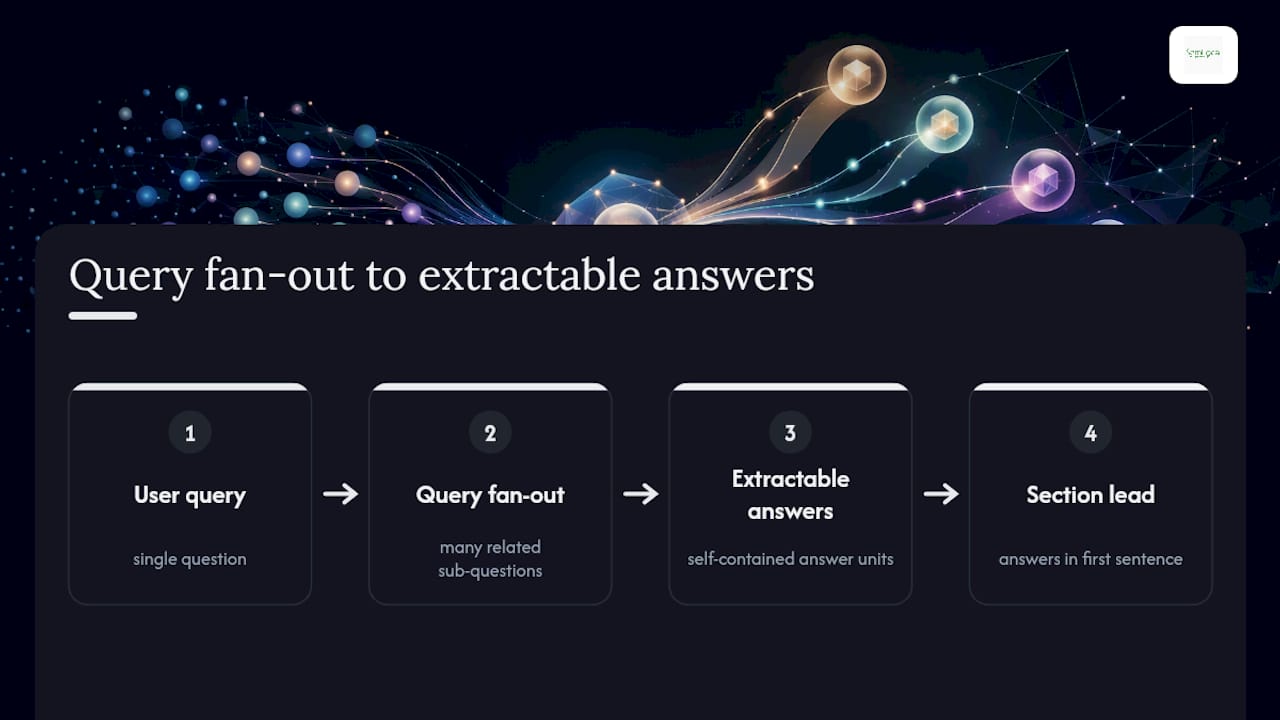
This is where extractable fragments come in. The AI isn’t reading your page the way a human does, scanning top to bottom for context. It’s hunting for self‑contained chunks it can lift cleanly: a short definitional sentence, a numbered step, a table row, a schema‑marked answer. Industry analysis of entity‑centric optimisation frames this as the core skill of the discipline: content built around named entities and their relationships tends to fan out into cleaner sub‑answers than content built around loose narrative.
Practically, this means your page needs to work on two levels simultaneously. It has to read naturally for a human visitor, with argument, nuance, and flow. And it has to contain individually quotable units that make sense stripped entirely of that surrounding context. A sentence like “this approach tends to work better” fails that second test, because “this” refers to something three paragraphs up. A sentence like “answer‑first formatting places the direct response in the first 40 to 60 words of a section” passes, because it stands alone.
Think of each H2 or H3 section on your page as a mini answer engine. If a sub‑question gets fanned out from a user’s query, does your section under that heading answer it in the first sentence or two? If not, that’s the gap to close first.
Technical foundations: crawlability, indexing and Search Console checks
Before any content or schema work matters, the page has to be technically eligible. Google’s own Search Central guidance is blunt about this: there’s no separate technical standard for AI overviews. If your page is indexed, crawlable, and eligible for a standard snippet, it’s eligible for generative AI features too. The bar is the same one you’ve always been held to, just with higher stakes for missing it.
That said, a few checks catch out even experienced teams:
- Confirm the page isn’t blocked by a
noindextag or an accidentalnosnippetdirective, either of which removes it from consideration entirely. - Check your
robots.txtisn’t disallowing crawl paths that lead to the page, particularly after a site migration or a CMS change. - Run a live rendering test to confirm the answer‑first content you’ve written is actually present in the rendered HTML, not hidden behind a JavaScript interaction the crawler never triggers.
- Watch crawl budget on large sites. Pages buried five or six clicks from the homepage, or duplicated across faceted URLs, often get crawled too rarely to stay fresh in the index.
- Check canonical tags point where you intend them to. A miscanonicalised page can quietly hand its citation potential to a duplicate.
Search Console gives you a direct read on how you’re doing here. The Generative AI performance report shows impressions and clicks specifically tied to AI‑powered surfaces, separate from your standard performance data. Reviewing this report against your traditional Search Console metrics reveals a pattern worth watching: pages with strong traditional rankings but weak AI Overview presence usually have a structural problem, not a relevance problem. That’s almost always the first place to look before touching content.
Content structure and writing: creating extractable, answer‑first sections
The single highest‑leverage change you can make is putting the direct answer first. Every section needs its response delivered in the opening 40 to 60 words, before any throat‑clearing, before the history of the topic, before the caveats. Practitioner testing across multiple SEO teams consistently backs answer‑first formatting, FAQ sections, and extractable lists as the tactics most correlated with citation.
Four moves make this concrete:
- Write the answer before you write the context. If a section is titled “How long does Google Business Profile verification take?”, the first sentence should state the timeframe, not explain what a Google Business Profile is.
- Match headings to the actual questions people ask. A heading like “Verification timelines” is descriptive but passive. “How long does verification take?” mirrors the query and gives the fan‑out system a direct hook.
- Pre‑package your lists and takeaways. Bullet points, numbered steps, and short FAQ entries are already shaped the way RAG systems want to consume content, so build them deliberately rather than as an afterthought at the bottom of the page.
- Push up your fact density. Generic summaries of well‑known information rarely get cited over a page offering something distinct. Google explicitly favours first‑hand data, unique statistics, and original perspective over content that just restates the consensus.
That fourth point deserves emphasis because it’s the one teams skip most often. If your page on local SEO says “reviews matter for rankings,” that’s true and useless. A page saying “profiles with 40 or more reviews see markedly stronger map pack visibility than those with fewer than ten” gives the AI something specific to extract and attribute. Entity links matter here too. Naming the standards, tools, or organisations relevant to your claim (Search Console, a named schema type, a specific ranking factor) gives the retrieval system firmer ground to stand a citation on.
Pro Tip: Read your finished section aloud, then delete the first sentence. If the section still makes sense and answers the question, you buried the answer too deep. Move it back to the top.
Schema and structured data: what to add and how to test it
Structured data doesn’t guarantee a citation, but it removes ambiguity for machines trying to parse what your page is saying. Multiple practitioner sources point to FAQPage and Article schema as the most consistently useful markup for AI extraction, because both formats explicitly label a question, an answer, and a publication context in machine‑readable form.
The schema types worth prioritising:
- FAQPage schema for any genuine question‑and‑answer content, with each answer kept to roughly 40 to 60 words, matching the length that practitioner guides find works best for extraction.
- Article or BlogPosting schema on every substantial content page, giving the system clear signals on authorship, publish date, and content type.
- HowTo schema for genuine step‑by‑step processes, though Google has scaled back rich result display for this type, so treat it as a machine‑readability aid rather than a visual guarantee.
- MerchantReturnPolicy and related product fields where you’re covering e‑commerce topics, since transactional AI Overview queries increasingly pull structured commerce data directly.
Once markup is live, don’t assume it’s correct. Run every templated page through Google’s Rich Results Test and validate the underlying JSON‑LD with the Schema.org validator. A single missing closing brace can invalidate an entire block silently, and you won’t know until a rich result fails to appear months later.
Measurement and experimentation: test design and tracking citation wins
Treat AI overviews optimization as a series of small, measurable experiments rather than one sweeping rewrite. The Generative AI performance report in Search Console gives you baseline impressions and clicks for AI surfaces specifically, and cross‑referencing that against your standard organic metrics tells you whether a change actually shifted citation behaviour or just moved traditional rankings.
A workable test structure:
- Pick three to five pages that already rank well for high‑intent queries but show weak AI surface performance.
- Apply one change at a time, answer‑first restructuring first, then schema, then fact density, so you can isolate what moved the needle.
- Hold a comparable set of pages untouched as a rough control group.
- Track citation appearances manually by running your target queries and noting whether your domain gets named in the summary.
- Layer in a third‑party tracking tool alongside Search Console, since native reporting can lag or aggregate data in ways that obscure page‑level detail.
Practitioner testing consistently recommends running these as small pilots rather than sitewide changes, because a controlled rollout gives you a clean signal on what actually caused a citation shift. The reduced click rate that Pew Research documented when AI summaries appear is precisely why this measurement discipline matters: if clicks are falling regardless, citation visibility becomes the metric that tells you whether you’re still winning the search, even when your traffic graph says otherwise.
Common myths and pitfalls to avoid
An llms.txt file sounds authoritative but isn’t a recognised or required standard for any major AI system. Adding one won’t hurt you, but treating it as a shortcut to citations wastes time better spent on actual page structure.
Splitting a solid page into a dozen thin ones purely to create more “extractable chunks” usually backfires. Google’s spam policies target exactly this kind of scaled, low‑value content, and a thin page with one fact on it is less likely to be cited than a well‑organised page covering the topic properly.
The pattern underneath both mistakes is the same: chasing the mechanism instead of the substance. Google’s own guidance is explicit that unique, first‑hand insight beats generic restatement every time. Original data and a genuine point of view will outperform a technically perfect but hollow page.
Semlocal’s practitioner playbook for service businesses
Working across hospitality, home services, and trades pages, Semlocal runs the same audit sequence before touching a word of copy. It starts with an index and crawlability check, confirming every priority page is actually eligible before spending time on content. Next comes a schema audit against existing FAQ and service pages, flagging anything missing FAQPage or Article markup. Then comes extractable answer mapping, going section by section through a page asking whether the first sentence actually answers the heading above it.
Prioritisation matters as much as method. Not every page deserves the same effort, so Semlocal ranks service pages on two axes: current search position and conversion intent. A page already ranking on page one for “emergency plumber near me” gets pilot treatment first, because the upside from a citation win is immediate and measurable.
What Semlocal actually tracks:
- Call volume and booking form completions tied to specific service pages
- Movement in the Generative AI performance report for those same pages
- The number of citation appearances logged during manual query testing
- Changes in traditional ranking position as a secondary signal, not the primary one
For a Google Business Profile tied closely to a service page, the two optimisation efforts tend to reinforce each other directly.
Use cases and benefits of AI overviews across industries
The benefit shifts depending on the industry, but the underlying mechanic stays the same: whoever answers most clearly wins the citation. In home services and trades, a well‑structured page on “how much does a boiler service cost” can capture a citation ahead of directories with thin, unstructured listings. In hospitality, an FAQ‑rich page on cancellation policies or check‑in times gets pulled directly into a summary, saving a guest the click while still building brand recognition through the citation itself.

Finance and accounting content benefits from this format too, particularly on regulatory or process questions like filing deadlines or eligibility thresholds, where a precise, well‑sourced answer is exactly what a retrieval system wants to lift. Cyber security firms find similar traction on definitional and “what is” queries, where a clear, jargon‑light explanation outperforms a dense technical whitepaper that never states its conclusion plainly.
Real estate content sees strong results from structured comparison and process pages, things like “what’s the difference between freehold and leasehold,” where a direct definition followed by supporting detail matches exactly how fan‑out systems decompose the query. Across all these sectors, the businesses winning citations aren’t necessarily the biggest names. They’re the ones whose pages happen to be shaped the way the retrieval system wants to consume them, which levels the field for smaller, well‑structured operators against larger competitors with sprawling but poorly organised sites.
Challenges and limitations of AI overviews
The most immediate challenge is the click‑through hit. Pew Research’s data on reduced clicks when an AI summary appears means even a successful citation may not translate into the traffic volume a page once earned from a strong ranking. Being cited is valuable for visibility and trust, but it doesn’t automatically restore the click economics content teams built their strategies around.
Attribution is another genuine limitation. AI overviews sometimes cite multiple sources for a single claim, diluting the credit any one page receives, and the summary format can occasionally compress nuance in a way that misrepresents a source’s actual position. There’s no reliable way to appeal or correct a misrepresentation the way you might request a correction from a journalist.
Volatility compounds this. AI overview presence and phrasing can shift between searches for reasons that aren’t always transparent, making it harder to build a stable measurement baseline compared with traditional ranking positions, which tend to move more predictably.
There’s also a structural tension for commercial content. Highly transactional or competitive commercial queries are less likely to trigger an AI overview at all, so businesses relying heavily on bottom‑funnel keywords may see limited exposure to this feature regardless of how well their pages are structured. The clearest wins remain concentrated in informational and long‑tail territory, which means AI overviews optimization complements a conversion strategy rather than replacing one outright.
Best practices for creating effective AI overview content
The practices that consistently correlate with citations share a common thread: they reduce the work an AI system has to do to extract a clean answer. Front‑load every section with its conclusion. Use headings that mirror actual search phrasing rather than internal jargon. Keep FAQ answers tight, in the 40 to 60 word range that practitioner data flags as most extraction‑friendly.
Beyond formatting, substance still decides the winner between two well‑structured pages. Original statistics, named sources, and specific figures give a retrieval system something concrete to attribute, rather than a paraphrase of what a dozen competitor pages already say. Linking out to authoritative entities, standards bodies, named tools, credible studies, signals to both readers and machines that a claim has grounding beyond the page itself.
Consistency across a site matters more than most teams assume. If one service page follows answer‑first structure perfectly and the next reverts to a meandering introduction, that inconsistency slows down any sitewide gains, because the AI has no reason to trust that your formatting holds. A complementary technical breakdown on structuring pages for citation reinforces the same point: consistency and technical soundness compound, they don’t operate in isolation from good writing.
Finally, treat every page as a living document. Content that gets revisited, refreshed with new data, and tightened over time tends to outperform a page written once and left untouched, because both search engines and generative systems favour freshness signals when a topic has any time sensitivity at all.
Emerging trends and future outlook for AI overviews
Query fan‑out is only going to get more granular. As retrieval systems get better at decomposing complex questions into sub‑questions, pages that map cleanly to a narrow, well‑defined slice of a topic will have an advantage over sprawling pages trying to cover everything. Expect the value of tightly scoped, deeply specific sections to keep rising relative to broad, generalist content.

Multimodal retrieval is another shift worth tracking. As AI systems get more capable of pulling from images, tables, and structured data alongside text, pages that pair a strong prose answer with a clean supporting table or diagram are likely to have an edge that text‑only pages don’t.
Measurement infrastructure will mature too. Search Console’s Generative AI performance report is still relatively new, and it’s reasonable to expect Google to expand what it surfaces there as the feature itself becomes more central to search behaviour. Third‑party tools tracking citation‑level detail are likely to become more standard in an SEO professional’s toolkit, the way rank trackers became standard a decade ago.
The underlying shift, though, is a permanent one, not a passing trend: search is moving from a list of links towards a synthesised answer with sources attached. Businesses that treat AI overviews optimization as a bolt‑on tactic will keep losing ground to those that build answer‑first, well‑structured content as their default writing standard, not an occasional exception.
Expert perspective: what actually moves the needle in the next 90 days
Most teams overcomplicate this. Start with the pages you already rank for on high‑intent queries and pilot three of them, not thirty. Restructure for answer‑first formatting, add FAQ and Article schema, and measure before touching anything else.
Schema upgrades are the cheapest win available. They cost an afternoon and carry almost no downside risk, yet teams routinely deprioritise them in favour of flashier content rewrites.
What I’d resist is the urge to declare victory after one round. Citation behaviour shifts, so treat your first pilot as a baseline, not a verdict, and scale only what the data from your Search Console report actually confirms moved.
— Geoff
Turn AI Overview visibility into booked calls
Getting cited by an AI overview is only half the job for a local service business. The other half is making sure the citation, and every search that follows it, leads somewhere that actually converts, which is where a properly optimised Google Business Profile earns its keep. Semlocal manages that whole layer end to end: profile optimisation, review management, and Local SEO working together so the businesses we manage show up whether the searcher clicks a map pin or reads an AI summary.
Where this article covered the content and schema side of AI overviews optimization, Semlocal handles the local visibility side that content alone can’t fix, the map pack ranking, the profile completeness signals, and the review volume that AI systems increasingly draw on when summarising local businesses. If you want a straight audit of where your profile currently stands, start with our Google Business Profile Manager and see exactly what’s holding your visibility back before you spend another hour on content changes.
Sources
For the official baseline, Google’s Search Central AI optimisation guide remains the authoritative reference, alongside the Generative AI performance report in Search Console for direct measurement.
For practitioner tactics, Semrush’s AI Overviews guide, HubSpot’s 2026 AIO playbook, and Conductor’s ten‑step optimisation breakdown each cover formatting and schema in more depth. For behavioural context, Pew Research’s study on AI summary click behaviour is worth reading in full.
- Optimizing your website for generative AI features on Google Search
- Google users are less likely to click on links when an AI summary appears in the results
- How to optimize for AI overviews (AIOs): A complete 2026 playbook