AI delivers measurable gains across every stage of business communication: faster responses, more relevant messaging, richer customer insight, and round-the-clock availability without proportional headcount growth. For UK service businesses, the practical case rests on five core advantages of AI communication, each of which translates directly into revenue or cost outcomes.
The top AI communication benefits at a glance:
- Efficiency and automation — AI drafts emails, summarises meetings, and handles routine follow-ups, freeing staff for higher-value work.
- Personalisation at scale — dynamic content and predictive segmentation mean each customer receives messaging that fits their context, not a generic broadcast.
- Collaboration and knowledge sharing — automated transcripts, searchable summaries, and intelligent routing cut meeting overhead and speed up decisions.
- Data-driven insights — sentiment analysis and topic clustering turn conversation data into customer intelligence that informs strategy.
- Customer service availability — chatbots and voice agents handle first-contact queries 24/7, reducing wait times and deflecting routine calls.
- Multilingual access — real-time translation and automated subtitling remove language barriers for diverse customer bases.
- Accessibility — voice-to-text, screen-reader-ready outputs, and plain-language generation widen reach to customers with different needs.
Research published in Frontiers in Human Dynamics found that AI acts as a mediator that amplifies communication effectiveness, reporting an indirect effect of approximately 0.286 — a meaningful signal that the technology multiplies the impact of the communication methods already in place.
One caveat is that AI outputs carry risks related to bias, transparency, and data privacy. Each benefit requires appropriate governance, as discussed in the risk section relevant to UK organisations.
Key takeaways
AI communication benefits are most reliably captured when organisations combine a clear pilot structure, quality data, and human oversight — not by deploying technology and hoping for results.
| Point | Details |
|---|---|
| Start with a baseline | Measure current task times and response rates before deploying any AI, so ROI is calculable from day one. |
| Personalisation needs clean data | Tools like Salesforce Einstein and HubSpot only deliver personalisation gains when the underlying customer data is accurate and complete. |
| Governance is non-negotiable | UK GDPR and ICO guidance require transparency and human oversight in AI-mediated communication — build this into your pilot from the start. |
| Native integrations outperform bolt-ons | Embedding AI in your existing CRM or collaboration platform reduces data synchronisation risk and keeps governance simpler. |
| Semlocal for managed AI agents | Semlocal designs and manages custom AI voice, SMS, and web chat agents for UK service businesses, handling setup and optimisation end to end. |
Table of Contents
- How AI communication benefits your personalisation strategy
- How AI saves time on routine business communication
- Does AI genuinely improve team collaboration?
- What can sentiment analysis tell you about your customers?
- How do AI chatbots and voice agents improve customer service?
- Does AI help you communicate across languages and accessibility needs?
- What are the risks and compliance issues with AI communication?
- How to adopt AI for communication: from pilot to scale
- Where is AI in communication headed in the next 12–36 months?
- Change management strategies for adopting AI communication tools
- Employee acceptance and training challenges with AI communication tools
- Where the real value lands for UK service businesses
- Semlocal’s AI agent and managed communication services
- Sources
How AI communication benefits your personalisation strategy
Generic messaging is increasingly expensive to send and cheap to ignore. AI changes that by assembling content dynamically from customer profile data, behavioural signals, and purchase history, so each recipient gets something that fits their situation.
The mechanism works in three layers. First, profile segmentation groups contacts by attributes such as industry, location, or engagement history. Second, dynamic content assembly selects the right subject line, body copy, or product recommendation for each segment at send time. Third, predictive recommendations surface the next-best action based on what similar customers did next.

Tools like Salesforce Einstein, HubSpot, and Copy.ai illustrate the range of approaches available. Salesforce Einstein scores leads and personalises outreach within CRM workflows. HubSpot’s AI content tools generate personalised email sequences from contact data. Copy.ai accelerates the drafting of variant copy for different audience segments. None of these is a silver bullet; their value depends entirely on the quality of the underlying customer data.
Practitioner overviews confirm that AI features embedded in CRM and collaboration platforms deliver practical gains in personalisation and responsiveness — particularly when the AI draws from a single, well-maintained data source rather than fragmented records.
Metrics worth tracking:
- Click-through rate (CTR) per campaign segment
- Email reply rate by personalisation variant
- Conversion rate per outreach sequence
Conversion uplift takes longer to measure reliably and needs at least one full sales cycle of data before drawing conclusions.
How AI saves time on routine business communication
Repetitive communication tasks consume a disproportionate share of a working day: drafting acknowledgement emails, writing up meeting notes, chasing outstanding actions, generating standard proposals. AI handles all of these, and the cumulative time saving across a team is where the ROI becomes visible.
A typical workflow that AI can compress looks like this:
- A client call is recorded and transcribed automatically.
- The transcript is summarised into three to five action items.
- Those items are pushed to the relevant CRM record and assigned to owners.
- A follow-up email draft is generated and queued for human review before sending.
Without AI, that sequence takes 20–40 minutes per meeting. With well-configured automation, the human touch-time drops to a two-minute review. Across ten client meetings a week, that is a meaningful return on the setup investment.
Tools that support this workflow:
- Grammarly for real-time writing assistance and tone adjustment in emails and documents.
- Zapier for connecting applications and triggering automated sequences (transcript arrives → CRM updates → draft email created).
- DocuSign for automating contract and agreement workflows that would otherwise require manual chasing.
Where native platform features cover the same ground, prefer them over bolt-on point solutions. Microsoft Teams’ built-in meeting transcription, for example, removes the need for a separate transcription tool and keeps data within your existing governance boundary.
Pro Tip: Run a two-week baseline measurement before deploying any automation. Log the actual minutes spent on each task you plan to automate. Without a baseline, you cannot calculate ROI, and you cannot tell whether the automation is working or just adding complexity.
Industry guidance is clear that data quality is the primary determinant of whether AI communication projects deliver. Automations fed by incomplete or inconsistent records produce unreliable outputs, which erodes trust faster than the time savings can recover.
Does AI genuinely improve team collaboration?
The honest answer is yes, with conditions. AI improves collaboration most where the bottleneck is information retrieval or meeting overhead, and least where the bottleneck is interpersonal trust or unclear accountability.
Where AI adds clear value in team workflows:
- Automated meeting notes in platforms like Microsoft Teams and Slack mean participants can focus on the conversation rather than note-taking, and absent colleagues get a reliable summary.
- Searchable knowledge bases built from past conversations, documents, and decisions reduce the time spent re-explaining context to new team members.
- Intelligent routing directs incoming queries to the right person or team without manual triage, cutting response lag.
- Summarisation of long email threads or document versions gives decision-makers the key points without reading everything.
Quantitative research published by MDPI in 2025 linked AI features in organisational settings to improvements in informing, message reception, and employee performance. The effect was strongest in environments where communication volume was high and information was previously difficult to retrieve.
Metrics to track collaboration improvement:
- Average meeting length (before and after AI summarisation)
- Time to resolution on internal queries
- Number of follow-up messages per project decision
That is achievable without changing meeting culture, simply by circulating AI-generated summaries that make re-discussion unnecessary.
What can sentiment analysis tell you about your customers?
Sentiment analysis reads the emotional tone of customer messages, reviews, and support tickets, then classifies them as positive, neutral, or negative. Topic clustering groups those signals by theme. Together, they give you a live picture of what customers feel and why, without manually reading thousands of messages.
Practical use cases for UK service businesses:
- CX monitoring: flag negative sentiment in support tickets before they escalate to complaints or public reviews.
- PR risk detection: track brand mentions across channels and alert the team when sentiment shifts suddenly.
- Employee engagement signals: analyse internal survey responses or communication patterns to identify teams under pressure.
Platforms like Zendesk include sentiment scoring within their support workflows, surfacing at-risk tickets automatically. Brandwatch provides broader social listening and trend detection across public channels.
Pro Tip: Never act on sentiment scores alone. This catches systematic bias early and prevents automated escalations based on misread sarcasm or industry jargon.
AI-powered sales call analysis extends the same logic to voice: transcribed calls are scored for objection patterns, competitor mentions, and buying signals, giving sales managers data they previously had to infer from memory.
The risk worth naming: sentiment models trained on general language data can misread industry-specific terminology or regional phrasing. A model that flags “wicked fast” as negative sentiment is not useful. Validate outputs against your specific customer language before scaling.
How do AI chatbots and voice agents improve customer service?
The clearest, most measurable AI communication benefit for service businesses is in customer service. A well-deployed conversational AI handles first-contact queries around the clock, routes complex issues to the right human, and does both without a queue.
Typical outcomes from conversational AI deployment:
- First response time drops from hours to seconds for routine enquiries.
- Handle time on resolved queries falls because the AI retrieves the right answer from a knowledge base instantly.
- Human agents spend more time on complex, high-value interactions rather than answering the same five questions repeatedly.
- 24/7 availability means enquiries captured outside business hours convert rather than going cold.
Research on algorithmic smart replies found they increased messages per minute by approximately 10.2% and raised positive sentiment in exchanges — though the same study noted that when customers suspect they are talking to AI, interpersonal evaluations can suffer. Transparency about AI involvement is not just an ethical requirement; it protects the quality of the customer relationship.
Integration checklist before going live:
- Connect the conversational platform to your CRM so customer history is available at the point of contact.
- Link to a maintained knowledge base — the AI is only as accurate as the information it can access.
- Define clear escalation rules: which query types always go to a human, and how the handover is signalled to the customer.
- Set KPIs before launch: first response time (FRT), resolution rate, and CSAT score.
For UK service businesses handling inbound calls, AI voice agents for call handling can qualify leads, book appointments, and answer FAQs without a receptionist on duty. The practical gain is most visible in hospitality, trades, and property management, where after-hours enquiries are common and conversion windows are short.
Does AI help you communicate across languages and accessibility needs?
For UK service businesses serving diverse communities, language and accessibility barriers are a direct revenue constraint. A hotel guest who cannot get an answer in their language books elsewhere. A customer with a visual impairment who cannot navigate your communications goes to a competitor who makes it easier.
Where AI removes those barriers:
- Real-time translation in chat and email means a customer writing in Polish or Urdu receives a response in their language without a human translator on staff.
- Automated subtitling on video content and meeting recordings makes material accessible to deaf and hard-of-hearing customers and colleagues.
- Voice-to-text transcription supports customers who find typing difficult and staff who need to dictate notes quickly.
- Plain-language generation simplifies complex documents — terms and conditions, policy updates, service agreements — into accessible formats.
Metrics to track:
- Response coverage rate by language (percentage of non-English enquiries receiving a same-language reply)
- CSAT score segmented by customer language
- Reduction in escalations from non-English-speaking customers
Industry summaries of AI benefits in unified communications consistently list multilingual capability and accessibility as practical gains that scale without proportional cost. For a UK hospitality business with international guests, that is a direct competitive advantage.
What are the risks and compliance issues with AI communication?
The benefits above are real. So are the risks, and UK organisations have specific legal obligations that make governance non-negotiable.
Principal risks to manage:
- Bias in outputs — AI models reflect the data they were trained on. If that data underrepresents certain demographics or contains historical bias, the outputs will too.
- Loss of communicative authenticity — over-automated communication can feel impersonal or formulaic, damaging customer relationships that depend on trust.
- Ontological uncertainty — scholarly analysis published in AI & Society (2026) argues that when AI acts as a communicative surrogate, users may not know whether a human or a machine is speaking. Design and governance must restore legibility and accountability.
- Data protection — customer communication data processed by AI systems falls under UK GDPR. The ICO expects organisations to be transparent about automated processing and to maintain human oversight where decisions affect individuals.
Policy checklist for UK organisations:
- Label AI-generated content clearly wherever it is customer-facing.
- Assign a named human reviewer for all AI outputs before they are used in regulated or high-stakes contexts.
- Run bias detection checks on outputs quarterly, using a sample of real interactions.
- Document the provenance of training data and review it when the AI is updated.
- Define retention and deletion rules for communication data processed by AI systems, consistent with your UK GDPR obligations.
- Maintain an escalation path that customers can access without friction.
Pro Tip: Embed a sampling review into your monthly operations rhythm — not as a one-off audit, but as a standing process. This catches drift in output quality before it becomes a complaint or a compliance issue.
For practical guidance on labelling AI outputs and ethical submission practices, this partner resource on submitting AI work ethically covers the key principles in plain language.
This article provides general information only and is not legal advice. Confirm your specific obligations with the ICO or a qualified legal adviser.
How to adopt AI for communication: from pilot to scale
A structured pilot reduces the risk of a costly deployment that does not deliver. The steps below apply to any AI communication use case, from email automation to a full voice agent rollout.
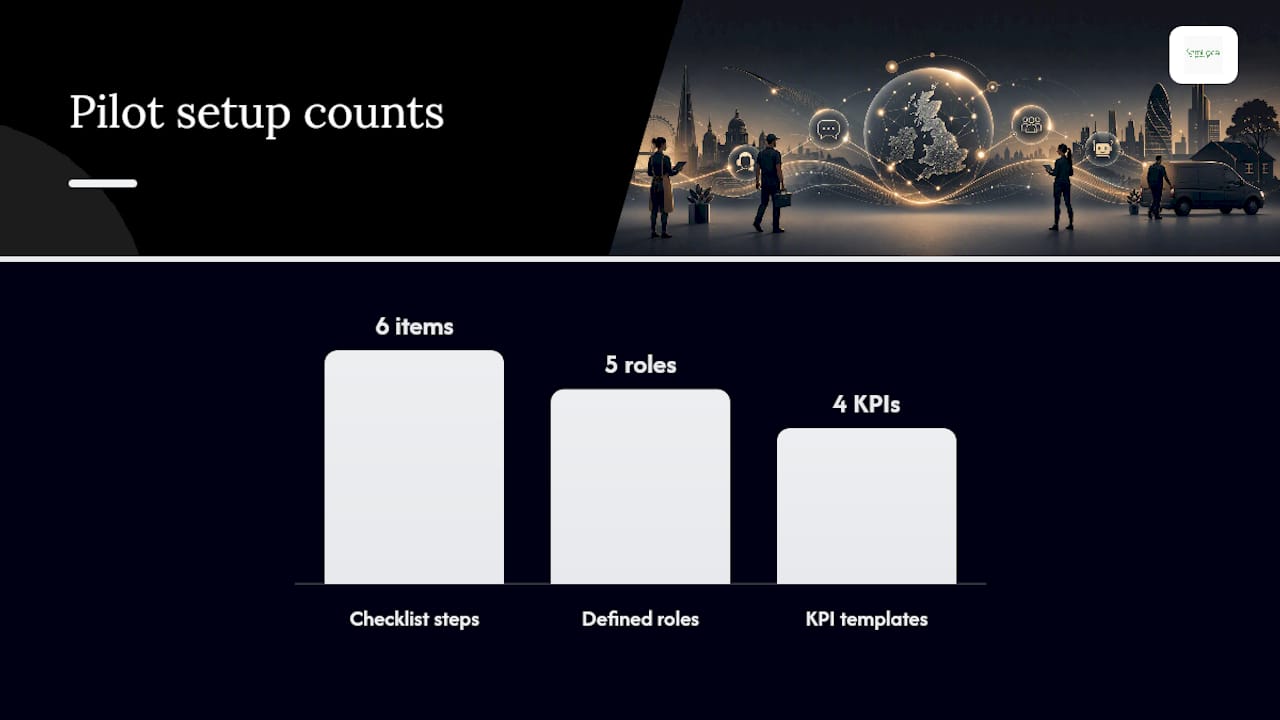
Pilot checklist:
- Define the outcome — state the specific problem you are solving and the metric that will tell you it is solved (e.g. reduce first response time from 4 hours to under 30 minutes).
- Choose a low-risk use case — start with internal communications or a single customer-facing channel, not your primary revenue touchpoint.
- Prepare your data — audit the accuracy and completeness of the records the AI will use. Incomplete data is the most common reason pilots fail.
- Define success metrics — agree KPIs before the pilot starts: time saved, CSAT delta, cost per interaction, resolution rate.
- Run the pilot for 60–90 days — long enough to capture meaningful data, short enough to course-correct without sunk-cost pressure.
- Iterate before scaling — fix what the pilot reveals before expanding to additional channels or use cases.
Roles and responsibilities:
| Role | Responsibility |
|---|---|
| Owner | Accountable for outcomes; approves go/no-go decisions at each stage |
| Data steward | Maintains data quality and governs access to customer records |
| Technical lead | Configures integrations, monitors system performance, manages vendor relationship |
| Reviewer | Samples AI outputs, flags quality issues, feeds back to technical lead |
| Change sponsor | Secures internal buy-in, communicates the pilot’s purpose to affected teams |
KPI templates to monitor:
- Time saved per task (baseline vs. post-deployment, measured in minutes per week)
- CSAT delta (score before vs. after AI-assisted interactions)
- Cost per interaction (total channel cost divided by resolved interactions)
- Resolution rate (percentage of queries resolved without human escalation)
A study across organisational settings found that AI features correlate with improvements in message reception and employee performance — but the effect depends on how well the deployment is prepared. A 60-day pilot with a clear baseline is the minimum viable test.
Pro Tip: Prefer native AI features in your existing CRM or collaboration platform over standalone point solutions. Native integrations reduce data synchronisation problems and keep your customer data in a single governed environment — which matters both for performance and for UK GDPR compliance.
For a practical list of AI tasks UK small businesses can automate, the linked resource covers low-risk starting points that suit most service business contexts.
Where is AI in communication headed in the next 12–36 months?
The shift is already underway. Research published in Frontiers in Communication describes a move to “intelligent maturity” — a state in which AI systems act as adaptive, strategic agents that anticipate needs rather than simply transmitting information. For business decision-makers, that means the tools available in 2027–2028 will be qualitatively different from what most organisations are using today.
Trends to watch:
- Agentic AI — systems that take multi-step actions autonomously (book a meeting, update a CRM record, send a follow-up) without a human initiating each step. The distinction between agentic AI and standard automation is worth understanding before procurement decisions are made.
- Deeper CRM-embedded intelligence — AI that surfaces the right customer context at the right moment within the tools your team already uses, rather than requiring a separate application.
- Improved sentiment and intent detection — models that handle regional accents, industry jargon, and sarcasm more reliably, reducing false positives in customer service workflows.
- Native voice agents — voice AI that handles inbound calls with natural conversation flow, not just menu navigation. Already viable for appointment booking and FAQ handling; improving rapidly for complex queries.
- Governance and legibility tools — vendor-side features that make AI involvement visible to end users, driven partly by regulatory pressure and partly by customer demand for transparency.
Your operational watchlist:
- Track whether your CRM or collaboration platform vendor is embedding AI natively — this often removes the need for a separate tool.
- Assess data readiness now: clean, structured customer data is the prerequisite for every capability on this list.
- Identify one or two skills to develop internally: prompt engineering, AI output review, and data governance are the most transferable across use cases.
The balance between automation and human-centred communication will remain the central tension. Customers want speed and availability; they also want to feel heard. The organisations that get this right will use AI to handle volume and use people to handle complexity.
Change management strategies for adopting AI communication tools
Technology rarely fails because of the technology. Most AI communication projects that underdeliver do so because the people side was not planned with the same rigour as the technical side.
The most effective change management approach for AI communication tools follows a straightforward sequence. Start by communicating the why before the what. Teams that understand the business problem being solved are far more likely to engage constructively than teams presented with a new tool and told to use it. Be specific: “We are deploying AI meeting summaries because our project managers spend an average of 45 minutes per day on meeting notes” lands differently than “We are adopting AI to improve efficiency.”
Identify your internal champions early. In most service businesses, one or two people in each team will be genuinely curious about the new capability. Give them early access, structured time to experiment, and a channel to share what they learn. Their peer influence is more persuasive than any top-down mandate.
Governance and communication about governance matter as much as the tool itself. Staff need to know what the AI will and will not do, what data it uses, and how their own work will be affected. Ambiguity breeds resistance. A one-page plain-English summary of the AI’s role, its limitations, and the escalation path for concerns goes a long way.
Finally, plan for iteration. The first version of any AI communication deployment will need adjustment. Build a formal feedback loop — a monthly 30-minute review with the team using the tool — and act on what you hear. Teams that see their feedback reflected in how the tool is configured become advocates rather than sceptics.
Employee acceptance and training challenges with AI communication tools
Acceptance is not the same as compliance. A team that uses an AI tool reluctantly, without understanding it, will find workarounds and revert to old habits within weeks. Genuine acceptance requires addressing the specific concerns that surface most often.
The most common objection is job security. When AI automates tasks that a person currently does, that person reasonably asks what their role becomes. The honest answer, for most service business contexts, is that AI handles volume and humans handle judgement. Making that division explicit in job descriptions and team briefings removes much of the anxiety.
Training is where most deployments underinvest. A 30-minute onboarding session is not sufficient for a tool that changes daily workflows. Effective training for AI communication tools covers three things: what the tool does, what it does not do, and what to do when it gets something wrong. The third point is the most neglected and the most important. Staff who know how to identify and correct an AI error are far more confident users than those who were only shown the success cases.
Skill gaps vary by role. A customer service agent needs to know how to review and edit AI-drafted responses. A manager needs to understand how to interpret sentiment scores without over-relying on them. A data steward needs to understand what data the AI is drawing from and how to keep it current. Tailored training by role is more effective than a single generic session.
One practical measure: track tool adoption rates by team in the first 90 days. Low adoption in a specific team is a signal worth investigating — it usually points to a training gap, a workflow mismatch, or an unresolved concern that was not surfaced in the rollout.
Where the real value lands for UK service businesses
The AI communication benefits that matter most for UK service businesses are not the ones that look impressive in a vendor demo. They are the ones that show up in your call volume, your booking rate, and your customer retention.
The fastest return on investment tends to come from two places. First, automating the communication tasks that currently fall through the cracks: the after-hours enquiry that goes unanswered, the follow-up email that gets forgotten, the appointment reminder that was never sent. These are not glamorous use cases, but they represent real lost revenue for trades businesses, hospitality operators, and professional services firms.
Second, using AI to make customer communication more consistent. A hotel that responds to every guest message within five minutes, regardless of time of day, builds a reputation that a competitor relying on manual responses cannot match. Consistency at scale is genuinely difficult without AI.
The tools worth evaluating first are the ones already embedded in platforms you use. If your team is on Microsoft Teams or Slack, the AI features available natively are a lower-risk starting point than a standalone deployment. If you use a CRM, check what AI capability is already included before procuring something separate.
One vendor selection principle worth applying: prioritise suppliers who can demonstrate integration with your existing systems over those who require you to migrate data. For a local service business, data migration is a project risk that rarely pays for itself.
Semlocal’s AI agent and managed communication services
More calls, more bookings, and a clear return on every pound invested: that is what Semlocal delivers for UK service businesses through purpose-built AI communication agents.
Semlocal designs, builds, and manages custom AI voice agents, SMS text-back agents, and web chat agents for service businesses across the UK — from hospitality and home services to estate agents and accountancy firms. Each agent is trained on your specific business context, integrated with your CRM and calendar, and configured to qualify leads, book appointments, and handle first-level customer queries without a receptionist on duty around the clock.
The managed service model suits businesses that need results quickly without an internal technical team. Semlocal handles setup, integration, ongoing optimisation, and performance reporting. You see the outcomes — more answered enquiries, shorter response times, higher conversion from inbound contact — without managing the technology yourself.
If you are ready to see what a custom AI agent could do for your inbound communication, book a discovery call with Semlocal to discuss your specific use case and get a clear picture of what is achievable.
Sources
These sources underpin the claims in this article and provide a solid foundation for building an internal business case or preparing for a regulatory review.
- Frontiers in Communication (2026) — intelligent maturity in AI communication
- The Impact of Artificial Intelligence on Communication Dynamics and Performance in Organizational Leadership (MDPI, 2025)
- Artificial intelligence in communication impacts language and social relationships (Scientific Reports, 2023)
- AI Is reshaping business communications. Here’s how to keep up without getting burned (UC Today)
- Better communication through AI (Berkeley Executive Education blog, 2024)
Recommended
- AI in business communication: boost efficiency and response – AI Management Agency
- Enhance customer service with AI: A guide for UK small businesses – AI Management Agency
- AI call handling basics for UK small businesses – AI Management Agency
- AI agent advantages for small UK businesses – AI Management Agency