Structured data for AI means organising information into predictable fields, types, and relationships so machines can retrieve, validate, and reason over it without guesswork. That predictability is what makes AI outputs fast and consistent rather than approximate. This article covers the specific data structures, tools, and steps that turn messy business information into something an AI system can actually use.
TL;DR:
- Structuring data into fixed fields and consistent types is essential for AI to retrieve, validate, and reason over information quickly and reliably.
- Using relational databases, CSVs, and spreadsheets with standard schemas simplifies querying, whereas unstructured data requires additional processing before AI use.
- Index types like HNSW and IVF enable fast semantic search in large-scale retrieval systems, with plan ahead to avoid costly reindexing later.
- Prioritizing data quality, standardization, and ongoing monitoring helps reduce bias, drift, and costs, especially in customer and booking data for service AI agents.
- Focusing first on correctly structuring key datasets, such as customer and booking records, creates a stable foundation for scalable AI implementation.
Table of Contents
- What counts as structured data for AI?
- What data structures and indexes do AI systems actually use?
- Why structured data improves AI outcomes
- How do you manage AI data in practice?
- Implementation checklist: preparing your data for AI
- What are the biggest challenges with AI data, and how do you fix them?
- How structured data makes AI agents work better for service businesses
- What the engineering actually tells you to prioritise
- Get structured customer data working for your AI agents
- Sources
- FAQ
What counts as structured data for AI?
Structured data lives in fixed fields with defined types: a customer record with a name column, a phone number column, and a booking date column that always follows the same pattern. Relational database tables, typed CSVs, and spreadsheets with consistent headers all qualify. An AI system can query these instantly because it already knows what shape the answer will take.
Semi-structured data sits in between. JSON documents and XML files carry labelled fields but allow flexible nesting, so a customer record might have three phone numbers in one entry and none in another. Unstructured data (call transcripts, emails, photos, PDF contracts) carries no predefined schema at all, which is why it needs extra processing before an AI model can use it reliably.
Deciding whether to convert or simply wrap a source depends on how often it changes and how precisely the AI needs to query it:
- Convert to structured when data feeds decisions repeatedly, like appointment slots or pricing tables.
- Wrap with metadata when the source is naturally text-heavy, like support tickets, but still needs tagging for topic and urgency.
- Leave unstructured only when a human, not an AI system, is the primary consumer.
What data structures and indexes do AI systems actually use?
Underneath every AI application sits a set of engineering primitives chosen for a specific job. Arrays and tensors handle the numerical computation inside deep learning models, storing the multidimensional grids of numbers that neural networks multiply and transform at every layer. Hash maps and dictionaries give near-instant lookups for metadata and tokens, which is why they underpin fast search and caching layers.
Graphs model relationships, powering knowledge graphs and the multi-step reasoning that AI agents rely on when orchestrating tasks across systems. Vector indexes solve a different problem entirely: finding semantically similar content. HNSW (Hierarchical Navigable Small World) graphs and IVF indexes are the standard approach for fast nearest-neighbour search in retrieval-augmented generation (RAG) systems, and libraries like FAISS implement several of these index types for production use.
- Arrays/tensors: numerical backbone of neural network computation.
- Hash maps: instant metadata and token lookups.
- Graphs: relationship modelling and agent orchestration.
- Vector indexes (HNSW, IVF, FAISS): semantic retrieval at scale.
- Columnar formats (Apache Arrow): fast column access across large ML datasets, cutting I/O overhead on training pipelines.
Pro Tip: Plan your vector index strategy before you scale past a proof of concept. Reindexing millions of embeddings later is far costlier than choosing the right index structure from the start.
Why structured data improves AI outcomes
Structured inputs cut the preprocessing work that otherwise eats most of a data team’s time, which shortens the gap between collecting information and getting a usable answer from it. Models trained on consistent, well-typed data are also easier to reproduce and audit, because you can trace exactly which fields fed which prediction.
- Speed: less cleaning before every query or training run.
- Reliability: consistent schemas make results reproducible and auditable.
- Reuse: a feature store lets teams share the same validated features across multiple models instead of rebuilding them.
- Visibility: marking up web content with schema.org and JSON-LD helps search systems and AI understand it, improving eligibility for rich results. Google has documented cases, including Rakuten, where structured data correlated with higher engagement on surfaced pages.
Schema markup also feeds the knowledge graphs that many AI overviews and generative search tools draw on, which raises the odds that your content gets cited rather than paraphrased incorrectly.
How do you manage AI data in practice?
Most AI data problems break down into the same pipeline stages, regardless of industry: ingestion, cleaning, labelling, feature engineering, storage, and serving. Effective AI data management prioritises quality, diversity, and scale over rigid consistency, which is a different mindset from traditional database administration.
- Ingestion: tools like Fivetran or Talend pull data from source systems.
- Cleaning and labelling: platforms such as Labelbox standardise and tag raw inputs.
- Storage: lakehouse systems like Snowflake, BigQuery, or Couchbase hold data at scale.
- Feature engineering: feature stores such as Feast or Tecton turn raw fields into reusable model inputs.
- Metadata and lineage: tools like Apache Atlas or DataHub track where data came from and how it changed.
- Monitoring: services such as Monte Carlo or WhyLabs flag quality issues before they reach production.
Tool choice depends on scale, latency tolerance, governance requirements, and your team’s existing skills. AWS documents several architecture patterns for querying structured stores with generative AI, from text-to-SQL to managed knowledge bases, each trading off real-time access against governance control. If any of your data touches public web pages, JSON-LD markup matters here too: it is what makes that content legible to the same AI systems querying your internal stores.
Pro Tip: Don’t buy a tool for every stage on day one. Start with whichever stage is currently your biggest bottleneck, usually cleaning or labelling, and add the rest as volume justifies it.
Implementation checklist: preparing your data for AI
Getting from scattered spreadsheets to AI-ready data doesn’t require a year-long project. It requires the right order of operations:
- Inventory everything. Catalogue existing datasets with metadata describing origin, owner, and update frequency.
- Standardise schema. Agree on field types and naming conventions; switch to columnar formats like Apache Arrow for large training sets.
- Version your features. Store feature definitions in a feature store so models share consistent inputs.
- Add validation and monitoring. Set alerts for schema drift and define retraining triggers before accuracy slips.
- Lock down access. Pseudonymise personal fields and restrict who can query raw versus processed data.
- Plan the vector index early. Decide on HNSW or IVF before your embedding volume forces a costly rebuild.
Pro Tip: Version your feature definitions the same way you version code. A silent change to how “active customer” is calculated can quietly break three downstream models at once.
What are the biggest challenges with AI data, and how do you fix them?
Every team preparing data for AI runs into the same handful of problems, and none of them are solved by better models alone.
- Bias: uneven sampling or inconsistent labelling standards skew outcomes; fixing this means auditing label guidelines and running fairness checks before training, not after.
- Drift: real-world data shifts, so monitoring and scheduled retraining catch degrading accuracy before customers notice.
- Cost: embedding and annotation runs are expensive, and repeatedly regenerating the same context adds up fast. Persisting context where possible reduces that recurring “sense work” bill.
- Privacy: pseudonymise identifiers and process sensitive fields locally where feasible, keeping raw personal data out of training sets entirely when you can.
- Complexity: build small, reusable primitives (one clean customer schema, one feature store) rather than a single sprawling platform on day one.
How structured data makes AI agents work better for service businesses
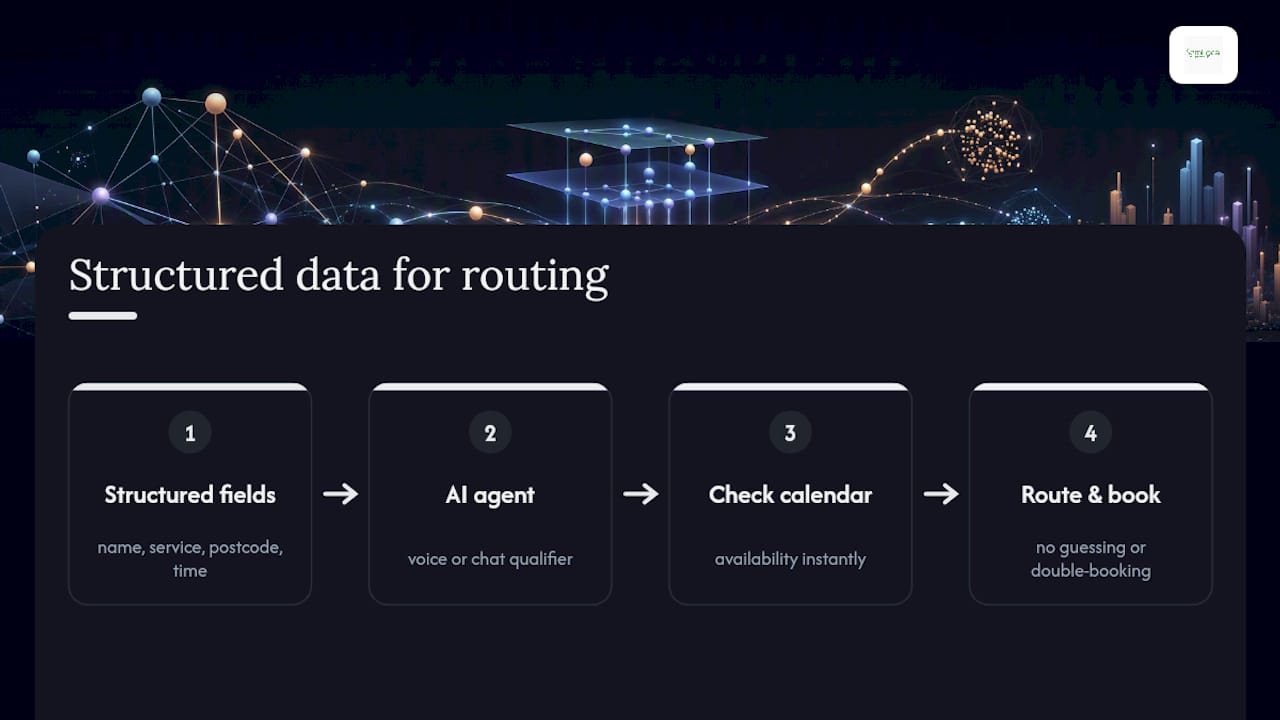
Booking and enquiry systems live or die on field consistency. An AI voice or chat agent qualifying a lead needs a customer’s name, service type, postcode, and preferred time slot to arrive in the same shape every single time, or it will misroute the call or double-book a slot. Structured customer and calendar data is what lets an agent check availability instantly instead of guessing.
This is precisely the gap a specialist closes for service businesses managing high enquiry volumes. Reading AI agent best practices for UK businesses is a reasonable starting point if you want to see how data quality feeds agent accuracy. Teams with basic technical resource can trial the checklist above in-house first; those juggling multiple systems, calendars, and lead sources usually see faster returns bringing in a specialist.
What the engineering actually tells you to prioritise
The conventional advice on AI data preparation spends too long on model selection and not nearly enough on the plumbing underneath it. Tensors, hash maps, graphs, and HNSW indexes aren’t academic trivia. They’re the reason one RAG system answers a query in milliseconds and another times out under load. Get the structure wrong, and no amount of prompt engineering fixes it downstream.
Where I think most teams go wrong is treating structured data as a one-off migration project rather than an ongoing discipline. Schema drifts. Fields get repurposed. A feature store that was clean in January is quietly wrong by June unless someone owns it. The businesses getting real value from AI right now, in my reading of how this space is developing, aren’t the ones with the fanciest models. They’re the ones who standardised their booking, customer, and inventory fields early and kept them that way.
If you’re starting from nothing, don’t try to structure everything at once. Pick the one dataset your AI project depends on most (usually customer and booking records) and get that right first. Everything else can follow once that foundation holds.
— Geoff
Get structured customer data working for your AI agents
Building the pipeline described above (ingestion, feature stores, vector indexes, ongoing monitoring) takes real engineering time most service businesses would rather spend on customers, not infrastructure. Some agencies manage this end to end: your Google Business Profile data, booking fields, and enquiry records get structured and connected to AI voice and chat agents that qualify leads and book appointments without you touching a schema document, as explained in AI for Agencies: Scale Client Work Without Burnout.
If you’d rather handle the basics yourself first, the checklist above will get you started with no cost involved. But if you want structured data working for you inside a live AI agent this month rather than next year, book a demo on the Semlocal local page and we’ll walk through what your current customer and booking data would need to go live.
Sources
- Intro to how structured data markup works | Google Search Central
- A guide to AI data management – The Couchbase Blog
- Choosing the right approach for generative AI-powered structured data retrieval – AWS Blog
- Structured data in the AI search era – BrightEdge
FAQ
What is structured data for AI?
Structured data for AI is information organised into fixed, typed fields (like database tables) so machine learning systems can query, validate, and reason over it predictably rather than guessing at meaning from raw text.
Which data structure is used in AI?
AI systems rely on several structures depending on the task: arrays and tensors for numerical computation, hash maps for fast lookups, graphs for relationships, and vector indexes like HNSW or IVF for semantic search in retrieval-augmented generation.
Does AI work better with structured data?
Yes. Structured inputs reduce preprocessing time, improve model reproducibility and auditability, and let teams reuse validated features through feature stores rather than rebuilding them for every project.
How do I structure content for AI?
Use schema.org markup in JSON-LD format on web pages so search and AI systems can parse your content accurately, and standardise internal fields (customer records, booking data) into consistent types before feeding them to any AI agent or model.