Yes, and it works the same way as being recommended by a well-informed neighbour: ChatGPT and Gemini cite businesses they can verify. The single highest-priority action is claiming and fully completing your Google Business Profile, then fixing every mismatch in your name, address and phone number across the web. Everything else in this guide builds on that foundation.
TL;DR:
- Fully completing and verifying your Google Business Profile is essential, with accuracy in name, address, and phone number across all directories being critical.
- Optimizing your website with answer-first content, structured markup, and detailed reviews significantly increases the likelihood of AI citation.
- Regularly testing across ChatGPT, Gemini, and Perplexity for accurate business details and updating discrepancies on your website helps maintain AI trust.
- Avoid common pitfalls like character mismatches in NAP data, vague service pages, shallow reviews, and reliance on a single platform for better citation results.
- Continuous manual monitoring and prompt correction of factual errors directly impact your AI visibility and search ranking over time.
Table of Contents
- What signals decide who gets AI citations
- How to become citable: a week-by-week action plan
- Which content formats does AI actually extract and cite?
- How do you test what AI knows about your business?
- What mistakes stop businesses getting cited?
- Why AI citation now decides who gets found first
- Get your Google Business Profile and AI visibility handled properly
- Sources
What signals decide who gets AI citations
AI platforms don’t guess. They read specific, verifiable data points, and businesses that supply more of them win more citations. Three signal types matter, and they don’t carry equal weight.
Entity signals confirm you exist and where you operate. Your Google Business Profile sits at the top of this pile. A fully optimised profile is the single most important local data source AI systems draw on, and consistency across directories and data aggregators reinforces it. When your name, address and phone number match everywhere, AI models gain confidence in the entity they’re citing — one mismatched digit on a single directory listing can quietly undermine that trust.
Content signals come from your own site: answer-first copy, dedicated pricing pages, and FAQ sections marked up so machines can parse them cleanly.
Third-party signals are the corroborating evidence: detailed customer reviews, local press coverage, trade association listings, and mentions on Reddit or YouTube.
Here’s where it gets interesting for anyone optimising across multiple platforms:
- ChatGPT leans heavily on Google’s ecosystem, including Maps data and your Business Profile
- Perplexity favours well-structured website content over entity listings
- Gemini pulls from the broadest citation net, blending Google’s own data with wider web sources
Recommendation queries lean on entity and homepage signals; explanation queries lean on articles and pricing pages. Ask an AI “who’s a good plumber near me” and it behaves differently to “how much does a boiler service cost”. Both matter. Neither substitutes for the other.
How to become citable: a week-by-week action plan
Treat this as a build sequence, not a wish list. Each stage depends on the one before it.
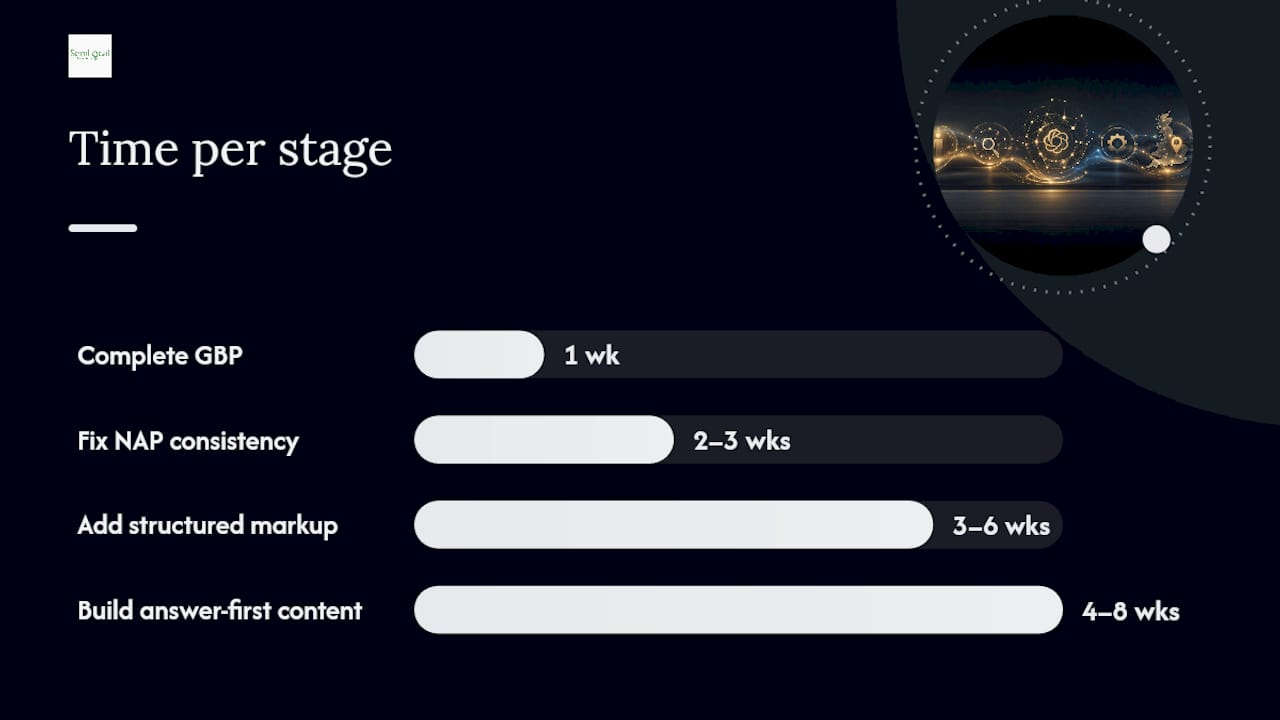
- This week: complete your Google Business Profile. Fill every field, not just the obvious ones. Choose the most precise category available rather than a broad one (Emergency Plumber, not just Plumber), and list every service individually rather than bundling them into one vague description.
- Weeks two to three: fix your NAP consistency. Audit your name, address and phone number on the top ten directories and data aggregators your industry uses. Correct even minor formatting differences, a missing suite number or an old phone number left on a defunct listing.
- Weeks three to six: add structured markup. Implement Schema.org markup for LocalBusiness and Service on your key pages. This is the technical layer that turns your content from readable to machine-readable, and it materially increases how extractable your facts are to AI crawlers.
- Weeks four to eight: build answer-first content. Rewrite your service and pricing pages so each section opens with a direct answer, then add FAQPage markup with genuinely useful question-and-answer pairs. Aim for 120 to 180 word extractable sections rather than long, meandering paragraphs.
- Ongoing: build a review flow. Ask every satisfied customer for a detailed review that mentions specific work done, and respond to every single one, good or bad. AI systems read review substance for extractable facts, and detail matters more than sheer volume.
- Months two to three: secure third-party corroboration. Get at least one mention from a local news outlet, trade body or industry association, and submit your business to the aggregators your competitors already sit on.
- Ongoing: monitor manually. Schedule a monthly check across the major AI platforms and log what they say about you.
Pro Tip: Run your test prompts in a private or incognito browser window. Logged-in AI accounts sometimes personalise answers based on your search history, which can mask what a genuine prospective customer would actually see.
Momentum here compounds. Businesses that complete these steps in sequence tend to see measurable citations within weeks, with the effect building steadily over several months as more corroborating signals accumulate.
Which content formats does AI actually extract and cite?
AI models don’t read your homepage the way a human browses it. They scan for clean, standalone facts they can lift and quote, which changes how you should structure a page.
- Open every section with the answer, then explain. A pricing page should state the fee in the first sentence, not the fourth paragraph.
- Keep extractable sections between 120 and 180 words. Answer-first blocks of this length, alongside genuinely substantial pages, tend to earn more citations than short, thin content.
- Build dedicated pricing and location pages. A single page trying to cover fees, service areas and booking details buries the facts an AI needs.
- Add FAQPage schema with tight, specific Q&A pairs. Cover the phrasing variants real customers actually type, not just one polished version of each question.
- Name a real person behind the content. Author attribution and demonstrable expertise give AI systems, and human readers, more reason to trust what they’re reading.
How do you test what AI knows about your business?
Run these prompts in a private browser window, once a month, across ChatGPT, Gemini and Perplexity:
- Ask “Who is the best [your service] in [your town]?” and note whether you appear.
- Ask “What does [your business name] charge for [specific service]?” and check the answer against your actual pricing.
- Ask “Tell me about [your business name]” and log any factual errors, old addresses, wrong phone numbers, discontinued services.
- Check Google Search Console’s AI-related reporting and Bing Webmaster Tools where available, since both increasingly surface how AI crawlers interact with your pages.
- Track four numbers over time: total AI mentions, factual errors corrected, pages being cited, and enquiries that mention finding you through an AI answer.
Different engines draw from different source mixes, so testing across all three matters more than optimising for just one. Expect your first measurable movement within six to twelve weeks, not days.
What mistakes stop businesses getting cited?
Most failures trace back to one of four habits, and each has a fast fix.
- Character-level NAP mismatches. “St.” versus “Street”, an old suite number, a landline listed on one directory and a mobile on another. Audit every listing character by character.
- Service pages with nothing to extract. No price, no timeframe, no coverage area, just marketing language. Add the concrete facts an AI (and a customer) actually needs.
- Thin or generic reviews, and no responses. A five-star rating with no detail gives AI nothing to cite. Prompt customers to mention specifics, and reply to every review.
- Betting everything on one platform. Optimising GBP alone while ignoring directories, press and schema leaves you invisible the moment an AI cross-checks a second source.
Pro Tip: If an AI gives an incorrect answer about your pricing, fix it on your website first, then update the same fact everywhere else it appears. AI models tend to favour the most recently and consistently confirmed version of a fact.
Why AI citation now decides who gets found first
I’ve spent enough time picking apart how ChatGPT actually behaves with local business queries to know most advice on this topic is too generic to act on. The businesses winning AI citations aren’t the ones with the flashiest websites. They’re the ones that treated their Google Business Profile like a legal document, not a marketing afterthought, and made sure every fact about them agreed with itself everywhere it appeared.
At SemLocal, our whole approach is built around that discipline: complete profiles, consistent data, review systems that generate real substance, and content structured for machines and humans alike. The businesses we work with measure success in enquiries, not vanity rankings. If you want to know where you currently stand, the first sensible step is running an AI visibility test on your own business name before you change anything.
— Geoff
Get your Google Business Profile and AI visibility handled properly
An alternative to a traditional agency retainer for local AI visibility work is to have a provider run the audit, apply the fixes and keep monitoring so the citations keep compounding after month one.
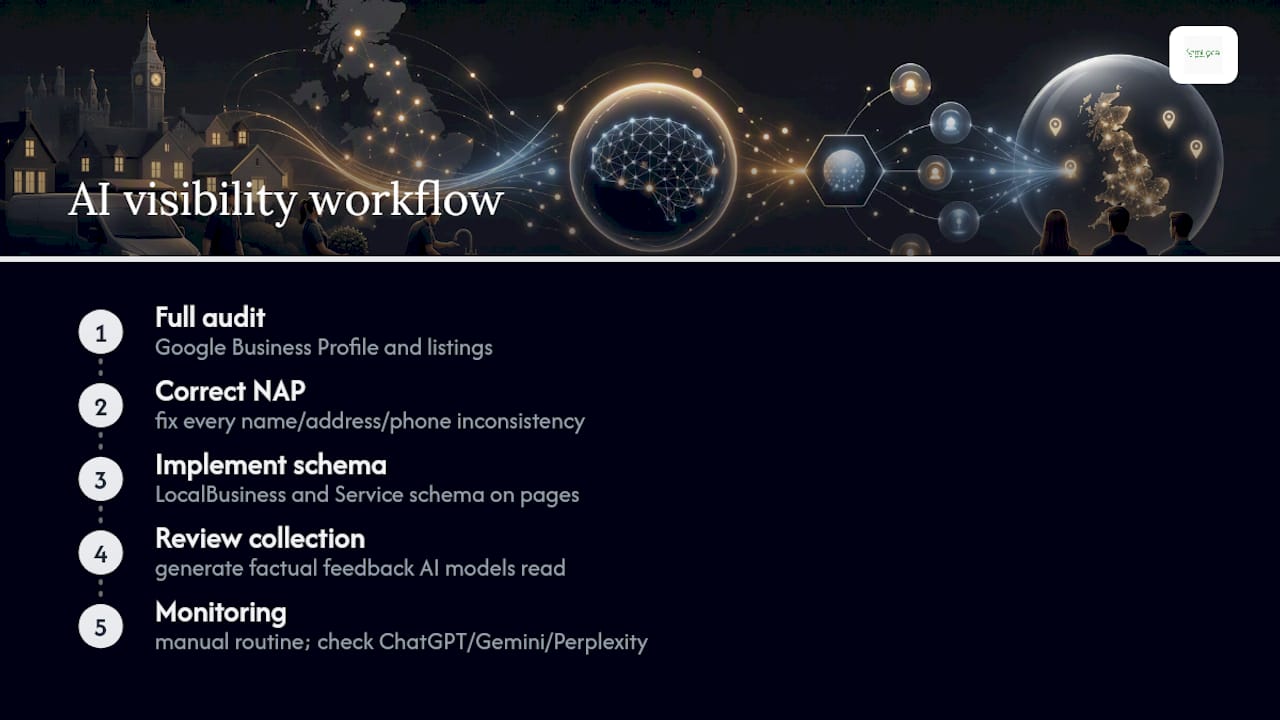
In practice, that means a full audit of your existing Google Business Profile and directory listings, correction of every NAP inconsistency found, implementation of LocalBusiness and Service schema on key pages, and a review collection system built to generate the detailed, factual feedback AI models actually read. A manual monitoring routine can be set up so you know within weeks whether ChatGPT, Gemini and Perplexity are getting your facts right.
If your business isn’t showing up when prospective customers ask an AI for a recommendation, start with our Google Business Profile Manager service and request an audit to see exactly where your current listings and data stand.
Sources
For readers who want to verify the mechanics behind this guide, Cited’s 12-market study breaks down how recommendation and explanation queries pull from different sources. Insites explains the cross-source confidence model AI platforms use, and ZipTie.dev covers schema implementation in practical detail.
- Get Cited by AI: The 2026 Local Search Guide (ChatGPT, Gemini) | Saphek
- How to Get Cited by ChatGPT for Local Business (2026)
- Where does ChatGPT get its information about local businesses? | Insites
- Ziptie