Local link building still moves the needle on Google’s Local Pack, and it now shapes whether AI platforms recommend your business at all. A single link from a regional newspaper can outweigh dozens of directory listings, because search engines and AI models both treat locally trusted sources as proof of relevance. Read on for the tactics, prospecting method, and 90-day plan that turn this into more calls and bookings, or talk to Semlocal about doing it for you.
TL;DR:
- Local backlinks from regional newspapers and government sites greatly enhance prominence and trust signals for local SEO and AI platform recommendations.
- Prioritizing high-authority sources first, such as press and sponsoring community events, yields more durable results than relying on low-quality directories.
- Building relationships with local journalists and community partners offers ongoing benefits, as repeated mentions from trusted sources outperform quantity-focused link strategies.
- Using competitor backlink profiles for targeted outreach increases the chances of securing valuable local links that improve rankings and AI visibility.
- Outsourcing local link building to specialized agencies can accelerate progress, especially for businesses lacking time or expertise in developing trustworthy press, sponsorship, or partnership links.
Table of Contents
- What is local link building and why does it matter now?
- Where to get local links: the proven source categories
- Practical tactics: a prioritised, actionable list of local link building methods
- Finding and prioritising prospects: competitor research that works
- Outreach that converts: templates, follow-up, and etiquette
- Measuring impact and avoiding risky shortcuts
- Priority checklist: a one-page 90-day action plan
- Agency insights and proof: when local link building needs outside help
- What actually works after running these campaigns
- Faster local visibility with Semlocal’s managed approach
- Sources
What is local link building and why does it matter now?
Local link building is the process of earning backlinks from websites that are genuinely relevant to your business’s geographic area, whether that’s a town newspaper, a chamber of commerce, or a neighbourhood blog. This is the standard industry term, distinct from broader “SEO link building,” which chases authority anywhere it can be found. Local link building narrows the target to places your actual customers already read, trust, and search.
Google’s local ranking system weighs three factors: relevance, distance, and prominence. Backlinks feed directly into prominence, which is Google’s proxy for how well known and trusted a business is offline and online. A locally relevant backlink acts as a vote of confidence that Google reads as a signal your business genuinely serves that area, not just that you’ve stuffed a postcode into your website copy.
Here’s what’s changed. AI platforms like ChatGPT, Gemini, and Perplexity are increasingly the first stop for “best plumber near me” or “family dentist in [town]” queries, and they lean on the same signals search engines have used for years, only amplified. When an AI system builds an answer, it favours businesses that show up consistently across sources it already trusts: local press, established directories, community organisations. Locally authoritative links increase the odds of your business getting cited in an AI-generated recommendation, not just ranked in a blue-link result.
Where backlinks contribute to local visibility:
- Relevance — geographic and topical alignment between the linking site and your business
- Distance — less link-dependent, but local links reinforce that your business genuinely operates in the claimed area
- Prominence — the factor backlinks influence most directly, built from citations, reviews, and editorial mentions
- AI trust signals — consistent appearances across locally credible sources that generative platforms already reference
The prominence connection: Backlinks feed the “prominence” factor in both organic local rankings and Local Pack positions, according to Moz’s local SEO research. A business with ten genuinely local, editorially earned links will typically outperform one with fifty generic directory submissions, because prominence rewards trust signals over raw volume.
This is why chasing quantity over quality is the single most common mistake local business owners make. One well-placed mention on a regional news site does more for your Local Pack position, and your chances of an AI citation, than a stack of low-relevance directory links ever will.
Where to get local links: the proven source categories
Not all local links carry equal weight. Treating them as one undifferentiated bucket wastes outreach hours on low-return targets while ignoring the sources that actually move rankings. A tiered approach, tackling authority sources first, then community sources, then partnerships, produces faster, more durable ranking gains than working through sources in random order.
-
Tier 1: Local press, government, and education sources. Regional newspapers, council pages, and university or college sites carry the strongest trust signals because their editorial standards are high and their domains are established. Find these by monitoring local news sites for “small business spotlight” features, checking your council’s business directory or grants pages, and searching
site:.ac.uk "local business"orsite:.gov.uk small businessfor relevant listing opportunities. -
Tier 2: Nonprofits, event sponsors, and neighbourhood blogs. Charity partner pages, event sponsorship listings, and independent local blogs offer strong topical and geographic relevance with a lower barrier to entry than press coverage. Search
"sponsors" OR "supported by" [your town]or browse local Facebook community groups for blogs that run “best of” roundups. -
Tier 3: Suppliers, vendor pages, and community calendars. Your suppliers’ “find a stockist” pages, local business association listings, and community event calendars are the easiest wins, often requiring nothing more than a polite email. Check your existing supplier relationships for a partner or dealer locator page you’re not yet listed on, and search local podcast directories for shows that interview small business owners in your sector.
Each tier demands a different outreach approach. Tier 1 needs a genuine news angle and patience; Tier 2 rewards relationship building and modest sponsorship spend; Tier 3 is often just a matter of asking. Working top-down means your highest-effort outreach targets the highest-value links first, rather than burning goodwill on low-impact directories before you’ve even tried for the newspaper feature.
Practical tactics: a prioritised, actionable list of local link building methods
Knowing the source categories is one thing. Turning them into a working outreach programme is another. Here’s the tactical order that consistently produces results, ranked by impact against effort required.
-
Local press outreach. Pitch a genuine story, a milestone, a community initiative, a data point unique to your business, to your local newspaper or radio station’s website. Editorial links from press coverage consistently outperform almost every other local link source because they carry both authority and audience trust simultaneously. A useful angle: tie your pitch to a seasonal event or local trend rather than a generic “we’re hiring” story, which editors ignore.
-
Sponsorships with a guaranteed backlink. Sponsoring a local 5K, school fair, or community festival typically earns your business a spot on the event’s sponsor page, usually with a link. Before committing funds, ask the organiser directly whether sponsor pages link out. Some don’t, and you want that answer before you write the cheque.
-
Charity and event sponsor pages. Beyond one-off sponsorships, ongoing charity partnerships (adopt-a-charity schemes, annual fundraiser support) tend to produce evergreen links that compound in value over time, since the relationship itself becomes a recurring source of mentions, not just a single placement.
-
Vendor and partner pages. If you’re a franchisee, dealer, or certified installer for a national brand, check whether that brand maintains a “find a location” or dealer locator page. These are frequently under-used because business owners forget to ask to be added, despite the link being essentially free.
-
Industry directories with genuine authority. Skip generic, low-quality directories and focus on the ones your trade body, industry association, or professional accreditation scheme actually maintains. A listing on your industry’s recognised register carries far more weight than a submission to a directory nobody has heard of.
-
Local roundups and “best of” content. Bloggers and local magazines regularly publish “best cafés in [town]” or “top-rated electricians near [area]” pieces. Reach out with a specific, useful pitch (a unique offer, a standout review, a local connection) rather than a generic “please feature us” email.
-
Neighbourhood guides and local data reports. Publishing genuinely useful local content, a guide to parking near your shop, a seasonal report using data specific to your area, gives other local sites and bloggers a reason to link to you without you asking. This is the slowest tactic to pay off but the most scalable, since one strong resource can attract links for years.
-
How-to resources built for locals. A practical guide (“What to do if your boiler breaks down in [town] this winter”) solves a real problem and naturally invites local blogs and forums to reference it as a resource.
-
GEO/AEO-specific tactics. For AI visibility specifically, focus on getting your business named clearly and consistently, with your service and location stated in plain language, wherever you appear. AI systems parsing a local news article or directory entry respond better to explicit phrasing (“family-run plumbing business in Leeds”) than to vague marketing copy, because that phrasing matches how people phrase questions to AI assistants.
Pro Tip: When pitching sponsorship or press links, always ask “will this include a link to our website?” before agreeing to anything. Sponsor pages and press features don’t automatically link out, and you’ll save yourself repeated disappointment by confirming it upfront rather than assuming.
The common thread across every tactic on this list: editorial links (press, event sponsor pages, genuinely useful content) outperform submission-based links (directories, vendor pages) on a like-for-like basis. That doesn’t mean skip the easier wins, they’re often the quickest to execute, but don’t mistake volume there for the kind of authority that actually shifts your Local Pack position.
Finding and prioritising prospects: competitor research that works
Before writing a single outreach email, build a prospect list by reverse-engineering where your competitors already earn links. This turns cold outreach into warm outreach, because if a site linked to a competitor, it’s already open to linking to businesses like yours.

Tools such as Ahrefs and Semrush let you pull a competitor’s full backlink profile in minutes, and AI-driven link building can assist in automating prospecting and outreach workflows. Search their domain, filter for links from sites in your city or region, and you’ll surface local press mentions, sponsorship pages, and directories you likely didn’t know existed. Search operators do a rougher version of the same job for free: try site:[competitor domain] OR "[competitor name]" combined with your town name to surface mentions across the web that a tool might miss.
Not every prospect is worth pursuing, though. Filter your list against these criteria before any outreach goes out:
- Geographic relevance — does the site genuinely serve or cover your area, not just mention it once?
- Topical fit — would a link from this site make sense to a human reader, or would it look out of place?
- Traffic and authority proxy — does the domain show real visitor activity, or does it look abandoned?
- Editorial placement — is the link embedded in genuine content, or is it a paid directory slot with no editorial context?
Automated prospecting tools can scale this discovery process considerably, but quality filtering still needs a human eye, since a tool will happily hand you fifty low-relevance domains alongside the five that matter. Score each prospect on a simple 1 to 3 scale for relevance and effort, then work the high-relevance, low-effort quadrant first. That’s where your quick wins live.
Outreach that converts: templates, follow-up, and etiquette
A good prospect list is wasted without outreach that actually gets replies. Keep pitches short, specific, and easy to say yes to.
-
Sponsorship or partnership pitch. Introduce your business in one line, state what you’re offering (sponsorship, product donation, expertise), and ask directly whether their page links to sponsors. Something like: “We’d love to sponsor [event] this year. Could you confirm whether the sponsor page on your site includes a link back to sponsors’ websites?”
-
Press pitch. Lead with the story, not your business. Editors respond to angles, not adverts. One sentence on why this matters to their readers now, followed by your offer to provide quotes, photos, or data.
-
Follow-up cadence. Send one polite follow-up after five to seven working days if you hear nothing. Track every outreach attempt in a simple spreadsheet with columns for date, contact, site, status, and outcome, so nothing falls through the cracks and you can measure your actual hit rate over time.
-
Converting unlinked mentions. Set a Google Alert for your business name and check periodically for sites that mention you without linking. A short, friendly email asking them to add a link “for readers who want to find you” converts far more often than cold outreach, because the relationship already exists.
Pro Tip: Never ask for a link outright as your opening line. Lead with value, a story, a sponsorship, useful data, and let the link follow naturally as a byproduct of the relationship, not the goal of the email.
Measuring impact and avoiding risky shortcuts
Track referral traffic, Local Pack ranking movement, appearances in AI-generated overviews, and, most importantly, conversions traceable back to specific placements. Set up a simple monthly review comparing new links earned against ranking movement for your priority keywords, but be honest that correlation isn’t causation. Local rankings shift for many reasons, and one link rarely moves a ranking alone.
- Referral traffic from the linking domain, checked in your analytics platform
- Local Pack position changes for your priority search terms, tracked monthly
- AI overview or citation appearances, checked periodically via direct queries
- Enquiries or bookings traceable to a specific campaign or placement
The risk to avoid: Directories and citations are foundational for NAP consistency but they aren’t a substitute for editorial backlinks in competitive markets. Paid-link schemes, low-quality directory mass submissions, and over-optimised anchor text (every link reading “best plumber in [town]”) all carry real risk of a Google penalty. Vary your anchor text naturally and prioritise editorial placements over volume.
Priority checklist: a one-page 90-day action plan
Turn everything above into a concrete plan you can start this week. Assign each action a realistic owner, whether that’s you, a team member, or an agency brief.
- Weeks 1 to 2: Audit and fix NAP consistency across existing citations (DIY, low effort)
- Weeks 1 to 2: Build competitor backlink prospect list using Ahrefs, Semrush, or search operators (DIY or outsource, medium effort)
- Weeks 3 to 6: Pitch three to five local press stories with a genuine angle (DIY or outsource, high effort)
- Weeks 3 to 6: Secure two to three sponsorship or partner page links (DIY, medium effort)
- Weeks 7 to 10: Publish one locally useful resource (guide, data report) designed to attract links (DIY or outsource, high effort)
- Weeks 7 to 10: Convert five or more unlinked mentions into links (DIY, low effort)
- Weeks 11 to 12: Review KPIs, refine anchor text mix, and set next quarter’s target
| Focus area | Monthly goal | Effort level |
|---|---|---|
| Editorial and press links | 1 to 2 placements | High |
| Sponsorship and partnership links | 2 to 3 placements | Medium |
| Directory and citation cleanup | Ongoing consistency check | Low |
| Content-led link attraction | 1 resource per quarter | High |
Aim for three to five quality placements a month once the programme is running, rather than a one-off burst. Keep your Google Business Profile details identical to every citation you build during this period. Inconsistent NAP data undermines the prominence signal you’re working so hard to build.
Agency insights and proof: when local link building needs outside help
Semlocal has run local link and citation programmes across sectors from hospitality to home services, and the pattern holds consistently: businesses that pair Google Business Profile management with genuine editorial link building see faster, more durable movement in the Local Pack than those doing either in isolation. A Google Business Profile that’s fully optimised gives outreach targets, journalists, directories, sponsors, something credible to link to in the first place.
Semlocal manages this end to end: Google Business Profile optimisation to make sure the destination is worth linking to, local SEO to structure the site around the right local terms, and digital PR to secure the press and community placements that move prominence. That combination is deliberate. A backlink pointing at a thin, inconsistent, or poorly reviewed profile does far less work than one pointing at a business that’s already dialled in.
DIY suits businesses with time to spend on relationship building and a founder willing to write pitches. Briefing an agency makes sense once outreach starts eating hours you’d rather spend running the business, or when you need press relationships you don’t already have.
What actually works after running these campaigns
Two patterns show up again and again. First, a single regional news feature routinely outperforms twenty low-relevance directory submissions, both for ranking movement and for the kind of trust signal that AI platforms seem to weight heavily. Second, businesses that chase link quantity as a target consistently plateau faster than businesses that chase relationships, because a relationship with one local journalist or one event organiser tends to produce repeat mentions over years, not a single placement.
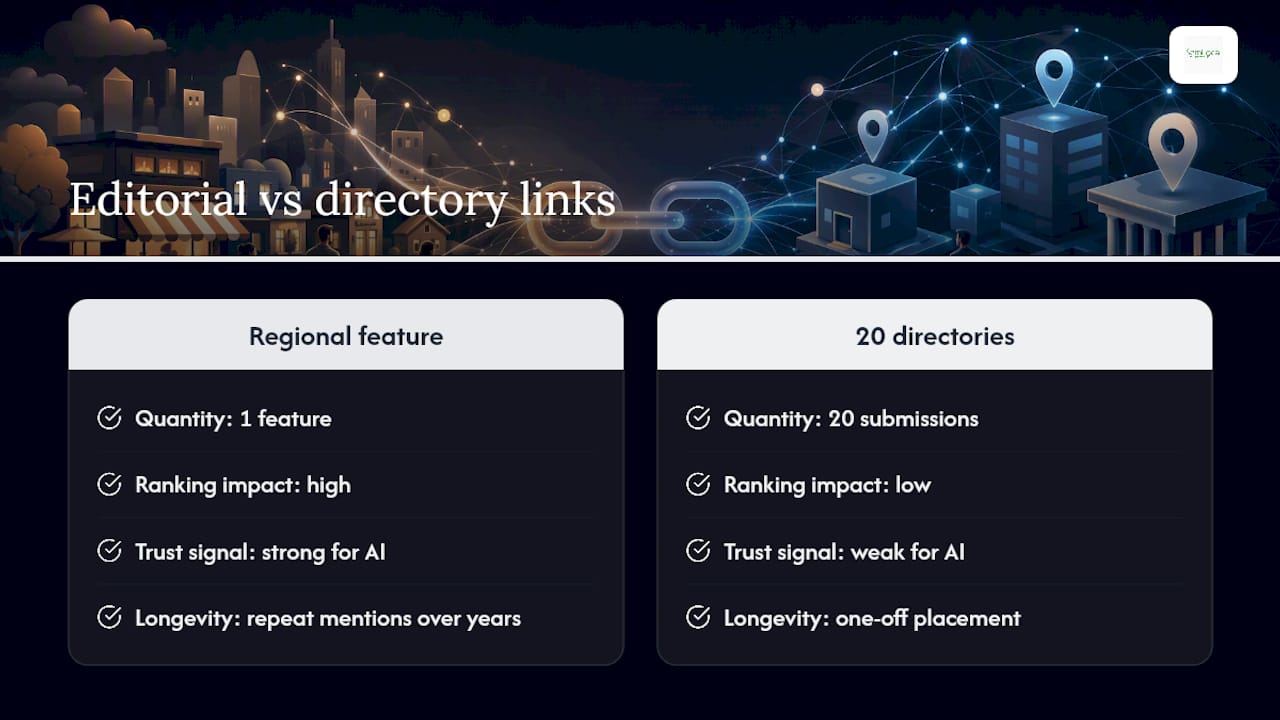
The maxim worth repeating to any team running this work: prioritise local editorial relevance over link quantity, every time. A spreadsheet full of forty low-value directory links looks productive and does almost nothing. Five links from sources your actual customers already trust will move a Local Pack position and get your business named in an AI answer, which is the whole point of doing this work at all.
The most common mistake isn’t a bad tactic. It’s giving up on press and sponsorship outreach after one rejection and retreating to directories because they’re easier. Easier isn’t the same as effective, and the businesses that stick with the harder outreach are the ones still ranking well eighteen months later.
— Geoff
Faster local visibility with Semlocal’s managed approach
Semlocal is the practical alternative to running this entire programme yourself, without needing to become a digital PR specialist, an outreach copywriter, and a Google Business Profile expert all at once. Where the tactics above take consistent weekly effort across press pitching, sponsorship management, and profile maintenance, Semlocal manages the whole stack as one coordinated service, so links, citations, and your profile move in the same direction instead of working against each other.
Semlocal’s Local SEO service handles the link building and content side, while Google Business Profile management makes sure every link you earn points at a profile that actually converts clicks into calls. For businesses relying on local search ads too, Local Service Ads management rounds out the local visibility picture. A discovery call typically starts with a quick audit of your current citations, profile status, and existing backlink gaps, then a straightforward plan for what to fix first. If you’d rather hand off the outreach and profile work than build it yourself, get your Google Business Profile optimised as the first concrete step.
Sources
- Essential Local Link Building Tactics
- Local Link Building: 25 Ways to Get Quality Local Backlinks
- Local SEO link building
- Local link building: How to build authority and get found by AI search