Missed call text back sends an automatic SMS the moment a call goes unanswered so callers get an instant reply instead of silence. For small businesses, it’s one of the simplest ways to recover leads that would otherwise call a competitor next. Set it up once and you keep every missed call working for you, day or night.
TL;DR:
- A 14,354-message study showed most callers reply within five minutes, significantly increasing the chances of booking when contacted promptly.
- The setup can be done using built-in platform features, VoIP auto-replies, or third-party integrations like Zapier and Twilio, depending on existing call infrastructure.
- Keep messages concise under 160 characters, clearly identify your business, and include a simple opt-out option to ensure compliance and trust.
- Sending times should be around 10 to 20 seconds after a missed call to balance immediacy without seeming impersonal or spammy.
- Missed call text back works best as a lead capture tool; for full conversations and bookings, integrating AI call answering enhances results.
Table of Contents
- What missed call text back is and why it matters for small businesses
- How to set up missed call text back
- What to say: message templates and wording rules
- Timing, delivery limits and pitfalls to avoid
- Compliance and trust: consent, opt-out and getting SMS right
- Test, measure and iterate
- Where text back fits in a small business lead stack
- How Semlocal helps you turn missed calls into booked jobs
- Sources
What missed call text back is and why it matters for small businesses
Missed call text back works on a straightforward trigger. A call comes in, nobody picks up, and the system fires an SMS to that number within seconds. The caller reads a short message acknowledging the call and telling them what happens next, and they can reply by text there and then, no callback required.
The payoff shows up in the numbers. A study of 14,354 missed-call text messages across 192 home-service businesses found a significant share of callers replied quickly, with many responding within five minutes. That speed matters more than most owners assume: a caller who hears back while they’re still thinking about the job is far more likely to book than one who’s already dialled the next tradesperson on their list.
What makes this work for small operators specifically:
- No extra staff needed to run it once it’s configured
- Works around evenings, job sites, and periods when nobody can reach the phone
- Turns a missed call from a dead end into a live text conversation
- Costs a fraction of hiring reception cover
How to set up missed call text back
There are three practical routes to get this running, and which one you pick depends on what you’re already using for calls.
Built-in platform feature. Many phone systems and CRM tools now include missed-call auto-reply as a toggle. If your provider has it, this is the fastest option.
VoIP or provider auto-reply. Some business VoIP lines let you set an automated text reply directly in the account settings, no third-party tool required.
Zapier or Twilio integration. If your platform doesn’t offer it natively, a reliable setup approach is to trigger the SMS from a “call status = missed call” event using Zapier or Make, connected to Twilio for sending.
Whichever route you choose, work through this checklist:
- Confirm which number receives calls and route it through your chosen platform.
- Set the trigger condition (typically an unanswered call after a set number of rings).
- Build the automation or workflow that fires the SMS.
- Write your reply template (covered in the next section).
- Add business-hours logic if you want a different message after closing time.
- Set a cooldown window so the same caller doesn’t get five identical texts in an hour.
- Test the whole chain end to end before going live.
Pro Tip: Route your main business line through whichever system handles the automation, not a side number nobody checks. If customers already save your business number in their contacts, changing it to enable text back can cost you more goodwill than the feature gains you.
What to say: message templates and wording rules
Every effective auto-reply hits four marks: it names your business, acknowledges the call, gives a clear next step, and includes an opt-out. Skip any of those four and the message either confuses the caller or creates a compliance gap.
Keep the message under 160 characters. Setup guidance from NextPhone is blunt about this: one text segment, business name included, no promotional filler, and no ambiguity about what happens next.
Templates you can copy and adapt:
- General enquiry: “Hi, this is [Business Name]. Sorry we missed your call. Reply here or call back and we’ll get straight to it. Reply STOP to opt out.”
- Booking-focused: “Thanks for calling [Business Name]. We missed you. Text us your availability and we’ll confirm a slot today.”
- Urgent issue: “This is [Business Name]. We saw your missed call. If this is urgent, reply URGENT and we’ll call you back within 15 minutes.”
- After hours: “You’ve reached [Business Name] outside office hours. We open at 8am and will call you back first thing. Reply STOP to opt out.”
Keep the tone plain and human. Nobody wants marketing copy in reply to a call they made hoping to solve a problem.
Timing, delivery limits and pitfalls to avoid
The timeout before the SMS fires matters more than most owners think. Too short, and you cut off callers who might have waited another few seconds. Too long, and the text feels like an afterthought rather than a genuine reply. Most service businesses find 10 to 20 seconds strikes the right balance.
A few practical limits catch people out:
- Landlines can’t receive SMS, so any text-back setup silently fails for those callers. Test with your actual customer base, not just mobile numbers.
- Some phone systems won’t classify a very short ring as a “missed call,” meaning the automation never fires at all.
- Set a cooldown window so a caller who rings three times in ten minutes gets one reply, not three.
- Cap daily sends per number to avoid looking like you’re spamming a persistent caller.
- Watch character counts: going over 160 characters can split the message into extra segments, which usually costs more per send.
Compliance and trust: consent, opt-out and getting SMS right
Before switching this on, tell callers plainly that missed calls may trigger an automated text reply, and give them an easy way out. Mobile compliance guidance for the United Kingdom recommends including a line such as “Reply STOP to opt out” in that very first message, not buried somewhere else.
Keep the first automated reply strictly transactional. No offers, no discount codes, no marketing hooks. The caller rang for a reason; the reply should address that reason and nothing else.
Good practice checklist:
- State clearly that this is an automated response, not a person typing live.
- Include an opt-out phrase in every first reply, every time.
- Avoid promotional language until a genuine conversation has started.
- Keep basic records of when messages were sent and to which numbers.
This matters for more than box ticking. Practitioners consistently point to transparent notices and a working opt-out as the things that protect customer trust long after the compliance question has been settled.
Test, measure and iterate
Before trusting the system with real enquiries, run through a short test plan:
- Live test: call your own number, let it ring out, confirm the SMS arrives and the wording reads correctly.
- Landline test: call from a landline to confirm you understand where the gap sits for those callers.
- After-hours test: check the closed-hours message fires correctly outside your set business hours.
- Repeat-caller test: call twice in quick succession to confirm your cooldown window is actually working.
Once live, track three numbers: reply rate, the percentage of replies arriving within five minutes, and how many of those conversations convert into a booked job or qualified lead. Vendor data consistently shows that catching callers within minutes materially lifts conversion, so time-to-reply is worth watching as closely as the reply rate itself. If either number looks weak after a few weeks, adjust the wording first, then test a shorter or longer trigger timeout before assuming the whole approach isn’t working for your business.
Where text back fits in a small business lead stack
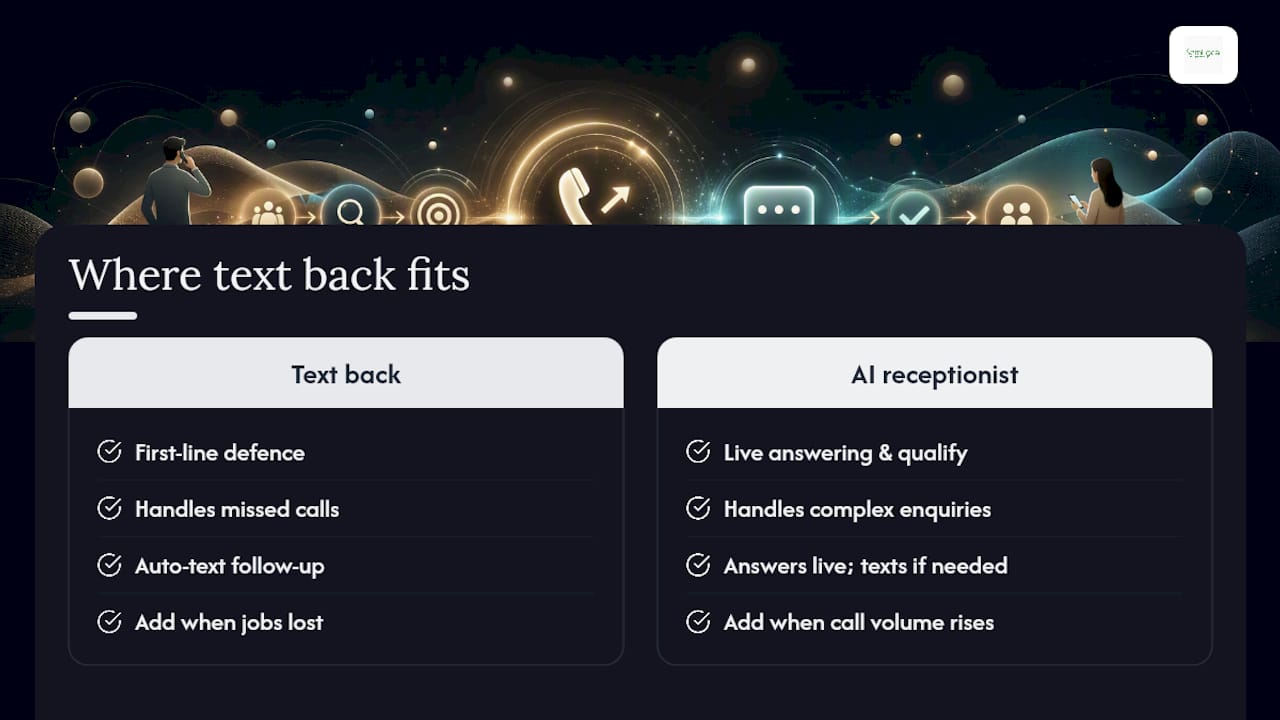
Missed call text back earns its place as a first line of defence, not a complete answer. It works brilliantly when nobody’s available to pick up: on a job site, after hours, or during a rush. Where it falls short is anything requiring real conversation, like a customer with three follow-up questions before they’ll book.
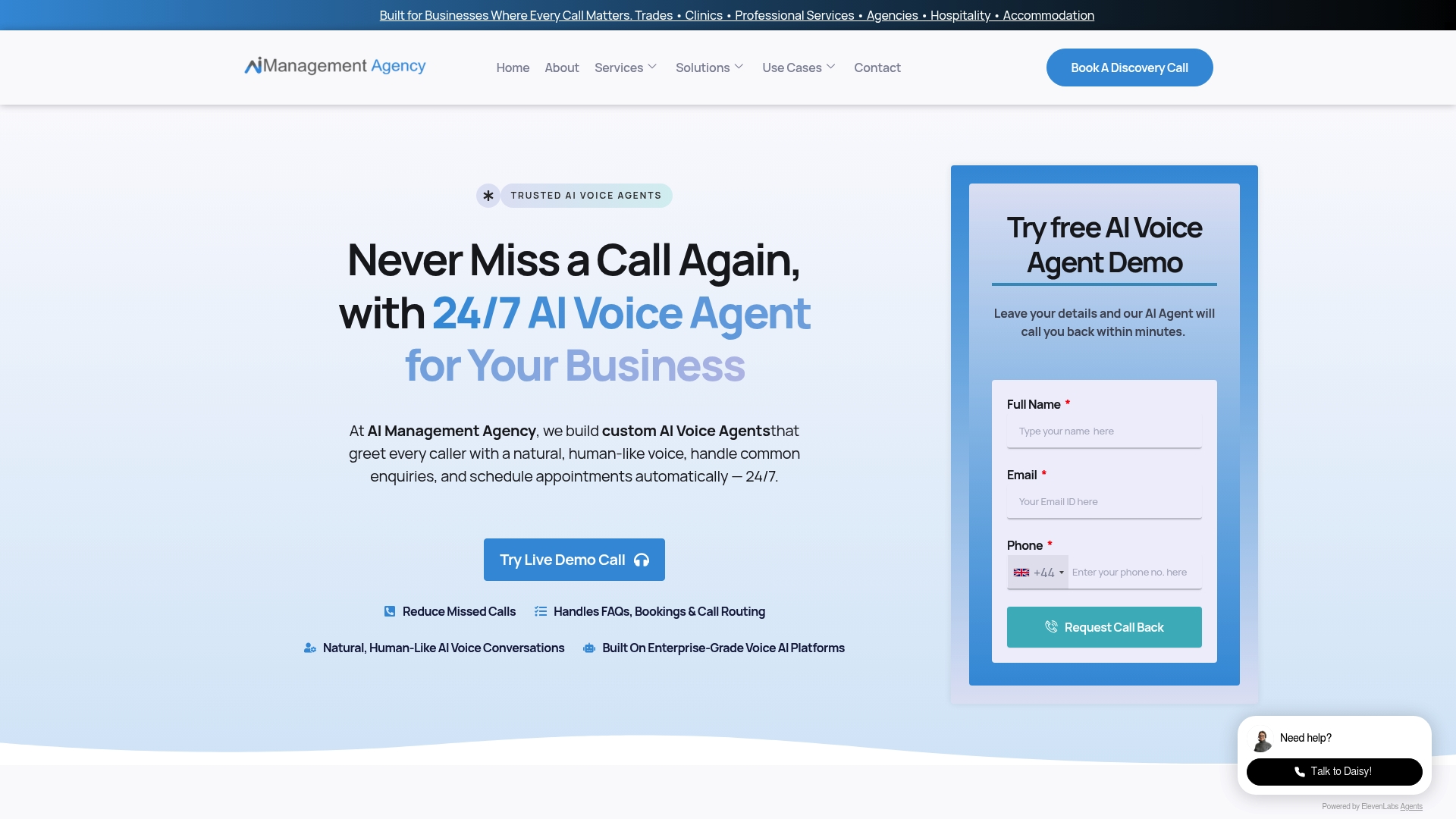
That’s where an AI Systems Brisbane receptionist changes the equation. Rather than waiting for a missed call to trigger a text, an AI voice agent answers the call live, qualifies the enquiry, and books the job there and then. Some setups route missed calls straight to an AI receptionist that answers instantly and follows up by text if the caller still doesn’t engage. Semlocal and its AI-agent partner AIM Agency build exactly this kind of layered setup for local businesses, pairing automated text-back with fuller call handling once volume justifies it. Text back is the floor. AI answering is what you add once missed calls start costing you real jobs.
— Geoff
How Semlocal helps you turn missed calls into booked jobs
Semlocal is the practical next step once your missed-call text back is live and working: while text-back catches the call, it won’t fix a Google Business Profile that’s invisible when someone searches for your service in the first place. We manage your complete local presence so the calls come in more often, not just get answered when they do.
Our team handles Google Business Profile optimisation to get you into the map pack, local SEO to rank you where customers are actually searching, and AI Optimisation so you show up when people ask ChatGPT or Gemini for a recommendation. Combine that with automated text-back and you’ve got a lead capture system that works from search to booking. If you want more calls landing in the first place, start with a look at how Google Business Profile optimisation can improve your visibility, then get in touch for a straight-talking assessment of what’s realistically achievable for your business this year.
Sources
- Mobile compliance in the United Kingdom (Listrak help)
- The Complete Guide to Missed-Call Text Back | WorkflowStack AI
- Missed Call Text Back: Setup Guide & Templates (NextPhone)
Recommended
- Automated SMS reply setup: quick start for service businesses
- SMS appointment reminders for small businesses: a practical guide
- Stop Wasting Time on Manual Outreach: Try These 7 AI Sales Automation Hacks
- The High Cost of Silence: Why Missed Calls are Killing Your B2B Growth (and How AI Voice Agents Fix It)