TL;DR:
- Hotel phone automation uses AI to handle routine guest calls, reducing front desk load and improving response times. Successful deployment depends on integrating real-time data from PMS, CRM, and ticketing systems, with phased implementation and ongoing optimization. Proper integration and monitoring ensure guest satisfaction and operational efficiency.
A hotel phone support automation workflow is a system that manages inbound guest calls by automating routine interactions, integrating directly with hotel operational systems, and escalating complex requests to staff. The industry term for the underlying technology is AI conversational telephony, and UK hotel managers are deploying it to cut front desk phone load while improving guest response times. AI can handle approximately 79.9% of total call volume at large properties, leaving staff free to focus on guests who genuinely need human attention. The result is a shift from reactive phone queuing to proactive, ticket-based service management.
What tools does a hotel phone support automation workflow require?
The foundation of any effective automated phone assistance system is real-time, bidirectional integration between your telephony platform and your core hotel systems. Integration with PMS, CRM, and work-order platforms is the primary criterion for selecting an AI automation system. Without live data sync, the AI cannot confirm a reservation, update a room request, or log a maintenance ticket accurately.
The core systems you need connected are:
- Property Management System (PMS): Feeds live room status, guest profiles, and booking data into the AI agent.
- Point of Sale (POS): Allows the AI to handle food and beverage requests tied to room accounts.
- Work-order or ticketing system: Converts guest requests into assigned tasks for housekeeping, maintenance, or concierge.
- CRM: Stores guest history and preferences to personalise automated responses.
- Telephony platform: The call routing layer that connects inbound calls to the AI agent and manages escalation to staff.
Static chatbots lack live data sync and cannot complete requests within a single call interaction. A properly integrated AI agent can. Data quality matters as much as the technology itself. Poor or inconsistent PMS data propagates errors through every automated interaction, so clean backend data is a non-negotiable precondition before go-live.
Most specialised hotel AI phone deployments go live within five business days, covering conversation design, voice configuration, and full system integration. Many providers also offer a trial period with a set number of free calls using your actual hotel phone number and policies, which lets you validate accuracy before committing.

Pro Tip: Before signing any contract, ask the provider to demonstrate a live call that reads from your PMS and creates a work-order ticket in real time. If they cannot show you that in a demo, the integration is not ready.
How to design and implement a hotel support automation workflow step-by-step
A phased approach is the most reliable path to a stable, revenue-positive deployment. Industry guidance recommends starting with reservations and call overflow before adding routine FAQs and maintenance requests. This sequence captures lost revenue quickly and gives your team time to build confidence in the system.
Phase 1: Call overflow and reservation enquiries
Begin by routing calls that currently go unanswered after hours or during peak periods. The AI handles availability checks, rate quotes, and booking confirmations by reading live PMS data. This phase alone recovers revenue from missed calls without touching your daytime front desk workflow.
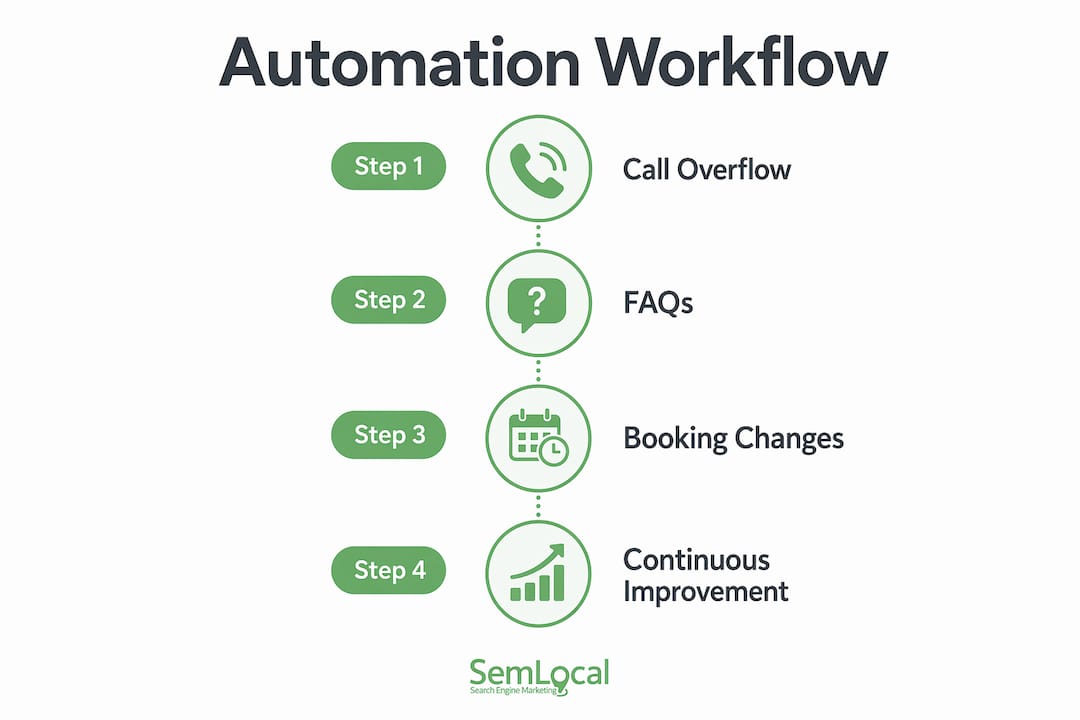
Phase 2: FAQs and standard guest requests
Once call overflow is stable, expand to common in-stay requests: directions, amenity hours, towel deliveries, and late checkout enquiries. Configure the AI with your hotel’s specific policies and tone. Test every conversation flow against real call recordings before activating.
Phase 3: Booking modifications and service requests
This phase requires the deepest PMS integration. The AI must read current bookings, apply modification rules, and write confirmed changes back to the system. Work-order creation for maintenance and housekeeping also activates here.
Phase 4: Continuous improvement with PDCA
A PDCA (Plan-Do-Check-Act) cycle is the recommended framework for ongoing optimisation. Review escalation logs weekly, identify recurring misclassifications, and update conversation logic accordingly.
| Deployment phase | Expected outcome | Key success indicator |
|---|---|---|
| Call overflow and reservations | Reduced missed calls, direct revenue recovery | Booking conversion rate from AI calls |
| FAQs and standard requests | Lower front desk call volume | Call handling share by AI |
| Booking modifications and service requests | Full ticket automation for in-stay needs | First Contact Resolution rate |
| PDCA optimisation | Continuous reduction in escalation rate | Weekly escalation rate trend |
Pro Tip: Run a parallel test for two weeks before full rollout. Keep one phone line on the old process and route a second line through the AI. Compare escalation rates and guest feedback before switching fully.
What are common challenges in hotel customer service automation?
The most frequent failure point in any hotel automation system is the handoff process. The best practice is partial automation at 80–85%, with a reliable and fast escalation path to staff for complex issues. Attempting to automate every call creates friction and damages guest trust.
Common challenges include:
- Legacy system bottlenecks: Older PMS platforms often lack APIs for real-time data exchange. In these cases, middleware connectors are required, which add latency and a potential point of failure.
- Inconsistent PMS data: If room types, rates, or guest profiles are not kept current, the AI will give guests incorrect information. Data governance must be assigned to a named staff member before go-live.
- Over-automation: Automating 100% of calls creates friction. Guests with complaints, accessibility needs, or complex multi-room bookings require human judgement.
- Unreliable escalation paths: If the handoff to a staff member fails or takes too long, the guest hangs up. The escalation route must be tested as rigorously as the automation itself.
- Misclassified requests: The AI may route a complaint as a standard service request. QA sampling of recorded calls each week catches these errors before they accumulate.
The KPIs to monitor from day one are: call handling share by AI, escalation rate, average front desk phone time, and First Contact Resolution rate. Automation systems must have fallback mechanisms for integration failures or misclassifications to avoid losing guest requests entirely.
Pro Tip: Set an escalation rate alert at 25%. If more than one in four calls escalates to staff, your conversation logic needs revision. That threshold is a reliable early warning signal.
How does phone support automation transform front desk operations?
The core value of phone support automation is rebalancing front desk effort from reactive call answering to proactive guest service management. When the AI handles routine calls, staff work from a prioritised ticket queue rather than a ringing phone. That shift changes the mental experience of the job as much as the workload.
Consider a practical example. A guest calls to request extra towels at 11:00 PM. Without automation, that call interrupts a night auditor mid-task. With automation, the AI takes the call, creates a housekeeping ticket, and the auditor sees it in the queue. The guest receives a consistent, documented response. The auditor keeps working. Neither party experiences friction.
“A well-designed workflow avoids phone interruptions and changes front desk work to managing prioritised service tickets, improving operational efficiency. Front desk staff work more proactively and guests receive consistent, documented service without repeat calls.” — EHVA, 2026
Scalability is a significant benefit for UK hotels that experience strong seasonal demand. During peak summer or Christmas periods, call volume can double without requiring additional headcount. The AI absorbs the volume increase while staff focus on face-to-face guest interactions. This is where automated call answering delivers measurable return on investment.
The guest experience improvement is equally concrete. Guests receive immediate answers at any hour, with information drawn from live hotel data rather than a staff member’s memory. Consistency across every call builds trust. A resolution-first workflow design ensures the AI completes requests within the call interaction rather than promising a callback, which is the single most effective way to lift guest satisfaction scores.
Explore how AI voice technology is changing the front desk experience at smaller UK properties, including practical examples of valet signalling and late checkout automation.
Key takeaways
A hotel phone support automation workflow delivers measurable results only when AI telephony integrates directly with live PMS, CRM, and ticketing systems, and when deployment follows a phased PDCA approach rather than a single full rollout.
| Point | Details |
|---|---|
| Integration is the foundation | Connect AI telephony to live PMS, CRM, and work-order systems before go-live. |
| Phase your deployment | Start with call overflow and reservations, then expand to FAQs and service requests. |
| Target 80–85% automation | Reserve human escalation for complex calls; over-automation damages guest trust. |
| Monitor four core KPIs | Track call handling share, escalation rate, front desk phone time, and First Contact Resolution. |
| Use PDCA for ongoing improvement | Review escalation logs weekly and update conversation logic to reduce misclassifications. |
Why integration readiness is the real barrier, not the AI
Having worked with UK hotel operators across independent properties and small groups, the pattern I see most often is this: managers focus on the AI’s voice quality and conversation capability, then discover six weeks later that their PMS cannot push live data to an external system without a custom connector. That delay costs money and erodes confidence in the whole project.
My honest view is that the technology itself is no longer the hard part. The AI conversation engines available in 2026 are genuinely capable. The hard part is getting your operational data into a state where automation can act on it reliably. Before you speak to any provider, audit your PMS data quality and document your existing call handling procedures in writing. If you cannot describe your escalation rules clearly on paper, the AI cannot follow them either.
I also think the industry undersells the staff benefit. Front desk teams at hotels I have worked with report that moving from a ringing phone to a managed ticket queue reduces the sense of constant interruption significantly. That matters for retention, which is a real cost pressure for UK hospitality right now.
The future direction is clear. AI agents will handle an increasing share of booking modifications and complaint triage, not just simple requests. Hotels that build clean integration foundations now will extend automation to those higher-value interactions far more quickly than those starting from scratch in two years.
— Geoff
How Semlocal supports UK hotels with automation and local visibility
UK hotel managers who want to implement phone support automation also need guests to find them in the first place. Semlocal works with service businesses and hospitality operators across the UK to build the local visibility that drives real enquiries, not just website traffic.
From fully managed Google Business Profiles to Local SEO and AI search visibility, Semlocal handles your complete local presence so that when a guest searches for a hotel near them, you appear and get chosen. Every service is built around measurable outcomes: more calls, more bookings, and a clear return on every pound you invest. If you are ready to combine stronger local visibility with the operational gains from phone automation, explore our local hotel services or get in touch directly to discuss your property’s needs.
FAQ
What is a hotel phone support automation workflow?
A hotel phone support automation workflow is a system that uses AI telephony to handle routine inbound guest calls automatically, integrating with hotel systems such as PMS and ticketing platforms to resolve requests within the call and escalate complex cases to staff.
How much of call volume can automation realistically handle?
AI can handle approximately 79.9% of total call volume at large properties, with the remaining calls escalated to human staff. Industry best practice targets 80–85% automation to maintain service quality.
How long does it take to deploy a hotel phone automation system?
Most specialised hotel AI phone deployments go live within five business days, covering conversation design, voice configuration, and integration with PMS and ticketing systems.
What is the biggest risk in hotel phone support automation?
The most frequent failure point is the handoff process between AI and staff. Unreliable or slow escalation paths cause guests to abandon calls, so the escalation route must be tested as thoroughly as the automation itself.
How do I measure whether my automation workflow is working?
Monitor four KPIs from day one: call handling share by AI, escalation rate, average front desk phone time, and First Contact Resolution rate. A rising escalation rate above 25% signals that conversation logic needs updating.
Recommended
- AI sales appointment automation for hotels: a step-by-step guide – AI Management Agency
- Types of hotel AI agents: a UK manager’s guide – AI Management Agency
- Hotel AI customer service benefits: 2026 guide – AI Management Agency
- Step-by-step task automation guide for UK small businesses – AI Management Agency