TL;DR:
- Multi-agent orchestration has become essential for enterprise AI in 2026, enabling specialized roles that improve reliability. Open standards like MCP, A2A, and AP2 lower deployment costs and increase accountability for AI actions. Governance with human oversight and strict security protocols ensures safe, measurable AI workflow performance at scale.
AI agents in 2026 are defined as software systems that plan, act, and adapt across multi-step tasks with varying degrees of human oversight. The dominant shift this year is not in model capability. It is in architecture: single-agent chatbots have given way to coordinated, multi-agent systems governed by explicit protocols and human supervision. Understanding the AI agent trends in 2026 is now a practical business priority, not a speculative one. Organisations that treat agents as black boxes will fall behind those that build governed, measurable workflows around them.
How multi-agent orchestration is defining AI agent workflows in 2026
Multi-agent orchestration is the leading architectural pattern in production AI deployments this year. Rather than one agent attempting an entire complex task, orchestration assigns specialised agents to distinct roles: planning, context retrieval, execution, and evaluation. Multi-agent systems reduce failure rates that plague single-agent loops by containing errors within bounded sub-tasks. A failure in the execution agent does not cascade into the planning layer.

The business case is clear. Nearly half of organisations now expect their agents to interact with other agents, making interoperability a planning priority rather than an afterthought. That figure signals a structural shift in how enterprises think about AI deployment. Coordination and measurable handoffs between agents are becoming standard expectations, not advanced features.
Practical orchestration in 2026 follows a recognisable pattern:
- A planning agent breaks the goal into sub-tasks and assigns them.
- A retrieval agent pulls relevant context from databases or documents.
- An execution agent carries out the task using available tools.
- An evaluation agent checks outputs against defined success criteria before passing results to a human reviewer.
This division of labour mirrors how high-performing human teams operate. Each agent has a narrow remit, which makes the system easier to audit and correct.
Pro Tip: Avoid building a single agent that does everything. A monolithic agent is harder to debug, harder to govern, and more likely to fail silently. Start with three agents: one to plan, one to act, and one to check.
What protocols are enabling AI agents to scale in 2026?
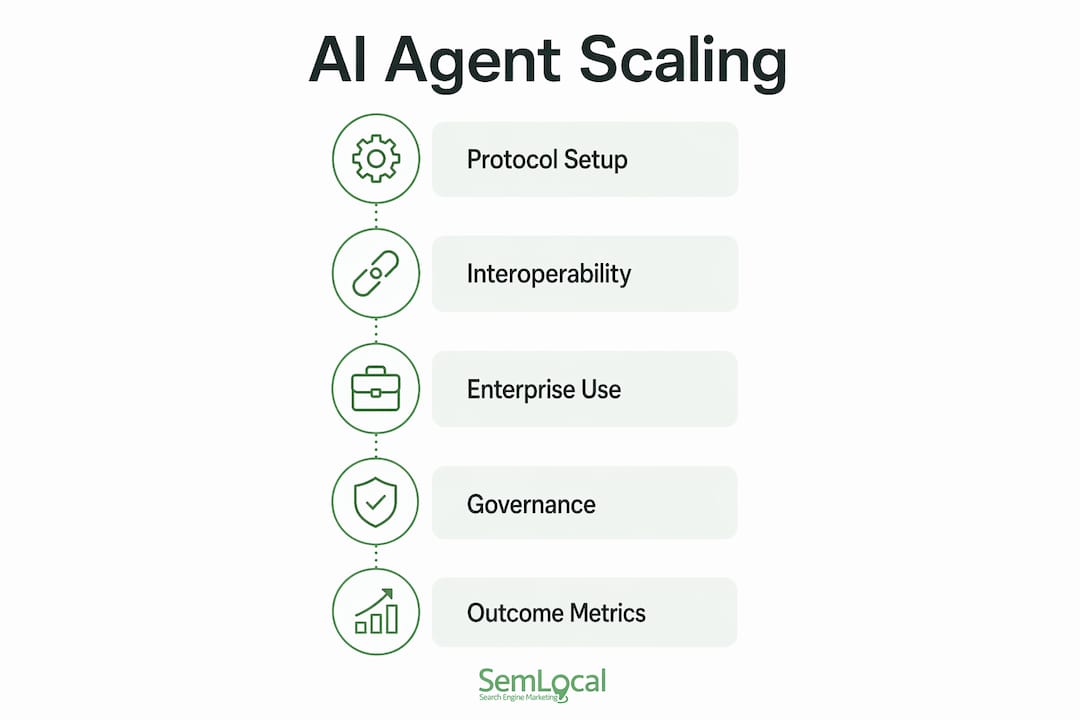
Interoperability standards are the infrastructure layer that makes multi-agent systems viable at enterprise scale. Three protocols now define how agents connect, communicate, and transact.
| Protocol | Full name | Primary role | Business impact |
|---|---|---|---|
| MCP | Model Context Protocol | Standardises agent connections to data sources and tools | Reduces custom integration cost; described as the “USB-C for agents” |
| A2A | Agent2Agent Protocol | Enables structured communication between AI agents | Supports coordinated multi-agent workflows across systems |
| AP2 | Agent Payments Protocol | Facilitates agent-initiated financial transactions | Enables autonomous purchasing and billing since september 2025 |
MCP standardises agent connections to data and tools in the same way a universal connector standardises hardware. Before MCP, every agent integration required bespoke engineering. That cost is now largely eliminated for teams adopting the standard. Google’s Agent Payments Protocol extends this further, allowing agents to initiate real transactions without human intervention at each step.
Open standards reduce the total cost of enterprise deployment. They also create accountability: when agents use documented protocols, their actions are traceable and auditable. That traceability is not a technical nicety. It is a governance requirement for regulated industries.
Pro Tip: Before selecting an agent framework, confirm it supports MCP natively. Frameworks that require custom connectors for every data source will create technical debt that compounds as your agent estate grows.
Why are specialised AI agents outperforming general-purpose models?
Domain-specific agents now outperform general-purpose models in production environments. One third of organisations have already shifted their core operations to agentic AI workflows rather than broad generative AI tools. That adoption rate reflects a practical conclusion: narrow agents deliver more predictable, auditable results.
The reason is scope. A general-purpose model must handle ambiguity across every domain. A specialised agent for medical coding, legal contract review, or inventory management operates within a defined set of rules, tools, and success criteria. Its outputs are easier to validate and its failures are easier to diagnose.
Consider these use cases where vertical agents are proving their value:
- Medical coding: Agents trained on ICD-10 and CPT code sets process claims faster and with fewer errors than generalist models attempting the same task.
- Legal review: Contract agents flag non-standard clauses against a firm’s approved templates, reducing review time without replacing solicitor judgement.
- Inventory management: Agents monitor stock levels, trigger purchase orders, and flag anomalies within defined thresholds, freeing procurement teams for exception handling.
- Customer service triage: Agents classify and route enquiries by intent, reducing first-response time without requiring a generalist model to resolve every query.
Production metrics have evolved beyond output quality to measure task success rates, tool correctness, compliance adherence, and cost per successful outcome. That shift in measurement is significant. It means organisations are no longer asking “does the agent sound right?” They are asking “did the agent complete the task correctly, within budget, and within policy?”
How should businesses approach AI agent governance and security?
Governance is the operating model that makes AI agents safe to deploy at scale. 74% of organisations identify inaccuracy as their primary concern with AI agents, and security and risk rank as the top barriers to wider adoption. Those concerns are not resolved by better models. They are resolved by better harnesses.
A governed AI agent deployment in 2026 includes the following non-negotiable elements:
- Human-in-the-loop checkpoints: Critical steps require explicit human validation before the agent proceeds. 68% of production agents execute ten or fewer steps before human intervention is required. That constraint is a feature, not a limitation.
- Kill switches and action allowlists: Every agent must have a defined set of permitted actions. Anything outside that list requires escalation. Kill switches allow immediate suspension without data loss.
- Logging and traceability: Every agent action, tool call, and decision point must be logged with timestamps and context. Logs are the audit trail for compliance and incident response.
- Fine-grained permissioning: Agents should operate with the minimum permissions required for their task. Broad access creates broad risk.
The OWASP Top 10 for Agentic Applications 2026 provides a standardised risk taxonomy covering threats specific to agent systems: goal hijack, memory poisoning, and tool misuse. These threats differ materially from generic prompt injection risks. Memory poisoning, for example, involves corrupting an agent’s stored context to alter its future behaviour. Goal hijack redirects an agent’s objective mid-task through malicious input. Generic security frameworks do not address either threat adequately.
Pro Tip: Write your evaluation contract before you run your first demo. Define what “success” means in measurable terms: task completion rate, escalation frequency, cost per outcome. Agents that pass a demo but lack defined success criteria rarely survive contact with production workloads.
What do these AI agent developments mean for business workflows?
The shift from pilot projects to production engineering is the defining business story of AI agent market trends in 2026. Organisations are no longer asking whether AI agents work. They are asking how to operate them reliably at scale. That question requires a different skill set and a different set of KPIs.
Emerging outcome metrics now include task success rate, cost per completed outcome, and escalation rate. Escalation rate, in particular, is a leading indicator of agent maturity. A high escalation rate signals that the agent’s scope is too broad or its confidence thresholds are miscalibrated.
Practical frameworks for scaling agent deployments in 2026 include LangGraph and n8n, which offer different trade-offs between flexibility and accessibility. LangGraph suits engineering teams building complex, stateful workflows. n8n with LLM nodes suits operations teams who need agent capabilities without deep coding expertise. Both support multi-agent patterns and integrate with MCP-compatible data sources.
Common pitfalls that derail production deployments include:
- Undefined scope: Agents given vague objectives fail unpredictably. Every agent needs a bounded task definition.
- Rising operational cost: Agents that call expensive models for simple sub-tasks inflate cost rapidly. Route simple tasks to lighter models.
- Inadequate monitoring: Agents without real-time monitoring can fail silently for hours. Alerting on escalation rate and task failure is the minimum viable monitoring setup.
The value of AI agents lies in specialist, coordinated workflows rather than autonomous generalists. Customer service, software delivery, and competitive intelligence are the three workflow categories showing the strongest return on investment in 2026. Each benefits from the combination of specialisation, orchestration, and human oversight that defines mature agent deployment. For businesses exploring how to integrate these capabilities, reviewing AI agent best practices for UK contexts provides a grounded starting point.
Key takeaways
AI agents in 2026 succeed through governed, multi-agent orchestration built around specialised tasks, open protocols, and explicit human oversight, not through autonomous generalist models.
| Point | Details |
|---|---|
| Multi-agent orchestration dominates | Specialised agents working in coordinated roles outperform single-agent systems on complex tasks. |
| Open protocols reduce deployment cost | MCP, A2A, and AP2 standardise integration and enable traceable, auditable agent actions. |
| Domain-specific agents deliver better results | Vertical agents in legal, medical, and operational contexts produce more predictable, measurable outcomes. |
| Governance is the operating model | Kill switches, logging, permissioning, and OWASP-aligned security are non-negotiable for production deployments. |
| KPIs must shift to outcomes | Task success rate, cost per outcome, and escalation rate replace output quality as the primary measures of agent performance. |
The governance layer is where the real work happens
I have watched businesses spend months selecting the right AI model and the right framework, then deploy agents with no defined escalation policy, no logging, and no kill switch. The agent works beautifully in the demo. It fails quietly in production, and no one notices until a customer complains or a compliance audit surfaces the gap.
The most important decision in any agent deployment is not which model to use. It is how you build the harness around it. The harness is the runtime that manages context, enforces human-in-the-loop policy, and controls what the agent is permitted to do. A well-governed harness makes a mediocre model reliable. A poorly governed harness makes a brilliant model dangerous.
My honest recommendation: treat human supervision as a business advantage, not a sign that your agents are immature. The organisations winning with AI agents in 2026 are not the ones with the most autonomous systems. They are the ones with the clearest policies, the tightest permissioning, and the fastest escalation paths. Autonomy is earned incrementally, through demonstrated reliability under supervision.
If you are planning your first production agent deployment, start with a single, bounded workflow. Write your success criteria before you write your first prompt. Measure escalation rate from day one. And build your governance model before your agent estate grows large enough to make retrofitting it painful.
— Geoff
How Semlocal and AI Management Agency can support your AI agent strategy
AI agents are reshaping how businesses generate and manage leads, from automated enquiry triage to AI-optimised local search visibility. Getting the foundations right matters whether you are deploying your first agent workflow or scaling an existing one.
AI Management Agency provides practical guidance on deploying AI agents with the governance and oversight frameworks that production environments require. For local service businesses looking to ensure their digital presence keeps pace with AI-driven search behaviour, Semlocal’s free AI tools offer a direct way to assess and improve your visibility across Google Maps, Local Services Ads, and AI platforms. The two capabilities work together: better agent workflows inside your business, and stronger local presence where your customers are searching.
FAQ
What are the main AI agent trends in 2026?
The main trends are multi-agent orchestration replacing single-agent systems, adoption of interoperability protocols like MCP and A2A, a shift to domain-specific vertical agents, and governance models centred on human oversight and OWASP-aligned security standards.
How many steps do production AI agents typically run before human review?
68% of production AI agents execute ten or fewer steps before human intervention is required. That limit reflects deliberate design choices around safety and accountability rather than technical constraints.
What is the Model Context Protocol (MCP)?
MCP is an open standard that standardises how AI agents connect to data sources and tools. It functions as a universal connector for agent integrations, reducing the need for custom engineering on every new data source.
Why are specialised AI agents preferred over general-purpose models in 2026?
Specialised agents operate within defined rules and success criteria, making their outputs more predictable and easier to audit. One third of organisations have already prioritised agentic AI workflows over general generative AI for core operations.
What security risks are specific to AI agents?
The OWASP Top 10 for Agentic Applications 2026 identifies agent-specific threats including goal hijack, memory poisoning, and tool misuse. These differ from generic prompt injection risks and require a dedicated security framework rather than standard application security controls.
Recommended
- Agentic AI vs. AI Automation: Which Is Better For Your B2B Pipeline in 2026? – AI Management Agency
- Agentic AI vs. AI Automation: Which Is Better For Your B2B Pipeline in 2026? – AI Management Agency
- AI agent onboarding process: a 2026 guide – AI Management Agency
- AI agents in hospitality: your 2026 guide – AI Management Agency